






Definition and Purpose of Form DS-2029
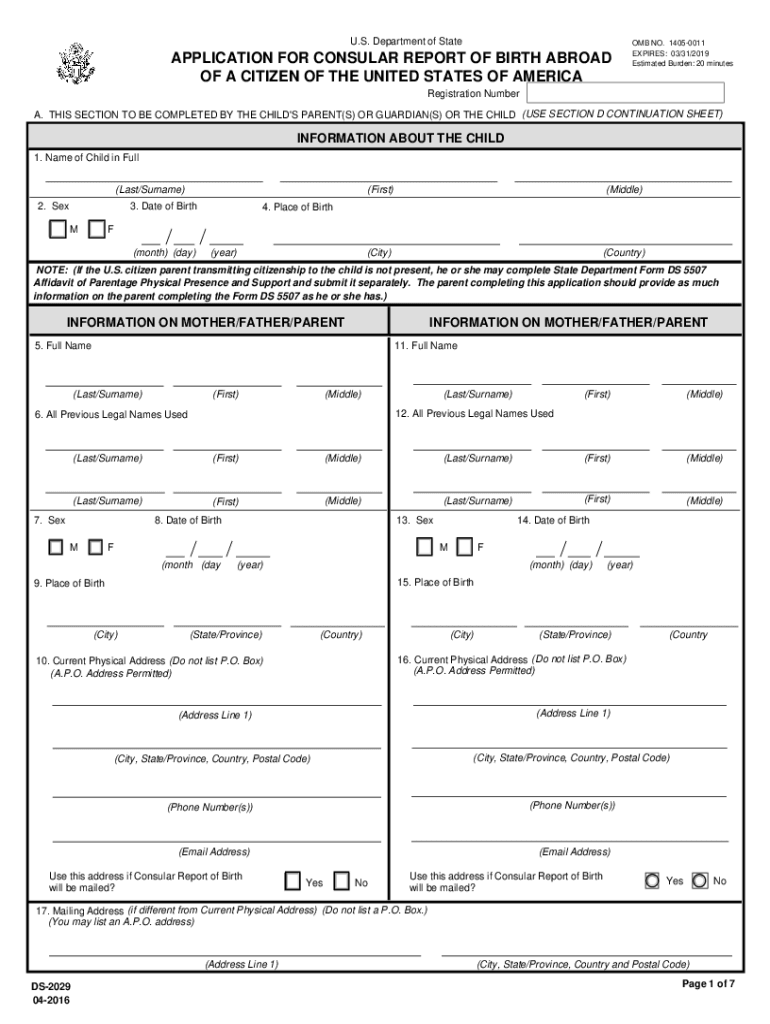
Form DS-2029 is officially known as the "Application for Consular Report of Birth Abroad." This crucial document is used by U.S. citizens to register the birth of their child born outside the United States. Once approved, it serves as proof of the child's U.S. citizenship, affirming their rights and responsibilities as an American citizen. Though this document is not a travel document, it is vital for establishing the identity and citizenship status of the child, ensuring they can later obtain a U.S. passport.
Significance of a Consular Report of Birth Abroad
This document is equivalent to a birth certificate within the U.S. It is recognized by all U.S. authorities and government agencies, enabling the child to access benefits and rights afforded to U.S. citizens. It also serves as pivotal documentation for future applications for social security numbers or passports. The form ensures that children born abroad to U.S. citizen parents have the same legal recognition as those born domestically.
Eligibility for Using Form DS-2029
Eligibility for submitting Form DS-2029 hinges on the citizenship and residency status of the parent(s). At least one parent must be a U.S. citizen at the time of the child's birth. There are specific criteria and conditions around the duration of physical presence the U.S. citizen parent(s) must have in the United States before the child’s birth. These details ensure that the parent’s connection to the United States is substantial enough to warrant transmitting citizenship to their child born abroad.
Documentation Proving Eligibility
To establish eligibility, applicants are required to provide numerous documents, including:
- A child's foreign birth certificate
- Proof of the parent's U.S. citizenship, such as a passport or birth certificate
- Evidence of the relationship between the child and the U.S. citizen parent(s), such as marriage certificates
- Documentation of the U.S. citizen parent's physical presence in the United States
How to Obtain and Submit Form DS-2029
Form DS-2029 is available through U.S. consulates and embassies worldwide. Applicants need to schedule an appointment with the nearest U.S. consulate or embassy to submit the completed form in person. This process is essential to verify the documentation submitted and to conduct any interviews required as part of the application review.
Steps for Submission
- Download the Form: The form can be downloaded from the U.S. Department of State’s website or obtained at a U.S. consulate.
- Fill Out the Form: Complete the form meticulously, ensuring all sections are filled accurately.
- Collect Supporting Documents: Gather all necessary supporting documents, ensuring they meet the legal criteria.
- Schedule an Appointment: Arrange for an appointment at the nearest U.S. consulate or embassy through their official website.
- Attend the Interview: Attend the appointment with all documents ready for review by consular officials.
- Pay Required Fees: Be prepared to pay the application fee, which varies depending on the country of the consulate.
Key Elements of Form DS-2029
The DS-2029 form requires detailed information regarding both the child and the parent(s). This includes personal details of the child, biographical data of the parent(s), and information about the birth circumstances. Particular attention should be paid to the accuracy of dates and names, as any discrepancies could delay processing.
Important Sections of the Form
- Biographical Information: Details about the child, such as full name and date of birth.
- Parental Information: Information about each parent, including citizenship status.
- Birth Details: Data regarding the birth location and conditions.
- Affidavit of Physical Presence: A sworn statement regarding the U.S. citizen parent’s physical presence in the United States.
Legal Use of DS-2029 and Compliance
Form DS-2029 has legal standing and must be completed with full accuracy. Providing false information or failing to disclose pertinent details can result in the application being denied and may also lead to legal consequences under U.S. law.
Compliance and Accuracy
Those filling out the form must ensure that all provided information is truthful and verifiable. Any false representation or misinformation can invalidate the application and erode the credibility of the applicant in future dealings with U.S. consular services.
Application Process and Approval Time
The timeframe to process Form DS-2029 can vary depending on the country and the specific U.S. consulate handling the submission. Typically, applicants can expect to receive a decision within a few weeks to several months, factoring in the time taken to verify the supporting documents and conduct interviews if required.
Expedited Processing Situations
In certain situations, expedited processing may be possible, especially if there is a time-sensitive need for the child's citizenship documentation. Such requests should be communicated during the appointment scheduling, and applicants should be ready to provide justification for the expedited processing.
State-Specific Rules and Considerations
While the DS-2029 form is governed by federal regulations, some nuances may differ based on the specific consulate’s operational protocols. It is crucial for applicants to understand any local directives or supplementary requirements that may apply in the country of the consulate.
Case Examples
In countries with complex diplomatic interactions or in places experiencing administrative delays, applicants might encounter lengthier processing times. It is advisable for applicants to contact the consulate directly for guidance tailored to their situation and location.
Examples of Using Form DS-2029 in Practical Scenarios
Consider a scenario where a U.S. citizen working abroad gives birth in a foreign country. This citizen must file a DS-2029 form to ensure the child is recognized as a U.S. citizen. The child will need this certification to enroll in U.S. schools, apply for jobs, or secure a U.S. passport.
Real-World Outcomes
By properly completing and submitting the DS-2029 form, parents can secure their child’s future access to the rights and benefits of U.S. citizenship, ensuring they have equal status as their U.S.-born counterparts, thereby allowing for seamless integration into the American societal framework when needed.