




01. Edit your form online
Type text, add images, blackout confidential details, add comments, highlights and more.

Type text, add images, blackout confidential details, add comments, highlights and more.

Draw your signature, type it, upload its image, or use your mobile device as a signature pad.

Send it via email, link, or fax. You can also download it, export it or print it out.
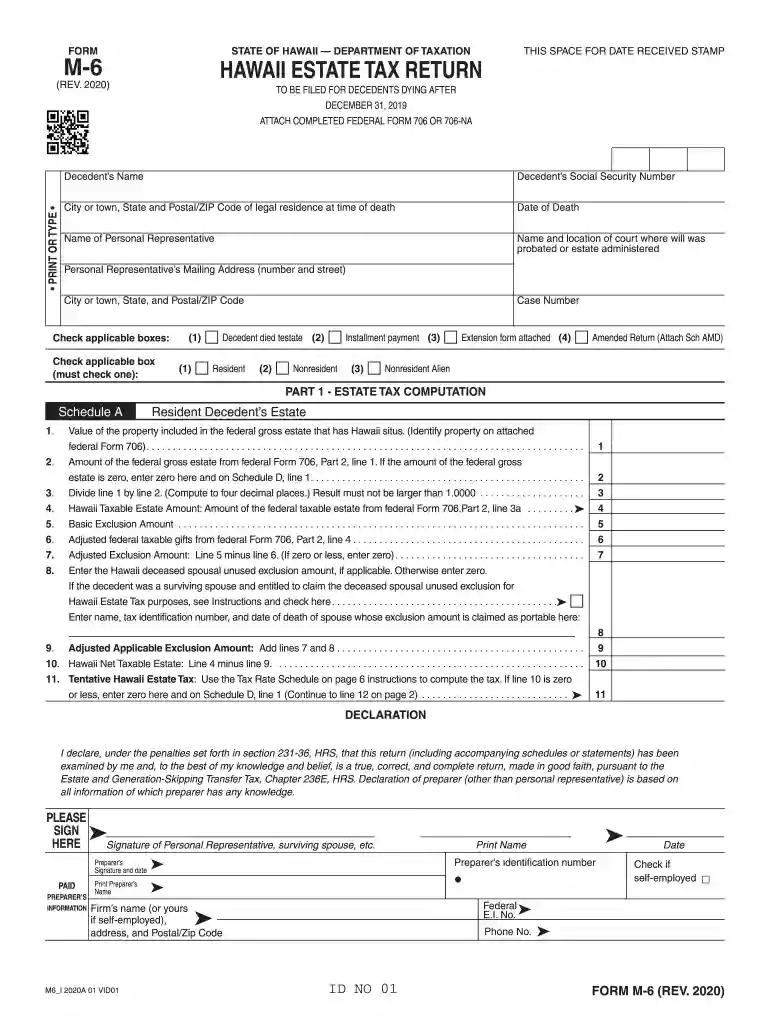
Hawaii Form M-6, the Hawaii Estate Tax Return, is a legal document used to report estate tax obligations due for decedents who passed away after December 31, 2019. This form is required to be filed with the Hawaii Department of Taxation and provides a detailed account of the estate’s value and applicable taxes. The main purpose of this form is to determine the estate tax owed based on the fair market value of the decedent’s property at the time of death and ensure compliance with state-specific tax obligations.
To acquire Hawaii Form M-6, you can visit the Hawaii Department of Taxation website, where the form is available for download. The online accessibility ensures that anyone required to file the form can easily obtain it without needing to visit a physical location. Additionally, tax professionals or estate planners may provide this form as part of their services. Always ensure you use the most recent version of the form to comply with current regulations.
Completing Hawaii Form M-6 serves a legal requirement for estates exceeding certain value thresholds, affirming that the estate adheres to state taxation laws. It ensures the accurate reporting of estate value and tax liabilities, protecting both the estate and beneficiaries from potential legal complications. Proper use of this form is crucial in maintaining compliance with the Hawaii estate tax code and avoiding unnecessary legal disputes.
The filing deadline for Hawaii Form M-6 is nine months after the date of the decedent’s death. It is essential to adhere to this timeline to avoid penalties or interest accumulation. In some cases, an extension may be requested if additional time is needed to gather required information, though these extensions should be applied for in advance of the original deadline.
When submitting Hawaii Form M-6, include supporting documentation such as:
Failing to file Hawaii Form M-6 or filing late without an approved extension can result in significant penalties. These may include monetary fines, interest on due taxes, or legal actions to enforce compliance. It’s crucial for estate representatives to consult with financial advisors or legal experts to avoid these outcomes by ensuring timely and correct filings.
Hawaii Form M-6 is available in both digital and paper formats, providing flexibility depending on the filer’s preference. The digital version allows for electronic submission, which is generally faster and includes features such as automatic calculations. The paper version can be manually filled out and submitted via mail or in person. Most filers now opt for the digital method due to its efficiency and convenience.
Estate processing software compatible with Hawaii Form M-6, like TurboTax or QuickBooks, can simplify form completion by automating calculations and ensuring accurate reporting. These programs often integrate with other financial management tools to provide comprehensive tax management for estates, making the filing process smoother and reducing the chances of errors.
We've got more versions of the hawaii form m form. Select the right hawaii form m version from the list and start editing it straight away!
| Versions | Form popularity | Fillable & printable |
|---|---|---|
| 2025 | 4.7 Satisfied (44 Votes) | |
| 2024 | 4.4 Satisfied (34 Votes) | |
| 2022 | 4.7 Satisfied (44 Votes) | |
| 2021 | 4.8 Satisfied (110 Votes) | |
| 2020 | 4.4 Satisfied (177 Votes) | |
| 2019 | 4.3 Satisfied (68 Votes) | |
| 2018 | 4.3 Satisfied (82 Votes) | |
| 2017 | 4.3 Satisfied (48 Votes) | |
| 2016 | 4 Satisfied (26 Votes) | |
| 2015 | 4.3 Satisfied (141 Votes) | |
| 2014 | 4.4 Satisfied (492 Votes) | |
| 2013 | 4 Satisfied (58 Votes) | |
| 2005 | 4.3 Satisfied (33 Votes) |
At DocHub, your data security is our priority. We follow HIPAA, SOC2, GDPR, and other standards, so you can work on your documents with confidence.
Instructions for Form M-6: Hawaii Estate Tax Return. State of Hawaii Department of Taxation 2020. Instructions for Form M-6: Hawaii Estate Tax Return [link]Read more
Dec 31, 2025 M-68, Application for Extension of Time to File Hawaii Estate Tax Return or Hawaii Generation-Skipping Transfer Tax Return and/or Pay HawaiiRead more


