
Judicial council Complaint Forms - Page 2
Keep and manage Judicial council Complaint Forms with DocHub forms. Customize and manage your documents twice as quickly and optimize your internal workflows with a few clicks.

Create a new Judicial council Complaint Form
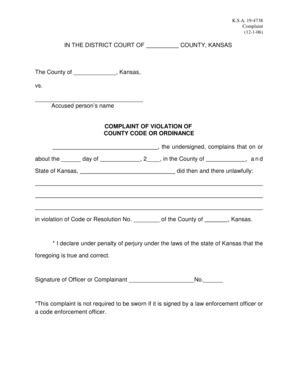
Kansas complaint violation 19 4738 pdf

Complaint (Civil Action) :: Louisiana - Free Legal Forms

THE COMMONWEALTH OF MASSACHUSETTS Commission on Judicial Conduct Annual Report 2001 14 Beacon Street

CM-010 CIVIL CASE COVER SHEET

EA-200 Proof of Personal Service Judicial Council form
- 1
-
2
Enhance your form administration with Judicial council Complaint Forms
Your workflows always benefit when you can easily discover all the forms and files you may need at your fingertips. DocHub gives a a large collection forms to relieve your daily pains. Get a hold of Judicial council Complaint Forms category and easily discover your document.
Begin working with Judicial council Complaint Forms in a few clicks:
- Open Judicial council Complaint Forms and discover the document you need.
- Click Get Form to open it in our online editor.
- Begin editing your form: add more fillable fields, highlight sentences, or blackout sensitive information and facts.
- The application saves your modifications automatically, and after you are ready, you can download or share your file with other contributors.
Enjoy easy file administration with DocHub. Check out our Judicial council Complaint Forms collection and locate your form right now!
Video Guide on Judicial council Complaint Forms management

Commonly Asked Questions about Judicial council Complaint Forms
Can you file a complaint against a judge in New York?
You can make a complaint about a Civil Court judge in New York City. Judges who engage in misconduct may be admonished, censured, or removed from office. The Civil Court of the City of New York has jurisdiction over civil cases involving amounts up to $25,000 and other civil matters referred to it by the Supreme Court.
What are common ethical violations of a judge?
Common complaints of ethical misconduct include improper demeanour; failure to properly disqualify when the judge has a conflict of interest; engaging in ex parte communication and failure to execute their judicial duties in a timely fashion. Behaviour outside of the courtroom can also be at issue.
What is unethical behavior for a judge?
Some examples of judicial misconduct are rude, abusive, and improper treatment of lawyers, litigants, witnesses, jurors, court staff or others, failure to disqualify when the law requires, receipt of information about a case outside the presence of one party, abuse of contempt or sanctions, and delay in decision-making
How to deal with corrupt judges?
There are several different options you can pursue if you feel a judge has acted in an unfair way, and each navigates a slightly different path. Request Recusal. File Appeal to Send Decision to a Higher Court. File a Motion for Reconsideration. File a Grievance on the Basis of Unethical Behavior.
Who investigates corrupt judges in NY?
The New York State Commission on Judicial Conduct is the independent state agency that reviews complaints of ethical misconduct against the 3,350 judges and justices of the State Unified Court System filling 3,500 positions and, where appropriate, renders public disciplinary Determinations.
Can you file a complaint about a judge in NYS?
You can make a complaint about a Court of Claims judge in New York State. Judges who engage in misconduct may be admonished, censured, or removed from office.
Who holds judges accountable in NY?
The Commission is an independent agency created by the New York Constitution to investigate complaints against New York judges.
Can I sue a judge for being biased?
If a judge violated your constitutional rights or discriminated against you, you may be able to sue under federal law. Suing a judge is complex and requires the expertise of an experienced lawyer. Its not something typically done by individuals without legal representation.
What are examples of judicial misconduct?
Obvious examples are violations of criminal law, sexual misconduct with staff/attorneys/parties, joining discriminatory organizations and using the judicial position to enhance a private interest.
Related Templates

Application from a Resident or Former Resident Visa Holder (INZ1175)
The document is an application form (INZ 1175) for individuals holding a resident or former resident visa in New Zealand ...

Application to add a child to an existing child support
The document provides instructions for using the CS065 form to add a child to an existing child support assessment. It o ...
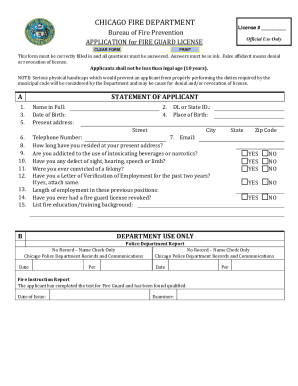
CHICAGO FIRE DEPARTMENT BUREAU OF FIRE PREVENTION
The document is an application form for a Fire Guard License issued by the Chicago Fire Department. It requires applican ...

Louisiana unemployment
The document is an Employer Application form for a Louisiana Unemployment Account, provided by the Louisiana Workforce C ...

Employment Application - City of Ashland Fire Department
The document is an employment application for the City of Ashland, Wisconsin. It includes sections for personal informat ...

ELKO COUNTY EMPLOYMENT APPLICATION Mailing: 571 Idaho
The document is an employment application for the Elko County Fire Protection District, outlining the necessary informat ...
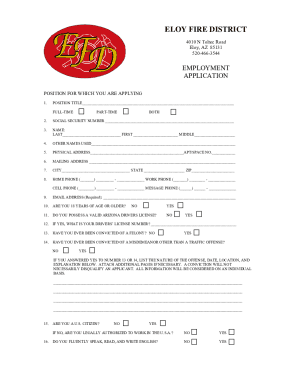
Eloy Fire District Eloy opening hours 4010 N Toltec Rd
The document is an employment application for the Eloy Fire District, detailing the information required from applicants ...