



Definition & Meaning of the ABC Chart Printable
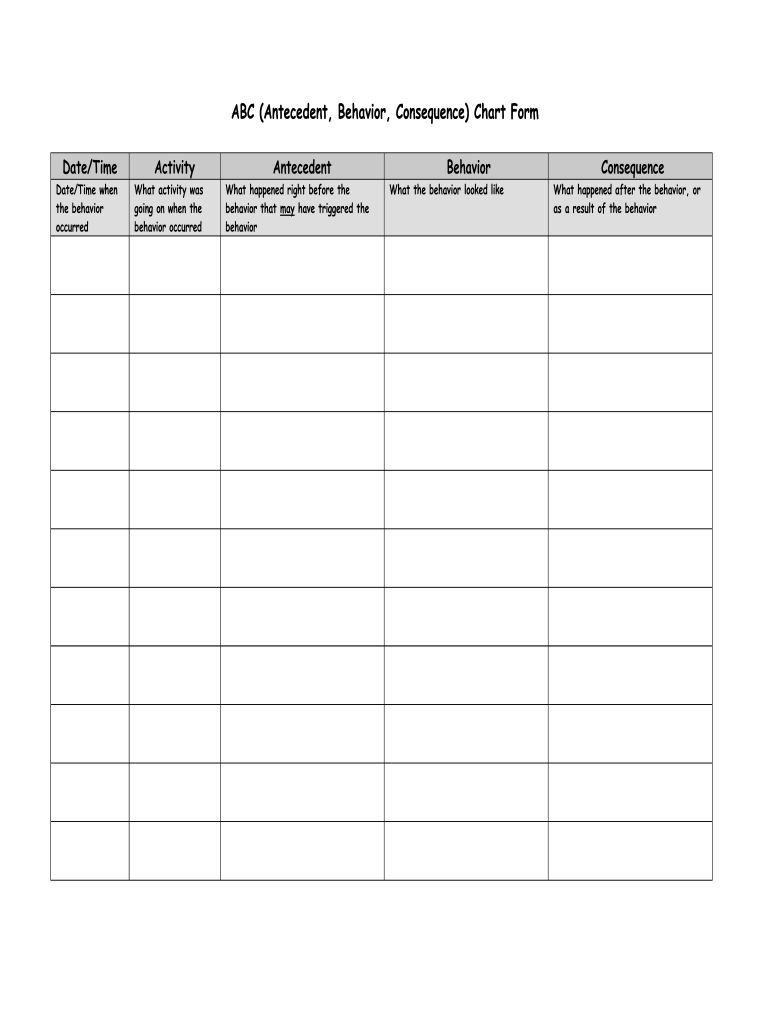
The ABC Chart, which stands for Antecedent, Behavior, and Consequence Chart, is a tool commonly used in educational and behavioral settings to document and analyze specific behaviors. It serves as a structured method to understand what triggers certain behaviors, the behavior itself, and the outcomes that follow. The ABC chart printable is a convenient version that allows users to print the form for offline use, making it accessible for various applications such as schools, therapy sessions, and personal behavior tracking.
Purpose of the ABC Chart
- Behavior Analysis: The primary function of the ABC chart is to break down behaviors into manageable components. This analysis helps identify patterns that can inform interventions.
- Data Tracking: Collecting data on behaviors over time can help in making informed decisions about strategies to address any challenges faced by individuals, particularly children with learning or behavioral issues.
- Communication Tool: This chart can serve as a communication tool between caregivers, educators, and therapists. It documents observations and can be shared during meetings or consultations for collaboration on behavior management strategies.
Key Components of the ABC Chart Printable
The ABC chart consists of three main sections that function together to provide a complete picture of the behavior being analyzed.
Antecedent
- Definition: Antecedents are events or conditions that occur before a behavior. Understanding these can provide insights into triggers.
- Examples:
- Specific situations or environments, such as a classroom setting.
- Interactions with peers or authority figures.
- Changes in routine or expectations.
Behavior
- Definition: The behavior is the specific action or response exhibited by the individual. It should be described clearly and objectively.
- Examples:
- Tantrums, refusal to follow instructions, or specific verbal responses.
- Positive behaviors like raising a hand to answer questions or staying on task.
Consequence
- Definition: Consequences are the outcomes that follow the behavior. These can reinforce or discourage the behavior.
- Examples:
- Attention from teachers or peers, or loss of privileges.
- Positive reinforcement such as praise or rewards for appropriate behavior.
How to Use the ABC Chart Printable
Using the ABC chart involves several key steps to ensure effective data collection and analysis.
- Identify the Behavior: Clearly define the behavior to be observed. It should be specific and measurable.
- Document Antecedents: Keep detailed accounts of what happens right before the behavior occurs. Note any patterns you observe.
- Describe the Behavior: Write down exactly what the behavior looks like, avoiding subjective language.
- Record Consequences: After the behavior occurs, document what happened afterwards including any responses from others.
- Review and Analyze: Regularly review the collected data to identify patterns and develop strategies for intervention.
Practical Examples
- If a student frequently disrupts class, the antecedent might be transitions between activities, the behavior is talking out of turn, and the consequence could be receiving attention from peers.
- In a therapeutic setting, if a child refuses to engage in group activities, the antecedent could be feelings of anxiety, the behavior might be withdrawal, and the consequence may involve adults providing reassurance.
Benefits of Using the ABC Chart for Behavior Tracking
The ABC chart is beneficial for various stakeholders including educators, parents, and therapists.
- Customization: The printable nature of the chart allows for customization based on specific needs and contexts. Users can adjust the layout to focus more on particular areas of interest.
- Flexibility: This tool can be applied in various settings, not limited to educational environments; it is useful in therapy, home, and even workplaces to understand professional behavior.
- Immediate Feedback: Regular use of the chart allows for immediate feedback to both the individual exhibiting the behavior and those involved in their care or education.
Accessibility of ABC Chart Printable Resources
The ABC chart printable is available in various formats to accommodate different user preferences.
- Free Download Options: Many online resources provide free templates that can be easily printed. Some platforms also offer customizable fillable versions in PDF format.
- Editable Versions: For users who prefer digital documentation, editable ABC charts can be created using document editing tools, allowing for easy updates and modifications.
- Integration with Other Tools: The forms can often be integrated with behavior management software, enhancing their utility in comprehensive tracking systems.
Edge Cases and Variations in ABC Chart Use
While the ABC chart is widely applicable, variations may arise based on specific contexts.
- Individual Variations: The chart should be adapted for different settings such as special education, where additional emphasis might be placed on socio-emotional factors.
- Focus Groups: Specific populations, such as adults in therapeutic settings or individuals with autism, might require a modified approach in what behaviors are tracked and how antecedents are understood.
- Cultural Sensitivity: When using these charts in diverse environments, it's essential to consider cultural background, as behaviors may be interpreted differently across cultural lines.
By integrating these detailed components, the ABC chart printable becomes a powerful tool for understanding and addressing behavior in a comprehensive manner.