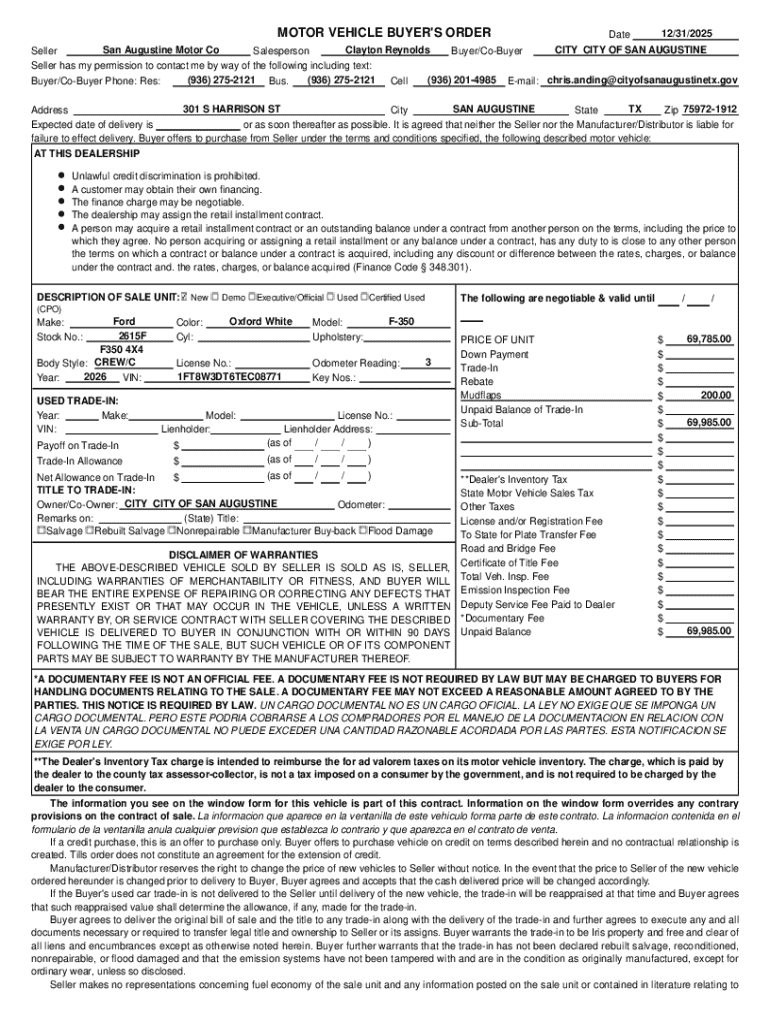







Motor Vehicle Buyer's Order Basics
A Motor Vehicle Buyer's Order is a dealership sales document that records the agreed terms for a vehicle purchase. In many U.S. transactions, it functions as the written summary of the deal before final title and registration paperwork are completed. It usually captures the vehicle identification details, price, taxes, fees, trade-in information, financing references, and the signatures of the buyer and seller.
The form is especially important because it helps reduce confusion about what was promised during the sales process. In practice, it can reflect the negotiated sale price, optional products such as service contracts or gap coverage, and any dealer-installed accessories or rebates that affect the final amount due. For many buyers, it becomes one of the most important records of the transaction because it shows the structure of the deal in writing.
The buyer’s order is not the same thing as a title application, registration form, or loan agreement, although it may support each of those later steps. It is often completed at the dealership after negotiations but before final delivery. In some states and dealerships, it may also be called a purchase order, retail buyer’s order, or sales agreement, depending on local practice.
This form matters in both cash and financed purchases. A cash buyer may use it to confirm the full out-the-door price and itemized charges. A financed buyer may use it to compare the amount financed against the vehicle price and added costs. In either case, it creates a written reference point if a question later arises about the agreed terms.
The document can also be useful when the sale involves a trade-in, a rebate, a dealership discount, or conditional approval from a lender. Those features often affect the final amount paid and can be easy to misunderstand unless they are clearly listed. A carefully completed buyer’s order helps ensure the numbers on the final paperwork match the earlier agreement.
Because the Motor Vehicle Buyer's Order is tied to a vehicle sale, its accuracy affects several downstream steps. Registration fees, sales tax, title transfer, lender funding, and refund calculations may all rely on the details shown on the form. For that reason, it is often treated as a core transaction document rather than a simple sales receipt.
Key Information On The Form
A buyer’s order usually includes the vehicle description first. That section typically lists the year, make, model, body style, trim, color, VIN, and sometimes mileage if the vehicle is used. These details identify the exact vehicle being sold and help prevent issues involving incorrect units or swapped stock numbers.
Buyer and seller information is another central component. The form generally names the buyer, co-buyer if applicable, dealership legal name, address, and salesperson. When there is a co-buyer, the form may also indicate whether both parties are jointly responsible for the purchase terms, financing, or trade-in obligations.
Price-related terms are often the most detailed part of the document. Common entries include:
- Selling price of the vehicle
- Dealer discounts or market adjustments
- Manufacturer rebates
- Trade-in allowance
- Sales tax
- Title and registration fees
- Documentation fees
- Government fees
- Optional products and add-ons
These entries matter because they shape the total amount due. For example, a vehicle advertised at a lower sticker price may have higher out-the-door cost once processing fees, taxes, and accessories are added. A buyer’s order helps show how the dealership reached that total.
Many versions also include finance-related references. This can include a cash sale amount, a financed amount, or a note that the transaction is contingent on credit approval. In a financed sale, the buyer’s order may be used alongside the loan contract to confirm the vehicle price and the amount being rolled into the deal.
Trade-in information may appear as a separate section or be embedded in the pricing summary. If a buyer is applying trade equity toward the purchase, the form often lists the year, make, model, VIN, mileage, and agreed trade value. It may also show whether the trade is being paid off, whether there is negative equity, and how that balance is handled.
Signature blocks and date fields are also important. They show that the parties reviewed and agreed to the terms on a specific date. In some deals, the buyer’s signature confirms receipt of disclosures, acknowledgment of optional items, or understanding that the order may be subject to financing, inspection, or management approval.
How To Complete It
Completing a Motor Vehicle Buyer's Order usually begins with confirming the vehicle details. The year, make, model, VIN, trim, and color should match the actual vehicle being sold and the buyer’s intended purchase. Even small differences, such as an incorrect trim level or an inaccurate VIN digit, can create problems later in titling or financing.
The pricing section should then be reviewed line by line. This includes the negotiated selling price, trade-in credit, tax amount, license and registration fees, dealer fees, and any optional products. A useful way to review this section is to compare the buyer’s order against the deal worksheet and any verbal promises made during negotiation.
If the transaction includes financing, the financing language should be checked carefully. Some buyer’s orders are written to reflect a conditional sale, meaning the deal depends on lender approval or acceptable terms. In those cases, the form may specify whether the buyer can return the vehicle if financing is not finalized, or whether the dealership may re-contract at a different rate or term.
Trade-in sections require special attention. The buyer should confirm whether the trade value is fixed, whether the vehicle must be delivered with all keys and accessories, and whether a payoff is being handled by the dealership. If there is an existing lien on the trade-in, the payoff amount and negative equity treatment should be clear in the document.
Any optional products or service add-ons should be listed with precision. Examples include:
- Extended service contracts
- Tire and wheel protection
- Gap coverage
- Paint protection
- Window tint or accessories
- Maintenance packages
These items can materially affect the total cost. If a product is included, the buyer’s order should show whether it is required or elective, and whether it is financed or paid upfront.
Before signing, the buyer should verify that the total due matches the expected out-the-door amount. That total should reflect all taxes, fees, and credits, with no unexplained line items. If a dealership offers a lower monthly payment but the total contract price is higher, the buyer’s order is the place to identify how that calculation was reached.
Legal And Practical Purpose
The buyer’s order serves as a written record of the sales agreement. In a U.S. dealership setting, that matters because vehicle transactions often involve multiple documents, several people, and time-sensitive financing steps. The buyer’s order creates a single reference point for what was agreed before delivery and funding.
It can also help resolve disputes about price or included equipment. For example, if a buyer believes a set of floor mats, a roof rack, or a dealer discount was included, the buyer’s order may confirm whether that item was part of the deal. If the written form and the spoken agreement differ, the document often becomes important evidence of the original terms.
The form can be particularly useful when financing is not finalized at the time of delivery. Many dealerships allow conditional delivery while waiting for lender approval or final contract funding. In those situations, the buyer’s order may document the conditional nature of the sale and the obligations of each party if financing falls through.
It also helps with state tax and registration compliance. Dealers and motor vehicle agencies use transaction documents to determine the taxable amount, proper title transfer, and registration fees. An accurate buyer’s order reduces the likelihood of mismatched figures between the sales paperwork and the title application.
The document may also support recordkeeping for warranty, insurance, and tax purposes. Buyers often keep it with the final bill of sale, finance contract, and registration documents because it shows the purchase structure. Sellers keep it as part of the dealership file in case of audit, complaint, or lender review.
There are limits to what the form itself can do. A buyer’s order does not override state consumer protection laws, odometer rules, or lender requirements. If the terms conflict with mandatory legal disclosures, the controlling law and final signed retail installment contract usually govern. That is why consistency across the paperwork matters.
Required Terms And Disclosures
A well-prepared buyer’s order usually includes several disclosures that clarify the transaction. These disclosures can vary by state and dealership policy, but they often address the binding nature of the order, financing conditions, add-on products, and fee explanations. Clear disclosure helps avoid misunderstandings that could affect delivery or funding.
The document may identify whether the sale is cash, financed, or leased. It may also state whether the buyer is receiving the vehicle “as is” or subject to a warranty. In used vehicle transactions, “as is” language is especially important because it can significantly affect repair responsibility after delivery.
Common disclosure areas include:
- Conditional sale language
- Arbitration or dispute resolution terms
- Fee explanations
- Optional product consent
- Trade-in lien payoff treatment
- Delivery and acceptance terms
These disclosures are not always identical from one dealership to another. Some forms use dense contract language, while others separate disclosures into their own sections or addenda. The important point is that the buyer should be able to identify what is included, what is optional, and what depends on later approval.
If the transaction includes a service contract or ancillary product, the buyer’s order should identify it separately. This helps confirm whether the charge is voluntary, whether it can be canceled later, and whether the cost is included in the financed amount. Buyers frequently need that clarity when comparing offers or reviewing monthly payments.
Another important area is dealer fees. U.S. state laws may allow certain fees, require disclosures, or limit how they are labeled. A buyer’s order should not hide a fee inside a vague category when it is really a documentation fee, prep fee, or accessory charge. Transparent labeling supports informed consent and cleaner accounting.
There may also be signature-based acknowledgments. A buyer may be asked to acknowledge receipt of keys, title documents, disclosure statements, or a vehicle condition report. If the vehicle is used, the order may reference prior damage, reconditioning, or odometer status. Those details can be significant if the buyer later questions the condition of the vehicle at delivery.
State And Dealer Variations
The Motor Vehicle Buyer's Order is not standardized nationwide. Dealerships and states may use different formats, terminology, or disclosure requirements, even when the underlying purpose is similar. In one state, the form may look like a simple purchase summary, while in another it may include extensive legal language and regulatory notices.
Some states require specific dealer disclosures on taxes, titling, emissions, or temporary registration. Others focus more on itemized pricing and consumer signatures. That means a form prepared in one jurisdiction may not be sufficient for a sale in another if the vehicle is being delivered, titled, or registered under different rules.
Dealer practices also influence the layout. For example:
- Franchise dealers often use a more standardized buyer’s order
- Independent used car dealers may use a custom purchase order
- Special finance dealers may include lender-related conditions
- Commercial vehicle sellers may add business-use language or fleet terms
The sale type can change the contents as well. A new-car buyer’s order may reference manufacturer incentives, destination charges, and factory-installed options. A used-car buyer’s order may focus more on reconditioning, mileage, and “as is” language. A certified pre-owned transaction may include certification terms, inspection references, and warranty disclosures.
State-specific tax treatment can also affect the form. Trade-in credits, lease buyouts, military exemptions, tribal tax rules, and out-of-state registration procedures may all change the final figures. In some cases, the buyer’s order must reflect those adjustments so that the tax amount on the purchase paperwork matches the jurisdiction’s rules.
Because of these variations, the same document title may not mean the same thing everywhere. A buyer should review the local version as a transaction-specific agreement, not as a generic template. The dealership’s state of sale, the buyer’s state of residence, and the state where the vehicle will be titled can all affect the final version used.
Common Buyer Scenarios
First-time buyers often rely on the buyer’s order to understand the total cost beyond the advertised price. For example, a buyer may see a promotional sticker and expect one monthly payment, only to discover dealer-installed accessories and government fees that change the final amount. The buyer’s order shows whether those charges were included in the actual agreement.
Cash buyers use the form differently. A cash purchase usually focuses on out-the-door pricing, trade-in credits, and fee itemization rather than monthly payment terms. In that setting, the buyer’s order helps confirm the exact amount due at closing and what portion, if any, has already been paid as a deposit.
Financed buyers often use the buyer’s order alongside the retail installment contract. If the lender later asks for corrections, the buyer’s order can help verify the agreed selling price and trade allowance. This is useful when a deal is restructured due to credit approval changes, residual negative equity, or lender-specific fee rules.
Trade-in transactions are another common use case. Suppose a buyer trades in a vehicle with an existing loan. The buyer’s order may show the appraised trade value, the payoff amount, and whether any remaining balance is rolled into the new loan. That structure helps explain why the final financed amount may be higher than the new vehicle price alone.
Used-vehicle buyers often depend on the form to understand warranty status and disclosure language. For instance, if the vehicle is sold “as is,” the buyer’s order may be one of the documents that confirms there is no dealership warranty beyond any written promise. If the sale includes a limited warranty or certified coverage, the order should align with those terms.
Business buyers also use the form when purchasing fleet or company vehicles. In those cases, the buyer’s order may identify the business entity, authorized signer, EIN-related business details, and any fleet discount or commercial registration considerations. That can be especially important for LLCs, corporations, and partnerships that need clear records for accounting and asset tracking.
Records, Signatures, And Retention
Signatures on a buyer’s order usually show agreement to the listed terms, but the effect of the signature depends on the document language and local law. Some orders are binding immediately, while others are conditional on financing, management approval, or final contract execution. The signature area should make that status clear rather than leaving the buyer to guess.
The date is also important. A buyer’s order dated on the day of negotiation may be used later to compare against final delivery documents. If the vehicle is not delivered the same day, the date helps establish when the terms were initially accepted and whether any changes were made before closing.
Document retention is a practical concern for both sides. Buyers often keep the buyer’s order with the final purchase contract, warranty paperwork, title application, and registration receipt. Dealers retain their copy as part of the deal jacket for compliance, accounting, and lender audit purposes.
Good recordkeeping is useful when there is a later dispute about:
- Missing accessories
- Unclear fee disclosure
- Trade-in payoff handling
- Optional product cancellation
- Financing terms or contract changes
Digital copies are common in modern dealership workflows. A scanned or electronically executed buyer’s order can be stored with other transaction records and cross-referenced with the final contract. If the dealership uses electronic signatures, the form may also include authentication or audit information showing when it was signed and by whom.
If corrections are made after signing, those changes should be clearly initialed or reissued in a revised version. Handwritten alterations without clear acknowledgment can create uncertainty. A clean, dated revision is usually easier to defend and easier to reconcile with later paperwork than a form containing unexplained edits.
Review Points Before Signing
A careful review of the buyer’s order usually starts with the vehicle identification section. The VIN, year, make, model, and trim should match the actual vehicle exactly. Buyers should also check whether any add-ons listed on the form were actually agreed to, since unauthorized accessories can significantly change the final cost.
The next step is to review the numbers. Key items include:
- Selling price
- Dealer fees
- Government fees
- Sales tax
- Trade-in allowance
- Down payment
- Optional products
- Total amount due
The goal is not simply to see a single final number, but to understand how that number was built. A low monthly payment can sometimes hide a longer term, higher interest cost, or larger amount financed. The buyer’s order should be consistent with the broader deal structure, not just the payment quote.
Any conditional language should also be read closely. If the order says the deal depends on financing approval, income verification, or acceptable insurance proof, the buyer should understand what happens if one of those conditions is not satisfied. Conditional delivery terms can affect possession, down payment handling, and return obligations.
It is also important to confirm that the trade-in section matches the actual arrangement. If the dealership is paying off a loan, the payoff figure should be realistic, and the buyer should know how negative equity is being treated. A trade-in that has value on paper can still create additional financed balance if the payoff exceeds the allowance.
Finally, the buyer should make sure the signed copy is complete and readable. Blank spaces, missing initials, unsigned disclosures, or inconsistent date fields can create problems later. A fully completed buyer’s order is more reliable for financing, registration, and dispute resolution than one that has incomplete or ambiguous entries.