






What Form 4-505 Does
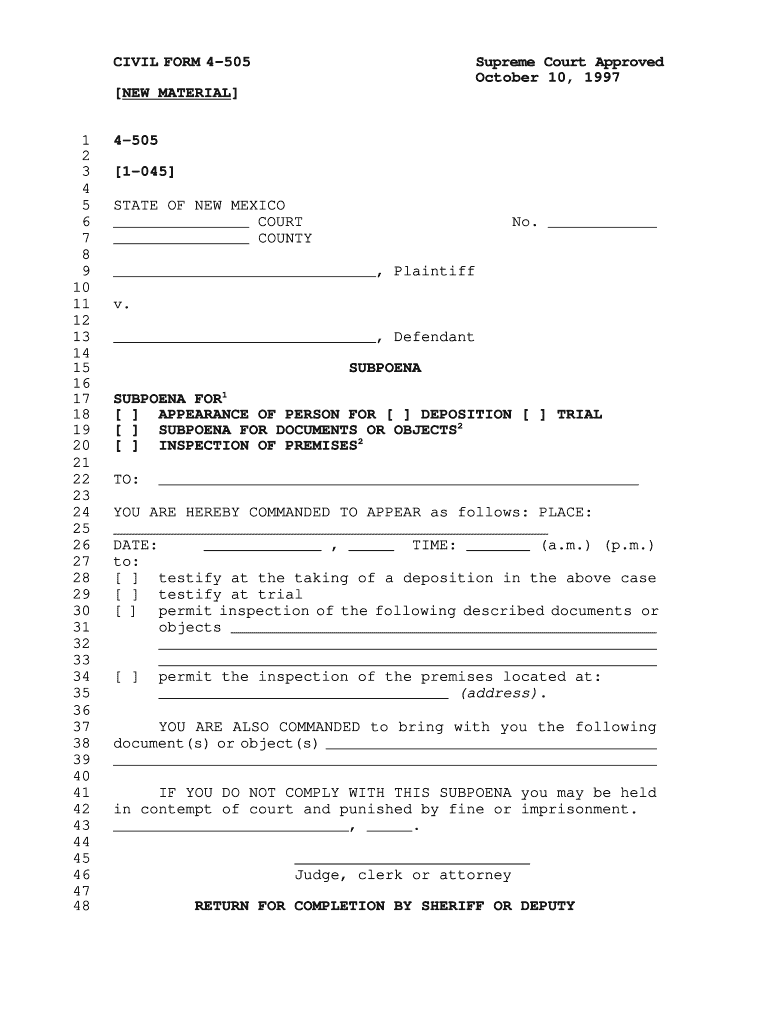
The New Mexico Civil Subpoena Form 4-505 is a court-authorized document used in civil cases to require a person to appear as a witness, testify at a deposition or trial, or produce documents, electronically stored information, or other items listed in the subpoena. It is part of the New Mexico court form system and is intended for civil matters rather than criminal proceedings.
In practice, the form is used when one party in a lawsuit needs evidence that is in the possession of a third party or needs a witness to attend a legal proceeding. A subpoena can support discovery, trial preparation, and fact-finding when information is not otherwise available through the parties to the case.
The form is significant because it carries the authority of the court. That means it is not simply a request for information. When properly issued and served, it creates a legal obligation to respond unless the recipient objects, seeks protection, or otherwise obtains relief under the applicable rules.
The subpoena may be used in several ways depending on the case. Some subpoenas require live testimony, some require the production of records, and some require both. For example, a medical office may be asked to produce records relevant to a personal injury claim, while a former employee may be ordered to testify about events in a contract dispute.
A properly prepared subpoena also helps define the scope of the demand. It should identify what is required, when and where compliance is expected, and any witness fee or mileage information that may be necessary under New Mexico procedure. Clarity matters because vague or overbroad demands can be challenged.
Because this form is tied to civil procedure, it must align with New Mexico court rules, local practice, and service requirements. A subpoena that is not issued, served, or worded correctly may be unenforceable, even if the underlying lawsuit is valid.
Who Uses This Subpoena
The New Mexico Civil Subpoena Form 4-505 is commonly used by attorneys representing plaintiffs or defendants in civil litigation. Attorneys rely on it when they need testimony or records from a nonparty who has relevant information and is not already obliged to provide it voluntarily.
Self-represented litigants may also use the form, provided they are authorized to do so in the case and follow the applicable procedural rules. In a small claims-related civil matter, a pro se party might use the subpoena to secure a witness who observed the events in dispute or to obtain business records that help establish damages.
Court clerks, judges, and legal staff may encounter the form as part of the filing, issuance, or review process, although they generally do not represent a party’s interests. Their role is usually limited to administrative handling or ensuring the document conforms to court requirements.
Businesses and institutions are frequent recipients of this subpoena. Common examples include employers, hospitals, schools, banks, insurance companies, and property managers. These recipients may be asked to produce records or designate a knowledgeable witness for testimony.
The form may also be used in cases involving personal injury, family law-related civil disputes, landlord-tenant conflicts, commercial disputes, and probate-related litigation when the matter proceeds through a civil case process. The exact use depends on the type of evidence needed and the issues in dispute.
A subpoena is especially useful when the information is held by someone outside the lawsuit. For instance, if a contractor dispute turns on payment records held by a bank, or if a vehicle accident case needs repair records from a third-party shop, the subpoena is often the appropriate tool.
Key Parts of the Form
A civil subpoena typically includes the court caption, which identifies the court, county, case number, and the names of the parties. This portion must match the case exactly, because even small mismatches can create confusion or make the document harder to enforce.
The form also identifies the person or entity being subpoenaed. That may be a named individual, a business name, or a records custodian. When a company is served, the subpoena often needs to be addressed in a way that makes clear who should respond on the entity’s behalf.
Another essential section describes what is required. This can include appearing for deposition, appearing in court, producing documents, or both. The demand should be specific enough that the recipient knows what to bring, when to appear, and where compliance is required.
Many subpoenas include a return date or appearance date. This is the deadline for compliance or attendance. The date should be realistic enough to allow service and preparation, especially if documents must be gathered from archive systems, off-site storage, or multiple departments.
The form may also contain notice or certificate language related to service. This matters because the subpoena usually must be formally delivered in a way that satisfies the rules, and the issuing party often must be able to show how and when that happened.
Some versions include an area for witness fees or mileage information, particularly when the subpoena requires a nonparty to appear. In many civil contexts, the requesting party must tender the appropriate amount when service is made, unless a rule or exception applies.
Key details that are often reviewed closely include:
- The exact name of the court and case
- The correct case number
- The subpoenaed person’s full name or business name
- The nature of the appearance or production required
- The time, date, and location for compliance
- Any attached schedule or list of requested records
How to Complete It Correctly
The first step is to confirm the subpoena matches the correct civil case. The caption must identify the right court, county, parties, and case number. If the case information is wrong, the subpoena may be questioned or rejected by the recipient.
Next, the issuing party should identify what is being requested with precision. If the goal is to obtain records, the request should describe the categories of records, date range, and subject matter. If the goal is testimony, the subpoena should clearly state whether the recipient must appear at deposition or in court.
The recipient information should be complete and accurate. For an individual, include the full legal name and, if helpful, a business affiliation. For a company, include the entity name and a person or department that can receive the papers. Ambiguity in the addressee can delay compliance.
The date, time, and location need to be realistic and consistent with the procedure used. A deposition subpoena, for example, should specify the deposition location and schedule in a way that gives the recipient fair notice. A trial subpoena should align with the trial setting and expected witness availability.
If documents are requested, it is usually helpful to define the scope in a way that reduces disputes. For example, a request for “all records” may be too broad, while “billing statements, treatment notes, and correspondence from January 1 through March 31” is more precise and easier to follow.
Before the subpoena is used, the issuing party should review the form for consistency with any local rules, scheduling orders, or discovery deadlines. In civil practice, a subpoena may be subject to timing limits, objections, or protective motions, so completeness matters as much as accuracy.
A careful completion process often includes:
- Verifying the court caption and case number
- Identifying the witness or records custodian
- Specifying what must be produced or where the person must appear
- Adding the date, time, and location
- Confirming witness fee or mileage requirements, if applicable
- Reviewing the form for errors before service
Service and Delivery Rules
A subpoena generally does not become effective merely because it is signed or filled out. It must be served according to the applicable New Mexico civil procedure rules. Service is the step that gives legal notice to the person being commanded to act.
Service commonly requires personal delivery to the named person, although business or organizational recipients may sometimes be served through an authorized agent, registered agent, or records custodian, depending on the context. Service methods should match the legal requirements for the type of recipient and the type of subpoena.
If the subpoena seeks attendance, witness fees and mileage may need to be provided at the time of service. This is an important procedural detail because failure to include the required payment can make the subpoena vulnerable to objection. The amount and method of tender should be checked against current rules and local practice.
When the subpoena seeks documents only, the service process may still require careful handling. The recipient should know where and how to send the records, whether electronic production is allowed, and whether the response should be sent to an attorney, law office, or designated party address.
Timing matters. A subpoena served too close to the compliance date may create an unfair burden and invite a motion to quash or modify. This is especially true if the recipient must retrieve archived records, consult multiple employees, or prepare a witness for testimony.
Proof of service is also important. The person who served the subpoena usually completes documentation showing how, when, and on whom service was made. That proof may become important if the recipient fails to comply or later disputes receipt.
Common service-related issues include:
- Serving the wrong person or entity
- Leaving out required witness fees
- Using an unrealistic compliance date
- Failing to serve a corporate agent properly
- Not documenting service clearly
New Mexico Legal Requirements
Because this is a New Mexico civil form, it is governed by the state’s civil procedure framework and the rules adopted for subpoenas in civil cases. The form itself reflects state-specific practice, so it should not be treated as a generic national subpoena template.
New Mexico rules may address who may issue a subpoena, what information it must contain, how it must be served, and what protections are available to the recipient. These rules are important because the legal force of the subpoena depends on compliance with both the form and the governing procedure.
The subpoena must stay within the limits of civil discovery and relevance. A request that is overly broad, unduly burdensome, or not tied to the claims or defenses in the case can be challenged. For example, asking a small business for years of unrelated internal records may be viewed differently from a narrow request for records tied to a specific transaction.
Nonparties also receive procedural protections. If the subpoena demands sensitive documents, trade secrets, confidential business records, or private medical information, the recipient may raise objections, seek a protective order, or ask the court to limit disclosure. This balance between access and privacy is a central part of subpoena practice.
The case posture can matter as well. A subpoena used early in a case may be treated differently from one issued shortly before trial. If discovery deadlines have passed, the requesting party may need additional justification to obtain records or compel attendance.
In some situations, the subpoena may intersect with other New Mexico laws, such as records confidentiality rules, privilege doctrines, or privacy protections. For example, medical, educational, or financial information may require extra care and may not be freely produced even when subpoenaed.
Important legal considerations often include:
- Relevance to the claims or defenses
- Nonparty burden and expense
- Privilege and confidentiality
- Required notice to other parties
- Motion practice for objections or quashing
Common Uses in Civil Cases
One of the most common uses of the subpoena is obtaining documents from a third party. In a vehicle collision case, for example, a party might subpoena repair invoices, surveillance footage, or towing records. These records can help establish timing, damage, or liability.
Another frequent use is securing testimony from a witness who is not a party to the case. A bystander, former employee, treating provider, or records custodian may be subpoenaed to appear at a deposition or at trial. Their testimony can clarify disputed events or authenticate records.
Businesses often receive subpoenas for records related to employment, billing, customer transactions, or communications. A subpoena to a payroll department, for instance, might seek pay stubs and time records relevant to damages or employment status in a civil dispute.
Governmental or institutional records may also be requested, though different rules may apply depending on confidentiality, notice, and production procedures. A school record request or public agency record request can involve additional procedural steps beyond a standard business records subpoena.
Subpoenas are also useful in cases where a party knows the records exist but does not know the exact contents. In that situation, the subpoena can establish a formal process for production and review rather than relying on informal requests that may go unanswered.
Examples include:
- Deposition subpoena for a former supervisor in a wage dispute
- Trial subpoena for a eyewitness to a premises liability incident
- Records subpoena for bank statements in a fraud case
- Subpoena duces tecum for vendor invoices in a contract action
Objections and Noncompliance
A person or entity receiving the subpoena may object if the request is improper, burdensome, privileged, or too broad. Objections are common when the subpoena seeks sensitive data, requires extensive review, or conflicts with confidentiality obligations.
If the recipient believes the subpoena is defective, they may move to quash or modify it. That can happen if the deadline is too short, if the request seeks materials outside the scope of the case, or if the subpoena imposes undue hardship. The court then decides whether to enforce, narrow, or deny the request.
Noncompliance does not always mean refusal. Sometimes the recipient requests more time, produces only part of the requested material, or asks for clarification. These responses can be appropriate when the scope is unclear or when the records must be reviewed for privilege.
If a subpoena is ignored entirely, the requesting party may seek court intervention. In civil cases, the court may compel compliance, enforce sanctions in appropriate circumstances, or issue other relief allowed by rule. The response depends on the facts, the service history, and the conduct of the parties.
There are also practical reasons for partial compliance. A hospital may produce records but withhold protected mental health notes, or a business may send payroll records but redact Social Security numbers. These are not unusual outcomes and often reflect legitimate legal limits rather than noncompliance.
Typical dispute points include:
- Whether the subpoena was properly served
- Whether witness fees were tendered
- Whether the requested material is privileged
- Whether the request is too broad or costly
- Whether the compliance date is reasonable
Related Terms and Variants
A subpoena is a formal command to appear or produce evidence. In civil practice, it may be described with added terms depending on what it requires. A subpoena ad testificandum generally refers to a command to testify, while a subpoena duces tecum refers to a command to produce documents or things.
The term “records custodian” often appears in subpoena practice. This is the person who keeps or manages records for a business or institution and is usually the best contact when documents are requested. In some cases, the custodian can certify records without appearing in person if the rules allow that method.
You may also see references to a “return date,” which is the deadline for compliance, or “service return,” which is proof that the subpoena was delivered. These terms are not always part of the face of the form, but they are common in use and filing practice.
Older or related versions of the subpoena may exist depending on local court updates or form revisions. When using any version, it is important to ensure it matches current New Mexico court requirements and the exact type of civil proceeding involved.
Another practical variation is whether the subpoena is used for live testimony, business records, or both. The form may be completed differently depending on the purpose, and attachments or schedules may be needed when the request is detailed or when multiple categories of items are sought.
Common related terms include:
- Subpoena
- Subpoena duces tecum
- Subpoena ad testificandum
- Records custodian
- Proof of service
- Motion to quash
- Protective order
Practical Examples and Edge Cases
In a landlord-tenant dispute, a tenant might subpoena maintenance logs from a property management company to show repeated repair complaints. The subpoena would likely focus on a narrow date range and specific property records rather than all tenant files, which would be too broad.
In a business contract case, one party may subpoena the opposing company’s vendor invoices and payment records to prove performance or nonpayment. If the records are stored electronically, the subpoena should be clear about the format requested, such as PDF copies or native electronic files if appropriate.
In a personal injury case, a medical provider may receive a subpoena for treatment notes and billing records. This is a classic example where confidentiality issues matter, and the provider may require proper authorization, notice, or redactions before disclosing the records.
An edge case arises when the subpoenaed witness lives far from the hearing location. Distance and burden may affect whether the subpoena can be enforced as written, especially if the appearance requirement is unreasonable under the rules governing witness travel and location.
Another edge case involves a corporation that has changed names, merged, or dissolved. In that situation, identifying the correct legal entity becomes essential. The subpoena may need to be addressed to the successor entity, registered agent, or appropriate custodian of records.
A final common issue appears when the recipient is willing to produce records but not appear live. Sometimes that can be handled through written records production, certification, or deposition coordination, depending on what the requesting party actually needs and what the rules allow.
Examples of practical handling include:
- Narrowing a broad records request to a specific transaction period
- Serving a business through its registered agent
- Requesting testimony from the records custodian rather than every employee involved
- Separating confidential attachments from ordinary business records
- Confirming whether electronic production is acceptable