




Understanding the Western Pleasure Show Score Sheet
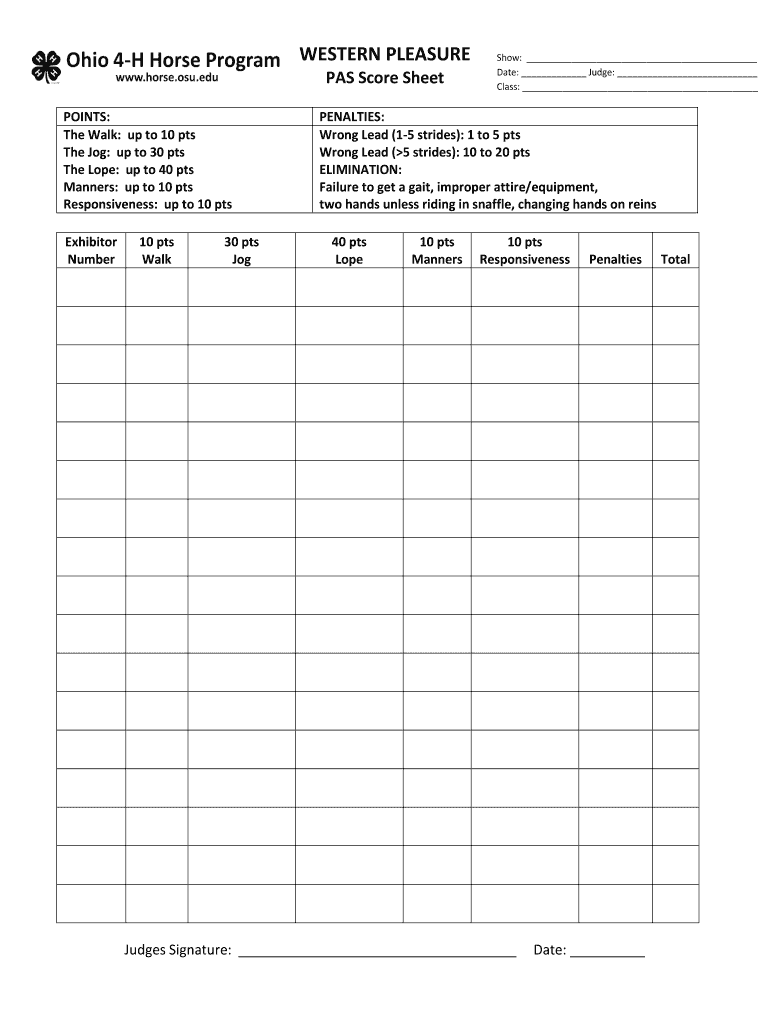
The Western Pleasure Show Score Sheet is a crucial tool for judges in horse shows to evaluate the performance of participants. This document captures various elements that contribute to the scoring of Western Pleasure equestrian events. At the heart of the score sheet are specific criteria that must be assessed to ensure a fair and accurate representation of each participant's performance.
Key Elements of the Western Pleasure Show Score Sheet
The score sheet is made up of several components, each carefully designed to assess the horse's performance. The following are the primary elements typically included:
- The Walk: This phase allows for up to 10 points. Judges observe the horse’s natural gait, checking for smoothness and consistency.
- The Jog: The scoring for the jog can go up to 30 points. Judges evaluate the horse's ability to move comfortably at this two-beat gait.
- The Lope: As possibly the most critical section, the lope can account for up to 40 points. The horse should exhibit a smooth and cadenced three-beat gait.
- Manners: Worth up to 10 points, this category assesses the horse's behavior and demeanor during the performance.
- Responsiveness: With a potential of 10 points, this section evaluates how effectively the horse responds to the rider's cues.
Steps to Complete the Western Pleasure Show Score Sheet
Completing the Western Pleasure Show Score Sheet involves a systematic approach to ensure all aspects of performance are adequately evaluated:
- Prepare the Score Sheet: Ensure that all basic information such as date, location, and participant number are filled in.
- Observe Each Element: As the horse performs, score each of the above sections independently based on observable criteria.
- Note Any Extra Observations: Use the notes section for any additional comments or observations that may impact scoring.
- Total the Scores: Sum the scores from each section to get the final score for the performance.
- Reassess if Necessary: Double-check calculations and criteria adherence to ensure scoring accuracy.
Importance of the Western Pleasure Show Score Sheet
The Western Pleasure Show Score Sheet serves several important purposes:
- Standardization: It provides a consistent framework for evaluating horse performances across different events, ensuring that all horses are judged by the same standards.
- Objectivity: A well-structured score sheet minimizes bias by focusing on specific criteria.
- Feedback: The score sheet offers valuable insights for riders on areas of strength and those requiring improvement.
Who Uses the Western Pleasure Show Score Sheet
The score sheet is primarily utilized by:
- Judges in equestrian competitions for accurate assessment.
- Trainers and riders who use it to better understand the judging criteria.
- Event organizers needing to maintain standardized scoring practices.
Important Terminology in the Western Pleasure Show Score Sheet
Understanding key terms is crucial for effective use of the score sheet:
- Gait: Refers to the horse’s manner of moving, critical in categories like walk, jog, and lope.
- Cadence: The rhythm and consistency of the horse’s movement.
- Responsiveness: How promptly and accurately a horse responds to rider commands.
Legal Use and Compliance
Judges are responsible for accurate scoring and maintaining integrity. Incorrect or biased scoring can lead to disputes. As such, judges must adhere to regulatory standards set by equestrian governing bodies.
State-Specific Rules for Western Pleasure Competitions
While the fundamental scoring criteria remain the same, there may be slight variations in rules based on the state. Event organizers should ensure that judges are familiar with any state-specific regulations before the event.
Practical Examples of Use
Consider a scenario at a state-level competition:
- Example 1: A horse smoothly executes each gait but shows minor behavioral issues, leading to a judges' deduction in the manners section.
- Example 2: Another horse exhibits exceptional responsiveness, earning full points in that section despite a slightly uneven jog.
These real-world applications illustrate the nuanced role the Western Pleasure Show Score Sheet plays in determining final outcomes in equestrian events.