






Definition and Meaning
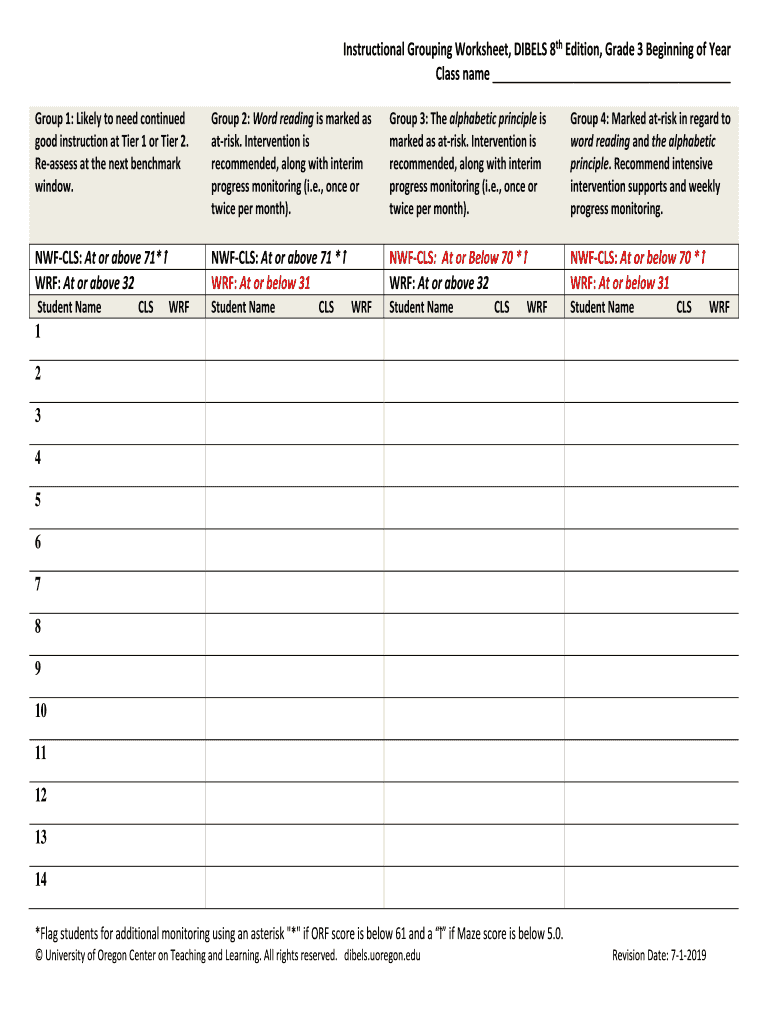
The DIBELS 8th Edition Grade 3 Instructional Grouping Worksheet is a critical tool used in educational settings to classify students based on their reading proficiency levels in grade three. DIBELS, which stands for Dynamic Indicators of Basic Early Literacy Skills, aims to assess and improve foundational literacy skills. The worksheet sorts students into different groups according to their performance on various literacy measures. This classification guides educators in tailoring instruction to meet each student's unique needs, providing targeted support and intervention as necessary.
Group Definitions on the Worksheet
- Group 1: Students likely to need continued Tier 1 or Tier 2 instruction. This group of students typically includes those not at immediate risk and who are expected to progress with standard instruction.
- Group 2: Students marked at-risk for word reading difficulties. Intervention and progress monitoring, suggested monthly, are recommended to prevent further literacy struggles.
- Group 3: This grouping focuses on students risk-laden concerning the alphabetic principle. Targeted interventions help address issues in letter-sound recognition.
- Group 4: Students marked at-risk in both word reading and the alphabetic principle. Intensive intervention, including consistent weekly support, is advised.
How to Use the DIBELS 8th Edition Grade 3 Instructional Grouping Worksheet
Using the DIBELS 8th Edition Grade 3 Instructional Grouping Worksheet involves several structured steps to assess and categorize students effectively. Here's how to navigate this process:
- Gather Assessment Data: Begin by collecting reading scores for each student using the DIBELS standardized tests.
- Review Scoring Rubric: Compare student scores against the rubric outlined in the worksheet to identify if they're below, at, or above benchmark levels.
- Identify Group Placement: Place students in the appropriate instructional group (Group 1 to Group 4) based on their performance in areas such as NWF-CLS and WRF, among other criteria.
- Plan Interventions: Align instructional plans and intervention strategies according to group assignments, ensuring supports are adequately intensive for students in higher-risk categories.
- Monitor Progress: Establish interim checkpoints for progress monitoring, especially for those requiring intensive interventions, to modify strategies if needed.
Considerations for Effective Use
- Ensure ongoing professional development for educators to accurately interpret worksheet data.
- Employ technology where feasible to streamline the collection and analysis of assessment data.
- Collaborate with families and guardians to support at-home literacy development and reinforce classroom efforts.
Steps to Complete the DIBELS 8th Edition Grade 3 Instructional Grouping Worksheet
Completing this worksheet requires detailed attention to each student’s assessment results, systematically working through each component:
- Input Student Information: Fill in each student's name and corresponding test scores in columns designated for NWF-CLS, WRF, and other metrics.
- Calculate Flag Indicators: Analyze scores, flag students for additional monitoring where necessary. For example, mark with an asterisk if ORF (Oral Reading Fluency) scores fall below a threshold of 61.
- Assign Group Designations: Use the worksheet's benchmarks to allocate students to the correct instructional group based on their assessed risks.
Special Notations
- Mark students with notable performance exceptions for further individual assessment.
- Annotate fields indicating upcoming reassessment dates or additional monitoring information.
- Safeguard and manage data in compliance with educational privacy standards.
Who Typically Uses the DIBELS 8th Edition Grade 3 Instructional Grouping Worksheet
Educators, particularly those specializing in elementary literacy education, are the primary users of the DIBELS 8th Edition Grade 3 Instructional Grouping Worksheet. This tool is also valuable for:
- Literacy Coaches: Facilitating targeted reading programs and interventions.
- School Administrators: Structuring and optimizing literacy resources across curricula.
- Special Education Teachers: Customizing lesson plans for students requiring adapted instruction.

Broader Educational Stakeholders
- Administrators leverage data from these worksheets for school-wide literacy initiatives aimed at reducing reading deficiencies.
- Parents and caregivers may engage with teachers' insights drawn from these assessments for home-based support.
Key Elements of the DIBELS 8th Edition Grade 3 Instructional Grouping Worksheet
The worksheet contains several components that are crucial for evaluating student literacy benchmarks and designing intervention strategies.
- Student Identifier Fields: Essential for tracking each student's progress and group placement over time.
- Numeric Literacy Scores: Derived from assessments such as Maze, CLS, and WRF, it underpins the instructional grouping decisions.
- Benchmark Guidelines: These standards help educators determine which scores indicate proficiency, risk, or need for intervention.
Numerical Benchmarks
- NWF-CLS (Correct Letter Sounds): At or above 71 indicates proficiency.
- WRF (Word Reading Fluency): Scores of 32 and above are benchmarks for proficient reading ability.
Progress Monitoring Indicators
- Use progress flags (e.g., asterisks) to highlight students needing additional scrutiny based on specific scoring thresholds.
Examples of Using the DIBELS 8th Edition Grade 3 Instructional Grouping Worksheet
To illustrate the practical application of this worksheet, consider the following scenarios:
-
Scenario 1: A student scores consistently high on NWF-CLS yet demonstrates low WRF scores. This student may need targeted interventions focusing on word recognition fluency to complement their strong alphabetic knowledge.
-
Scenario 2: Several students show marginal scores across all literacy areas. Grouping them under intensive support (Group 4) facilitates prioritized access to reading specialists and weekly progress monitoring.
Complexity and Nuance
- Adapt instructional strategies based on diverse learning styles identified during assessments, ensuring inclusive learning environments.
- Factor in linguistic backgrounds that might influence assessments and interventions for English Language Learners (ELLs).
Legal Use of the DIBELS 8th Edition Grade 3 Instructional Grouping Worksheet
Adhering to federal and state educational standards is crucial when implementing the DIBELS 8th Edition Grade 3 Instructional Grouping Worksheet. This includes:
- Privacy Compliance: Protect student information in accordance with the Family Educational Rights and Privacy Act (FERPA).
- Data Integrity Standards: Ensure all collected data is accurately recorded and interpreted by trained professionals.
Recommendations for Legal Compliance
- Regular training sessions on data handling and student privacy for educators and administrative staff.
- Establish a protocol for gaining parental consent when needed, particularly before undertaking intensive interventions or sharing data beyond classroom needs.
These guidelines ensure the responsible use of the worksheet in promoting literacy development while safeguarding student rights.