




01. Edit your form online
Type text, add images, blackout confidential details, add comments, highlights and more.

Type text, add images, blackout confidential details, add comments, highlights and more.

Draw your signature, type it, upload its image, or use your mobile device as a signature pad.

Send it via email, link, or fax. You can also download it, export it or print it out.
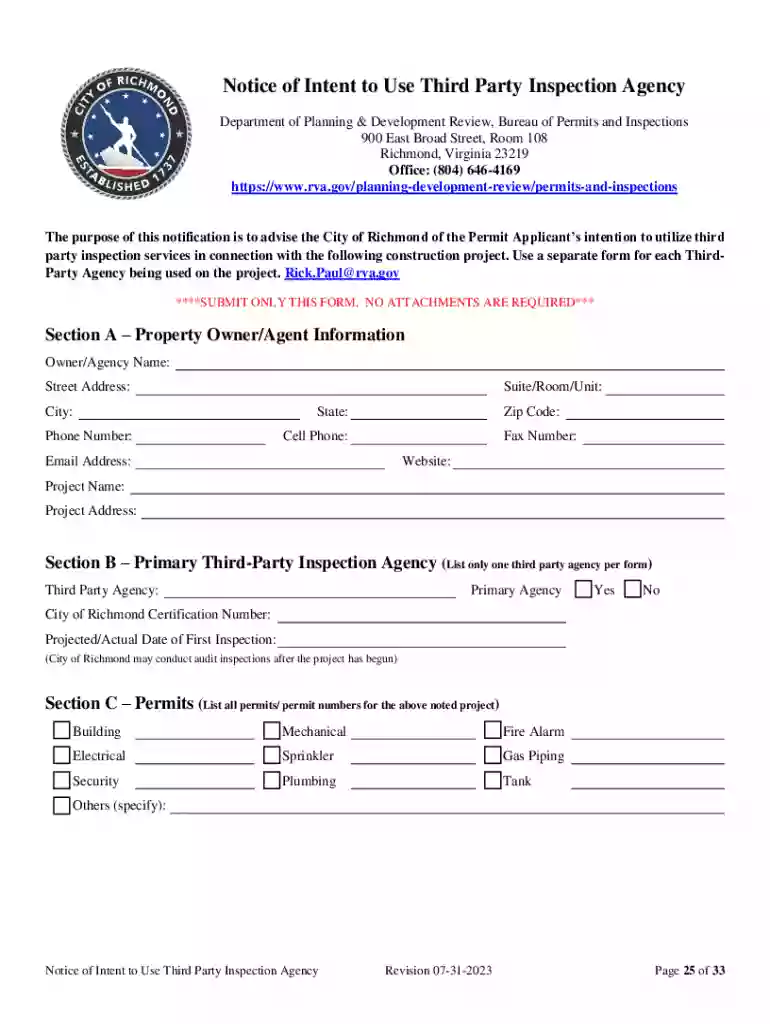
The "Notice of Intent to Use Third Party Inspection Agency" is a formal document issued by the Department of Planning & Development Review in Richmond, Virginia. Its primary purpose is to inform city officials that a permit applicant plans to hire a third-party inspection agency to oversee inspections for a specific construction project. This notice ensures that all parties involved are aware of the applicant's intention to engage external services for inspection purposes, promoting transparency and compliance with local regulations.
To utilize this notice effectively, property owners and project managers should ensure all sections are filled accurately. The document must be submitted ahead of any inspections conducted by the third-party agency to maintain compliance and avoid project delays.
For instance, if a construction company is building a new commercial complex, they may choose a specialized third-party agency for better oversight. Filling out and submitting this notice promptly ensures that inspections are recognized and authorized by the city.
Using this notice helps ensure that all inspections are carried out legally and in compliance with local rules. It protects both the property owner and the inspection agency by documenting intent and responsibility.
Failure to notify the city can leave a project subjected to legal scrutiny, blocking progress and incurring additional costs. Thus, timely submission is crucial.
Common constructions include residential buildings, commercial setups, and large-scale industrial complexes where specialized inspections might be necessary.
The use of the notice is governed by municipal codes requiring permits and inspections for any construction work. Compliance ensures lawful proceedings and minimizes project interruptions.
Non-compliance could result from inadequate understanding of the regulatory environment, leading to project delays and financial loss. Consistent consultation with legal professionals is advisable.
Each part of the document needs thorough review to eliminate errors, which might lead to non-acceptance or delays in the project timeline.
Within Richmond, this document adheres to local codes which might differ from those in other municipalities. Customization of sections related to city-specific compliance is necessary.
The regulatory body may conduct unannounced inspections to verify adherence to this notice, emphasizing the importance of accuracy and compliance.
Consider a new tech office being built in downtown Richmond; the stakeholders utilized the notice effectively by arranging for a structural specialist to approve the construction quality, streamlining approval from city inspectors.
Successful navigation through local regulations resulting in timely project delivery and enhanced confidence among all stakeholders involved.
At DocHub, your data security is our priority. We follow HIPAA, SOC2, GDPR, and other standards, so you can work on your documents with confidence.


Dec 27, 2022 In the digital age, information and communication technology (ICT) supports complex systems used for everyday activities.
A notice of a third-party claim must be submitted in writing by mail through the USPS or by a commercial delivery service. While the Deputy General Counsel will
Jul 31, 2023 The purpose of this notification is to advise the City of Richmond of the Permit Applicants intention to utilize third party inspection


