




01. Edit your p5 form online
Type text, add images, blackout confidential details, add comments, highlights and more.

Type text, add images, blackout confidential details, add comments, highlights and more.

Draw your signature, type it, upload its image, or use your mobile device as a signature pad.

Send p 5 form via email, link, or fax. You can also download it, export it or print it out.
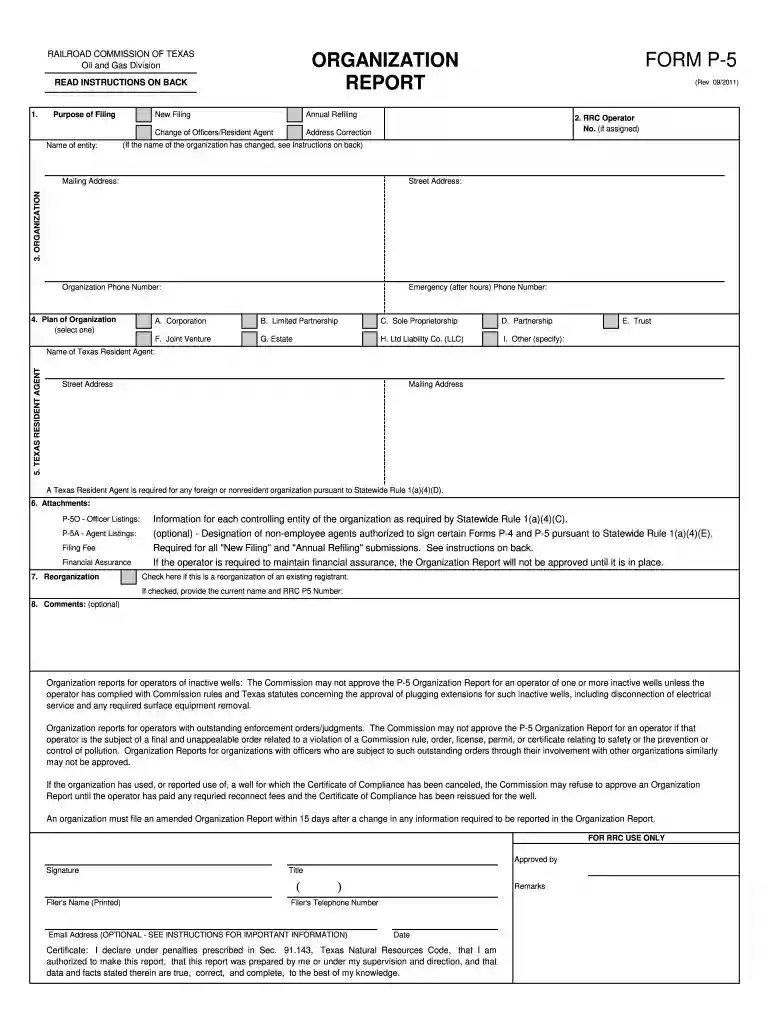
The P-5 Form, officially known as the Organization Report, is a critical document filed with the Railroad Commission of Texas. The primary purpose of this form is to register entities involved in oil and gas operations within Texas. It serves as a comprehensive registration mechanism that enables the Commission to maintain an updated registry of all operational entities. Organizations such as corporations, partnerships, and sole proprietorships engaged in the exploration, production, transportation, and sale of oil and gas must complete this form. Data collected through the P-5 Form plays a crucial role in regulatory oversight, ensuring compliance with state laws governing resource extraction and management.
Entities can obtain the P-5 Form through the Railroad Commission of Texas website. It’s essential to download the latest version to ensure compliance with current requirements. Updates to the form occur periodically to reflect changes in legislation or policy, so applicants must verify they have the most recent edition. Additionally, entities can acquire the form by contacting the Commission directly, where staff can provide guidance on acquiring and completing the document accurately.
Completing the P-5 Form involves a meticulous process to ensure all required information is accurate and complete. Below is a structured guide:
The submission of the P-5 Form requires several supporting documents to authenticate the information:
Filing the P-5 Form is crucial for legal and operational compliance within Texas’s oil and gas industry. The report ensures that businesses can legally engage in extraction and related activities. Non-compliance can result in penalties, including fines and the suspension of operational licenses. Furthermore, maintaining an active and accurate Organization Report minimizes legal risks and enhances the company's reputation with regulatory bodies and partners.
Compliance with state regulations is the primary focus of the P-5 Form. It serves as a legal declaration of an entity’s intention to engage in oil and gas operations. This form outlines conditions under which entities must operate, ensuring environmental and public safety standards are upheld. It acts as a binding agreement between the organization and the state, subject to legal scrutiny and penalties if not properly maintained or updated as required.
Failure to file a complete and accurate P-5 Form can lead to significant penalties. The Railroad Commission may render a company ineligible for permits necessary to operate in Texas. Monetary fines are also imposed, the magnitude of which depends on the severity and duration of the infraction. Chronic non-compliance may escalate to legal actions, further damaging an entity’s ability to conduct business and enforce contracts.
Entities may choose between digital and paper submissions of the P-5 Form. While both methods are acceptable, online submissions via the Commission’s e-filing system offer several advantages, including faster processing times and immediate verification feedback. Digital submissions also enable efficient document management and reduce the risk of clerical errors that are more prevalent in paper submissions. Electronic filing facilitates timely compliance, aligning with Texas’s broader initiative to modernize regulatory interactions through digital transformation.
We've got more versions of the p5 form form. Select the right p5 form version from the list and start editing it straight away!
| Versions | Form popularity | Fillable & printable |
|---|---|---|
| 2011 | 4.9 Satisfied (221 Votes) |
At DocHub, your data security is our priority. We follow HIPAA, SOC2, GDPR, and other standards, so you can work on your documents with confidence.





The result of this filing, is intended to bring the 4 wells, at Midland Farms, into compliance with TX Railroad. Commission Rules Regulations.
DO NOT USE THIS FORM TO DESIGNATE A TEXAS RESIDENT AGENT. (Your Texas Resident Agent is identified on Form P-5 to which this is attached.) This Form P-5ARead more
The goal during the design process was to identify potential project areas and give them conceptual form. In the future, these areas will need to be pairedRead more


