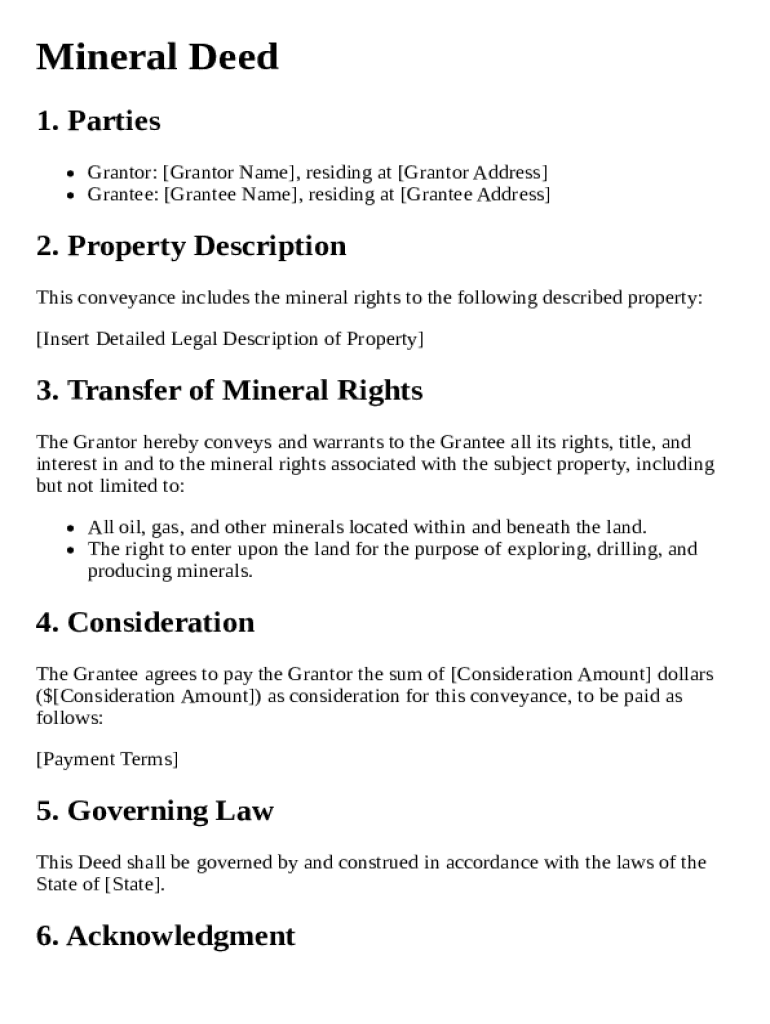







Mineral deed basics
A mineral deed is a legal instrument used to transfer ownership of mineral interests from one party to another. In U.S. real property practice, that transfer may cover minerals already known to exist, future production interests, or a specific share of the minerals beneath a parcel of land. A mineral deed template provides a structured starting point for documenting that transfer in a clear, recordable format.
The core purpose of a mineral deed template is to identify the grantor, the grantee, the property, and the exact mineral interest being conveyed. It also sets out the legal terms that control the transfer, such as whether the deed is conveying a fee mineral interest, a royalty interest, or another reserved or partial interest. Because mineral ownership can be split from surface ownership, precise language matters.
A mineral deed is different from a lease. A lease usually gives an operator the right to explore and produce minerals for a period of time under stated conditions, while a deed transfers ownership rights outright, subject to any reservations or limitations written into the document. That distinction is central when the parties intend a permanent conveyance rather than a temporary operating right.
In practical terms, mineral deed templates are often used when family members transfer inherited mineral rights, when investors purchase an interest from a current owner, or when a landowner wants to divide the mineral estate among heirs or business partners. The template helps organize the information needed for a valid recordation, but the completed deed must reflect the actual transaction with accuracy.
Because mineral interests can involve oil, gas, coal, lignite, sand, gravel, metals, and other subsurface resources, the deed should specify what is included. In some states and transactions, the parties may define “minerals” broadly, while in others the language is narrowed to avoid disputes over substances such as water, geothermal resources, or near-surface materials.
A mineral deed template also serves as a risk-management tool. Ambiguous wording can create title defects, disagreement over fractions, or disputes about whether the grantor retained a royalty, executive rights, or nonparticipating interest. A carefully completed deed supports cleaner title records and easier future transactions.
Key deed terms and clauses
The most important parts of a mineral deed template are the legal clauses that define what is being transferred and how the transfer works. These clauses are not merely administrative; they determine the scope of ownership and whether the deed will be enforceable as intended under state law.
Granting language
The granting clause is the central conveyance statement. It identifies the intent to transfer mineral rights from the grantor to the grantee and usually names the specific interest conveyed. Common formulations include a full transfer of all mineral rights, a transfer of an undivided fractional share, or a transfer limited to certain depths, formations, or substances.
A well-drafted granting clause should make clear whether the deed conveys:
- All mineral rights associated with the land
- A percentage or fractional interest
- A specified tract or legal description
- A limited interest tied to certain rights, such as royalty only
If the granting language is vague, the deed can invite disputes over whether the transfer includes leasing rights, bonus rights, delay rentals, or future development proceeds.
Legal description and estate language
The legal description identifies the land to which the mineral rights attach. This may include a metes and bounds description, lot and block information, or a government survey reference. The description must match the parcel with sufficient precision for county recording and title examination.
The estate language should also state whether the deed covers only the mineral estate or also associated rights. In many transactions, the parties want to address:
- Surface access rights
- Executive rights
- Royalty rights
- Delay rental rights
- Bonus payment rights
When the deed separates these rights, the document needs careful drafting so the title chain remains consistent with the parties’ intent.
Reservations, exceptions, and limitations
Reservations and exceptions are essential when the grantor intends to keep part of the mineral estate. For example, a parent may transfer one-half of the mineral rights to a child but reserve the other half for personal ownership. A deed may also exclude prior conveyances, existing leases, or certain depths already committed to another party.
Limitations are equally important in structured transfers. Common examples include:
- A reservation of all executive rights
- A transfer limited to a specific tract within a larger family farm
- A reservation of a fixed fraction, such as one-fourth of all minerals
- A depth restriction for certain formations or wells
These clauses should be carefully aligned with local title standards, because a reservation that is inconsistent with the granting language can create confusion.
How the mineral deed is used
A mineral deed template is typically used as part of a private transaction, estate planning arrangement, or title-clearing process. The template provides the framework, while the actual deed reflects the negotiated terms between the parties. It is often drafted before signing, reviewed by the parties or counsel, notarized, and then recorded in the county where the land is located.
In an inheritance context, a mineral deed may be used when heirs decide to distribute mineral interests among themselves or transfer them into a family trust or LLC. In that situation, the deed helps document ownership transitions that are separate from the surface estate. A common example is a probate-related conveyance where several heirs each receive a stated undivided interest.
In a sale transaction, the deed is used when one owner sells mineral rights to another person or entity. This could involve a family farm owner selling mineral rights to a neighboring landowner, or an investor acquiring a fractional interest in a producing tract. The document should match the agreed purchase terms and the title commitment, if one exists.
Mineral deeds are also used to correct title problems. If earlier transfers were incomplete, inconsistent, or never recorded, a current deed may be used to confirm ownership, fix a legal description, or clarify the extent of a reservation. These corrective instruments are especially important in older chains of title where recorded records may be incomplete or outdated.
A practical use case involves split ownership. If one person owns the surface and another owns the minerals, a mineral deed can transfer only the subsurface estate while leaving the surface title unchanged. This separation is common in many oil and gas regions, and the deed needs to make that division explicit.
Some mineral deed templates are also used in transactional cleanup before drilling, pooling, or unitization. Operators, title attorneys, and landmen may review the deed to verify who owns the minerals and who is entitled to related proceeds. In that setting, the accuracy of the deed affects not only ownership, but also lease negotiations and payment division orders.
Steps to complete the form
Completing a mineral deed template usually follows a sequence that begins with confirming ownership and ends with recording the signed document. Each step matters because mineral title issues can be expensive to resolve later, especially where the deed is intended to transfer a valuable royalty stream or producing interest.
Confirm the parties
The first step is identifying the grantor and grantee exactly as they appear in legal records. For individuals, this usually includes full legal names and marital status if required by the state or title company. For business entities, the name should match the entity’s formation records and signature authority should be confirmed.
If the grantor is deceased, owns the mineral interest through an estate, or holds the rights through a trust or LLC, the signing authority must be established before the deed is finalized. In family transfers, it is common to see errors caused by informal name usage, such as a nickname or married name that does not match recorded title documents.
Define the property and interest
The next step is inserting the legal description of the land and clearly stating the interest being conveyed. This is the point where the parties determine whether the deed transfers the full mineral estate, an undivided fraction, or only a reserved royalty or production share. If the deed concerns multiple tracts, each tract should be identified carefully.
A useful drafting practice is to confirm whether the interest is measured:
- By percentage
- By fraction
- By acreage
- By tract
- By depth or formation
This clarification prevents later disputes over whether the deed applies to the entire county parcel or only a specific section of it.
Add conditions and signatures
After the main property terms are completed, the deed should include any reservations, exceptions, or special conditions. These may involve retained rights, existing leases, tax allocations, or restrictions tied to future development. The deed should also include the execution block, acknowledgment language, and notary section required for recording in the relevant jurisdiction.
A complete signing process typically includes:
- Reviewing the final legal description.
- Confirming the ownership fraction.
- Signing in the required form.
- Notarizing the signatures.
- Recording the deed with the county clerk or recorder.
Verify before recording
Before recording, the completed deed should be checked for consistency. The granting clause, property description, reservation language, and signature block should all agree with one another. If the deed refers to one tract in the body and another tract in the legal description, the county recorder may accept it, but the title problem may remain.
In higher-value transactions, title counsel or a land professional often verifies the completed form. This is especially useful when the transfer involves multiple heirs, multiple counties, or partial mineral interests that must be coordinated across several records.
Legal requirements and state rules
Mineral deeds are governed primarily by state property law, so the requirements can vary significantly across the United States. A valid deed in one state may need different wording, different acknowledgment language, or different recording practices in another. Because of that, a template should always be adapted to the state where the minerals are located.
The legal description requirements may differ by state and county. Some jurisdictions accept a metes and bounds description, while others expect lot, block, and subdivision references or government survey descriptions. If the deed covers land in more than one county, separate recording may be necessary in each county where the property is located.
State law may also affect how mineral rights are characterized. In some states, courts and statutes distinguish between minerals, royalties, executive rights, and lease bonus rights. In others, the default rules are narrower or broader depending on local precedent. Those distinctions matter because a deed that says “mineral rights” may not automatically include every associated economic or control right.
Common state-level issues include:
- Homestead or spousal signature requirements
- Community property rules in some jurisdictions
- Notary acknowledgment format requirements
- Margin and formatting standards for recording offices
- Transfer tax or documentary stamp considerations, where applicable
If the property is in a state with strong oil and gas activity, local drafting custom can be especially important. Texas, Oklahoma, New Mexico, Louisiana, North Dakota, Pennsylvania, and other producing states often use familiar mineral conveyance language, but local title practices and courthouse recording preferences still vary.
A template should also respect state-specific rules about recording priority. Many states follow a race-notice or notice recording framework, meaning that delay in recording can affect priority against later purchasers. In a mineral ownership transfer, that issue can become significant if multiple deeds are executed close in time.
Recording and filing details
After execution, a mineral deed is usually filed with the county recorder, clerk, or registrar of deeds in the county where the mineral interest is located. Recording gives public notice of the transfer and helps preserve the chain of title. Without recording, the parties may still have a private agreement, but later purchasers or title examiners may not see it.
The filing package commonly includes the signed and notarized deed, the required recording fee, and any county-specific cover sheet or transfer declaration. Some counties also require a return address, parcel identification number, or additional indexing information. If the deed concerns multiple counties, each county record may need a separate filing.
Typical recording timing is immediate after signing or as soon as practical, especially when the transfer is part of a sale or estate settlement. Delayed recording can create issues if another deed is filed first, if the owner dies before recordation, or if a lender or operator relies on stale records.
Common recording issues
Several practical problems can delay recording:
- Missing notarization
- Incomplete legal description
- Incorrect county
- Unclear grantor or grantee identification
- Unpaid recording fees
- Formatting that does not meet county standards
These issues are administrative, but they can have substantive effects if they cause the deed to be rejected or misindexed. Misindexing is particularly important in mineral title work because title plants and county searches depend on accurate party names and parcel references.
Examples of filing scenarios
A single-parcel rural tract in one county is usually straightforward: the completed mineral deed is notarized and recorded in that county. A more complex case may involve a family ranch spanning two counties, where the deed must be filed in both counties to ensure the mineral transfer is fully reflected in public records. Another example involves a producing tract in a heavily leased area, where the operator may require a copy of the recorded deed before updating payee records.
Parties, rights, and ownership scenarios
Mineral deed templates are used by a wide range of owners and transferees, but the ownership structure often determines how the deed should be completed. The same form can look very different depending on whether the transfer is from an individual, a trust, an estate, or a business entity.
Individuals often use mineral deeds when transferring inherited rights among family members or selling a partial interest. In those cases, marital status and homestead issues may matter, depending on the state. An individual grantor may also hold the rights as separate property, in which case the deed and supporting documentation should be consistent with that ownership status.
Trusts and estates require particular care because the person signing may be a trustee, personal representative, or executor rather than the beneficial owner. The deed should identify the capacity in which the signer acts. For example, a deed signed by “Jane Smith, Trustee of the Smith Family Trust” is materially different from one signed by Jane Smith in her individual capacity.
Business entities can also own mineral rights. Limited liability companies, corporations, and partnerships may transfer mineral interests through authorized signatories. In those cases, the deed should reflect the exact legal entity name, and the signer’s authority should be supported by operating agreement, corporate resolution, or partnership authorization if needed.
Common ownership patterns
Mineral deed templates are often used in these arrangements:
- Full transfer of all mineral rights
- Fractional ownership transfer among heirs
- Transfer into a trust or LLC for estate planning
- Reservation of royalty rights after sale
- Conveyance subject to an existing lease
Each structure has a different effect on future leasing, revenue collection, and title administration. For example, a reserved royalty interest can allow the grantor to receive production proceeds while giving the grantee ownership of the underlying mineral estate. That arrangement must be drafted precisely so payment division matches the intended ownership split.
Real-world example
A parent owning a one-half mineral interest in a ranch may deed one-fourth to each of two children while reserving a life estate in the remaining one-half. Another common example is a landowner selling the mineral estate but retaining the right to receive proceeds from an existing lease until the lease expires. In both cases, the mineral deed must clearly distinguish between present ownership and retained economic interests.
Related documents and supporting information
A mineral deed template is most effective when paired with supporting documents that confirm ownership and clarify the transaction. The deed itself is only one part of the record. Depending on the transaction, additional documents may be needed for title review, recordation, payment setup, or tax reporting.
Common supporting documents include:
- Prior deeds in the chain of title
- Probate orders or estate administration documents
- Trust certificates or trustee powers
- Entity authorization documents
- Existing oil and gas leases
- Title opinions or ownership reports
These materials help verify that the grantor has the power to transfer the interest and that the grantee is receiving the correct fraction. They also help identify whether the mineral estate is burdened by a lease, mortgage, judgment lien, or prior reservation.
Tax-related records may also matter. While the mineral deed itself is not a tax return, transfers of valuable interests can have gift, estate, or income tax consequences depending on the transaction structure. In a family transfer, for example, the deed may support estate planning, but the parties may still need separate tax analysis. In a sale, the grantor may need documentation of basis and proceeds.
In some situations, an affidavit may accompany the deed. This can include an affidavit of heirship, an ownership affidavit, or an affidavit of nonproduction, depending on local title practice. These supporting statements are often used to clean up record title or explain why the deed transfers a specific interest.
Common errors and risk areas
Mineral deeds are prone to drafting mistakes because the subject matter is highly technical and often tied to older title records. A small wording problem can create a large ownership dispute later, especially when a property becomes productive or is leased after the deed is recorded.
One common error is using an imprecise legal description. If the tract description is incomplete or copied from an unrelated document, the recorded deed may not clearly attach to the intended property. Another issue is failing to distinguish between surface and mineral estates, which can lead to confusion about what rights were actually transferred.
A second major risk is fraction mismatch. Parties often intend to convey “one-half of my minerals,” but the legal effect may differ if the grantor owned only a partial interest to begin with. In mineral title work, a fraction should be verified against the grantor’s actual ownership, not just stated in general terms. For example, a grantor who owns one-fourth of the minerals and deeds “one-half” may only transfer one-eighth of the total mineral estate.
A third risk involves inconsistent reservation language. If the deed says the grantor reserves a royalty interest, but the granting clause suggests a full mineral conveyance with no exceptions, future title reviewers may need to interpret the document. Those disputes are often time-consuming and expensive to resolve.
Practical edge cases
Edge cases often arise when:
- The mineral rights were inherited from multiple ancestors.
- The tract is located in a county with outdated records.
- The deed references an oil and gas lease that no longer exists.
- A trust, estate, or LLC is involved in the transfer.
- Only certain depths or formations are included.
Each of these situations increases the need for careful drafting and review. A template can be helpful, but it should not be treated as a substitute for accurate title information.
Recordkeeping concerns
After recordation, the deed should be kept with the closing file, title documents, and ownership records. Accurate recordkeeping helps avoid duplicate transfers, mistaken payments, and future chain-of-title confusion. In producing properties, the recorded deed may also be needed to update operator pay records or division orders.
Variants and alternative forms
Not every mineral-related transfer uses the same deed form. The terminology and document type depend on the interest being transferred and the transaction’s purpose. A mineral deed template is appropriate when the parties want to transfer ownership of the mineral estate itself, but other instruments may be more suitable in different circumstances.
Common related forms include:
- Royalty deed
- Oil, gas, and mineral deed
- Quitclaim deed for mineral interests
- Special warranty deed for mineral rights
- Reservation or exception deed language within a larger conveyance
A royalty deed typically transfers the right to receive a share of production proceeds, rather than the broader mineral estate. A quitclaim deed may be used where the grantor does not want to make warranties about title, which can be appropriate in uncertain ownership situations but provides less protection to the grantee. A special warranty deed adds limited assurances tied to the grantor’s period of ownership.
The choice among these variants depends on the parties’ goals and the quality of title. If the transaction is family-based and intended to settle uncertain ownership, a quitclaim-style conveyance may be used. If the transaction is a negotiated sale, a special warranty deed may be preferred because it gives some protection without extending liability beyond the grantor’s ownership period.
A mineral deed template is also often adapted for state-specific naming conventions. In some regions, the form may be titled “Oil, Gas, and Mineral Deed,” while in others the broader “Mineral Deed” label is sufficient. The title matters less than the substance, but consistency with local practice can reduce confusion for county recorders and title examiners.
Choosing the right version
A useful distinction is whether the deed transfers:
- The mineral estate itself
- A royalty interest only
- A working interest or revenue stream
- A partial, reserved, or limited interest
- Title subject to an existing lease
That classification determines the legal and practical consequences of the transfer. It also affects how future royalties are paid and whether the grantee has leasing authority.
Common use cases and examples
Mineral deed templates are used in several recurring situations across the United States, especially in states with active oil, gas, and mineral development. The most common use is a private ownership transfer between parties who already know the property and want to document the change in title.
One frequent example is intra-family transfer. A grandfather may transfer mineral rights to grandchildren as part of estate planning, or siblings may divide inherited mineral interests so each person holds a clean fraction. In those transactions, the deed often needs to track probate documents, family settlement agreements, and any prior reservations.
Another common example is a sale to a third party. A mineral owner may sell a noncontrolling interest to an investor, a land company, or another family member. The deed then becomes the core record of ownership transfer and may later be used by the operator to update payment records.
A third example is a title cleanup transaction. If old deeds do not clearly state who owns the minerals, a current owner may execute a corrective deed or confirmatory deed to align the chain of title with the parties’ intended ownership. This is especially important in counties with long ownership histories or many generations of transfers.
Example scenarios
- A ranch owner conveys a 25 percent mineral interest to a family trust while reserving the remaining interest.
- Three heirs each receive equal undivided interests in inherited minerals under a probate settlement.
- A seller transfers mineral ownership subject to a preexisting lease, while the grantee takes future leasing rights after expiration.
- An LLC acquires mineral rights from members to consolidate management and future revenue administration.
Each scenario requires different wording, but all depend on the same core information: parties, property, interest conveyed, and execution details.
Why precision matters
Mineral ownership can affect long-term royalty income, leasing control, tax reporting, and estate value. A deed that is too general may be difficult to interpret decades later. By contrast, a well-completed mineral deed template creates a durable record that can support future title searches, operator inquiries, and family succession planning.