






What the form means
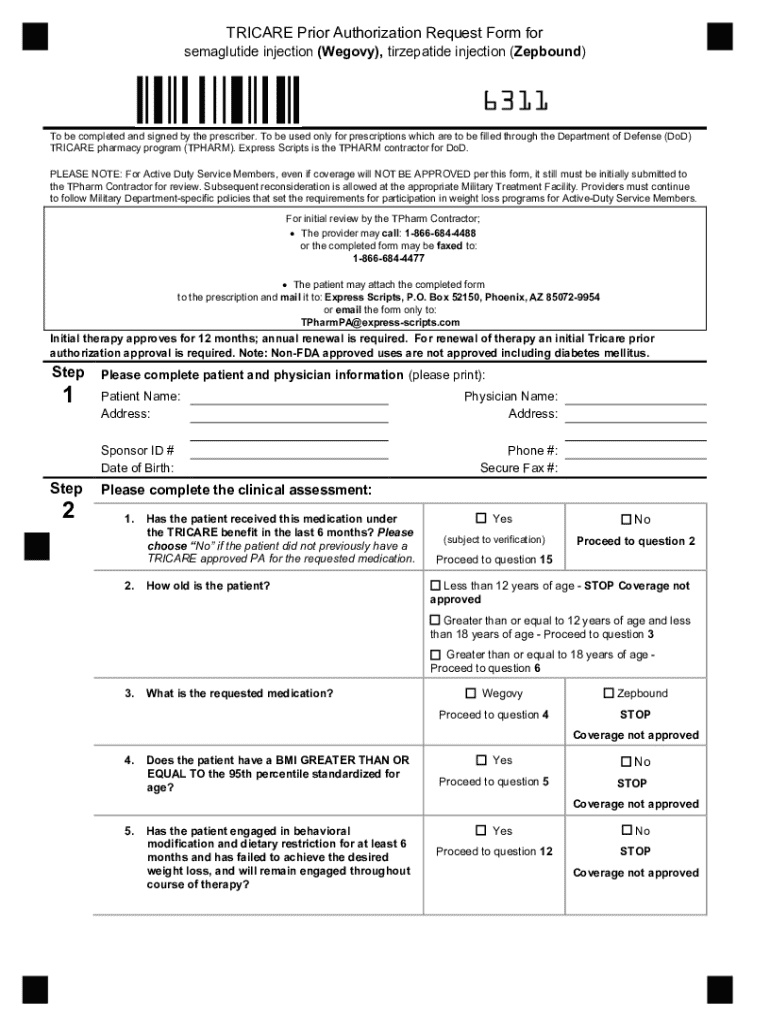
The TRICARE Prior Authorization Request Form is a medical coverage form used to ask TRICARE for approval before a patient receives certain services, procedures, drugs, or durable medical equipment. In practical terms, it is a utilization management document that helps determine whether a requested item meets TRICARE coverage rules before care is delivered. For some services, prior authorization is required to confirm medical necessity, network rules, place-of-service requirements, or benefit limitations.
This form is commonly used in the United States by patients, prescribers, care coordinators, and billing offices that work with TRICARE health plans. It is most often completed by the prescribing provider or their office, not by the patient alone, because the request usually depends on clinical details, diagnosis codes, treatment history, and supporting documentation. The form supports a structured review process so that TRICARE can evaluate whether the requested care fits the beneficiary’s plan rules.
A prior authorization request is different from a referral, although both may be part of the approval process. A referral generally points a patient to a specialist or service, while prior authorization is an explicit pre-service review request. In many situations, a service may need both, especially when care is provided outside of a primary care manager arrangement or when the requested treatment falls under a specialty benefit.
The form is especially important when a treatment has a high cost, a narrow clinical indication, or a specific TRICARE policy requirement. Examples can include advanced imaging, certain medications, home infusion therapy, medical equipment, or non-emergency specialty services. The purpose is not to delay care, but to confirm coverage terms before claims are submitted.
The document also creates a record of what was requested, who submitted it, what clinical justification was provided, and what decision TRICARE made. That record can help when there is later billing review, appeal activity, or coordination between multiple providers. It is part of the larger administrative workflow that surrounds TRICARE-covered care.
In many cases, the request is tied to the patient’s exact benefit category, such as Active Duty Family Member, retiree, or another eligible group. Coverage rules can vary based on the beneficiary’s status, the care setting, and whether the provider is in-network or out-of-network. That makes the form a highly specific document rather than a general intake sheet.
Who uses it and when
The form is typically used by prescribers, specialty clinics, hospital staff, pharmacy teams, and care management offices. Patients may be involved by signing consent, confirming demographic information, or supplying insurance details, but the clinical sections are usually completed by a licensed provider or an authorized office staff member acting on the provider’s behalf. In many organizations, the form is handled by a prior authorization department that coordinates with the clinician and the payer.
It is used before services begin, not after the fact. That timing matters because many TRICARE benefits require approval in advance. If the service is rendered before approval is obtained, the claim may be denied, reduced, or subjected to a retrospective review that is harder to resolve. This is especially relevant for elective procedures, specialty pharmaceuticals, or services that require documented medical necessity.
Common scenarios include a specialist requesting approval for a non-routine treatment plan, a prescriber requesting a medication not covered without additional review, or a clinic requesting durable medical equipment such as a mobility device. A pediatric patient needing ongoing specialty therapy may also require repeated or renewed authorizations if the plan has limited validity. The form is therefore both a first-time request and, in some cases, a renewal document.
In a real-world office workflow, the request often begins with the provider identifying that a service may need approval. Staff then gather diagnosis codes, visit notes, test results, prior treatment history, and the requested quantity or duration. The form is completed, signed, and submitted according to the applicable TRICARE process. If the request is incomplete, the review can stall until missing information is supplied.
The timing of the request can vary by benefit type. Pharmacy-related requests may need to be submitted quickly because medication starts are time-sensitive, while planned procedures may allow more lead time. A consistent rule is that approval should be secured before the beneficiary receives the service whenever the benefit requires preauthorization.
The form can also be used when the plan requires medical review after a change in therapy. For example, if a patient has failed standard treatments and the prescriber wants to move to a higher-tier medication or a more specialized intervention, the request form explains why the new approach is needed. In that sense, the form documents both current need and why less intensive options are no longer sufficient.
What information it asks for
The TRICARE Prior Authorization Request Form generally asks for identifying, clinical, and administrative details. At a minimum, it usually needs the patient’s name, date of birth, TRICARE identification information, diagnosis, requested service, and prescriber information. The goal is to connect the medical need to a specific beneficiary and a specific service request.
Clinical information is one of the most important parts of the form. This may include the diagnosis code, symptoms, duration of the condition, prior therapies tried, current medications, lab or imaging findings, and the provider’s rationale for the requested service. If the form involves a medication request, it may also ask for dose, frequency, route of administration, and expected duration of treatment.
Administrative information often includes the provider’s office contact details, National Provider Identifier, facility name, fax number or other submission channel, and the servicing provider or location. If a request applies to a specific procedure or equipment item, the form may ask for a CPT, HCPCS, or NDC code, depending on the benefit. These codes help TRICARE identify exactly what is being requested.
Supporting documents are frequently part of the request package, even if they are not embedded in the form itself. Examples include chart notes, treatment records, specialist consults, imaging reports, operative reports, and proof of prior conservative therapy. For pharmacy requests, documentation may include formulary alternatives already tried, adverse reactions, or step therapy history. The better the documentation, the easier it is for reviewers to understand the case.
The form may also ask for urgency details if the request is time-sensitive. In some cases, a provider may indicate whether the service is standard or expedited, and why delay could affect the patient’s health. That distinction can influence processing priority, although the exact review rules depend on the benefit and TRICARE program guidance.
Some versions of the request process include fields for the requested length of approval or number of units. For example, a durable medical equipment request may need a quantity and replacement timeline, while a medication request may need a 30-day, 90-day, or maintenance supply amount. These details matter because TRICARE authorizations are often limited to a specific quantity, time frame, or clinical scenario.
How to complete it correctly
The most reliable way to complete the TRICARE Prior Authorization Request Form is to align every section with the clinical record and the benefit rules that apply to the patient. The form should be filled out using accurate patient identifiers, current provider information, and a diagnosis that matches the requested service. Small inconsistencies, such as mismatched names, outdated member numbers, or conflicting dates of service, can delay review.
A complete request usually starts with verifying eligibility and the exact TRICARE plan type. Different TRICARE programs can have different authorization rules, and those rules affect what should be included on the form. The staff member completing the request should confirm whether the beneficiary has TRICARE Prime, TRICARE Select, TRICARE for Life, or another category, because that can change the required routing, documentation, and approval pathway.
Clinical explanation should be specific rather than general. For example, saying that a patient “needs more treatment” is usually less helpful than explaining that the patient has tried standard therapy for a defined period, has documented side effects, and now requires an alternative service because the first-line option failed. Strong requests usually connect diagnosis, treatment history, objective findings, and expected outcome in one clear narrative.
Dates and codes should be checked carefully. If the requested service begins on a date before the form is signed, or if the diagnosis code does not correspond to the documented condition, the request may require correction. Many offices use a checklist to confirm that the form includes patient data, provider signature, supporting records, and any necessary attachments before submission.
When the form includes a signature section, the signer should be the appropriate clinician or an authorized representative of the practice, depending on the submission rules. For electronic workflows, the signed copy should be saved in the chart or document system, along with the attached records used to support the request. That recordkeeping is important if the payer later asks for clarification or if an appeal becomes necessary.
Common completion errors include leaving mandatory fields blank, sending incomplete notes, using outdated form versions, and failing to specify the exact service requested. Another frequent problem is submitting only the form without the evidence that supports medical necessity. A well-prepared request is one where the reviewer can understand the full clinical picture without needing to guess at the rationale.
Supporting documents and evidence
Supporting records are often the difference between a smooth review and a delayed request. TRICARE reviewers generally need enough evidence to understand why the requested care is medically necessary, why it fits plan rules, and why other options may not be appropriate. The exact documents needed depend on the service, but the goal is consistent: prove the need with clear clinical support.
Typical attachments include office visit notes, specialist consult notes, imaging studies, lab results, medication history, and evidence of prior treatment failures. For example, if a patient is requesting a specialty medication, the chart may need to show previous formulary options, adverse effects, or lack of response to standard therapy. If the request is for therapy services, documentation may need to show functional limitations and measurable improvement goals.
Sometimes the submission requires more than clinical records. A provider may need to include a letter of medical necessity, a treatment plan, or operative and discharge summaries. In complex cases, the reviewer may need enough context to see why the request is not merely convenient, but clinically justified. This is especially true for higher-cost services or requests that fall outside routine benefit use.
For equipment requests, product specifications can matter. The request may need to identify the exact device, model, accessory, or supply quantity. If the item is a replacement rather than a first-time request, documentation may also need to explain why replacement is required and whether the item was lost, worn out, or no longer suitable because of a change in condition.
A common edge case is a request involving multiple diagnoses. In those situations, the records should show which diagnosis is driving the authorization request and whether the service addresses more than one condition. That clarity helps avoid denial due to ambiguity about the primary indication. It also helps if the service is later reviewed for continued coverage.
The submission package is strongest when the documents tell a consistent story. The form, chart notes, and billing codes should all support the same service request, the same timeframe, and the same medical need. If the narrative says one thing and the code set suggests another, reviewers may need clarification before making a decision.
Approval, denials, and timing
Once the request is submitted, TRICARE reviews the information to determine whether the requested service meets coverage criteria. The review can result in approval, denial, a request for additional information, or a partial authorization. A partial approval may limit the number of visits, units, days, or quantity allowed, rather than approving the full request as submitted.
Processing time depends on the service type, the completeness of the request, and whether the case requires extra clinical review. Routine requests may be handled faster than complex or high-cost ones. If the request is missing information, the timeline can pause until the office responds with what is needed. That is why complete submissions are often more efficient than sending a request quickly but incompletely.
A denial does not always mean the service is never covered. It may mean that the records did not show enough medical necessity, the requested item did not meet a policy requirement, the service was not obtained through the correct care pathway, or a step therapy requirement was not met. In some cases, a denial can be corrected by submitting more detailed documentation or by requesting reconsideration through the proper process.
Approval length can vary. Some authorizations apply for a defined number of months, while others are limited to a set quantity or specific episode of care. For chronic conditions, renewal requests may be required before the authorization expires. It is important to track expiration dates because continued care without renewed approval can cause claim issues, even if the original request was valid.
Urgent cases may be handled differently than standard requests, but urgency still requires documentation. A clinician should explain why delay could create harm or substantially worsen the patient’s condition. Without that explanation, a request may be treated as routine, which can affect review speed.
A helpful way to think about timing is in three parts. First is the submission date, second is the review date, and third is the service start date. If these dates are misaligned, the claim may become complicated. A service that starts too early, or a renewal that is sent too late, can create administrative problems even when the clinical need is clear.
Who should submit it
The form is usually submitted by the prescriber’s office, specialty clinic, hospital department, or pharmacy team. Although the patient may initiate the conversation, the actual authorization request usually requires clinical information that only the provider or office can supply. This is especially true when the request involves diagnosis codes, prior treatment history, and treatment justification.
In many organizations, the person who physically submits the form is a referral coordinator, prior authorization specialist, nurse, or medical assistant working under office procedures. The signer may still be the licensed provider, but the administrative team often prepares the packet and sends it to the correct review channel. This division of labor helps reduce clerical errors and keeps the request aligned with the patient’s chart.
Patients sometimes need to submit portions of the request if the benefit requires member information, consent, or supplemental details from the beneficiary. Even then, the patient usually does not replace the provider’s clinical role. For example, a patient may need to confirm personal details, but the prescriber still provides the medical rationale for the service.
If multiple providers are involved, the submitting office should be clear about which clinician is responsible for the request. This matters when one specialist orders the service and another manages long-term care. A mismatch between the ordering provider and the submitting provider can delay processing if TRICARE needs clarification about who is accountable for the request.
For facilities, the submission may come from a centralized department rather than the care team. Hospitals, outpatient centers, and large group practices often have standardized workflows for prior authorizations. Those workflows usually include verification, record gathering, form completion, and quality review before the request is sent.
The safest approach is to ensure that the submitter has access to both the current plan details and the complete clinical record. A request sent by someone who lacks the full chart often ends up needing correction. In healthcare administration, the quality of the submission is as important as the speed of the submission.
How to submit it
Submission methods can vary based on the TRICARE benefit, the type of request, and the processing contractor involved. In many cases, the form is sent by fax or through an electronic workflow connected to the provider office. Some requests may also be submitted through secure portals, depending on the service category and the applicable regional process.
Before submission, the office should confirm the destination and required format. Some requests must go to a specific contractor based on the beneficiary’s region or benefit type. Sending the request to the wrong channel can delay review, even if the form is otherwise complete. Because of that, routing is just as important as documentation.
A typical submission packet contains the completed form, signature if required, and all supporting records. The office should retain a copy of everything sent, including confirmation of transmission when available. That record helps if the packet is misplaced or if the reviewer states that an attachment was missing.
If the request is being sent electronically, file naming and document order can matter. Clear labels for the form, chart notes, imaging reports, and prior treatment records make it easier for reviewers to process the request quickly. When multiple documents are merged into one file, the pages should remain legible and in logical order.
In in-office workflows, a staff member may also enter the request into an internal tracking system. That tracking record should include the patient name, service requested, date submitted, expected response date, and any follow-up notes. This reduces the chance of duplicate submissions or missed renewal deadlines.
If a request must be corrected after submission, the office should respond promptly with the updated information. Common corrections include adding missing diagnosis details, clarifying the requested quantity, or providing a more specific medical rationale. A clean resubmission can often be easier to process than trying to patch an incomplete file piecemeal.
Common service examples
The TRICARE Prior Authorization Request Form is often used for services that are expensive, specialized, or subject to medical review. One common example is a specialty medication request that requires proof of step therapy or documentation of prior failure with preferred alternatives. In these cases, the form helps show why the requested drug is needed instead of a standard option.
Another example is advanced imaging, such as MRI or CT, when the plan requires review before the study is performed. The request may need to show that symptoms, exam findings, and earlier care justify the test. If the imaging is for a chronic issue, the documentation may need to explain why the study would change treatment or confirm a suspected diagnosis.
Durable medical equipment is another frequent use case. Requests for mobility aids, braces, oxygen-related equipment, or other devices often need product detail, diagnosis support, and an explanation of functional need. Replacement requests can require additional evidence showing wear, loss, or a change in the patient’s condition.
Specialty therapies can also require authorization. Physical therapy, occupational therapy, speech therapy, and certain infusion services may need approval when the requested number of visits or length of treatment exceeds routine thresholds. The form helps define the treatment plan and the expected clinical benefit.
In surgical or procedural settings, the request may be used for a planned operation that needs review before scheduling. The office may need to provide preoperative findings, conservative treatment history, and the reason the procedure is indicated now rather than later. This helps the reviewer understand the sequence of care and the medical necessity behind the procedure.
A useful edge case is recurring care. For example, a beneficiary who already had an approved authorization may need a renewal if treatment continues beyond the approved period. Another edge case is a change in therapy mid-course, which may require a new request instead of an extension. In both situations, the documentation should clearly explain whether the request is new, revised, or renewed.
Important terms to know
Medical necessity is one of the most important concepts tied to TRICARE prior authorization. It means the requested service must be appropriate, reasonable, and supported by the patient’s condition and the plan’s coverage rules. A request can be medically sensible in a general sense and still fail if it does not meet TRICARE’s specific criteria.
Prior authorization is the approval process that happens before the service is rendered. It should be distinguished from retrospective review, which happens after the service, and from a referral, which is a recommendation or directional order to another provider. Understanding the difference helps offices submit the correct paperwork in the correct order.
Another important term is formulary, especially for pharmacy requests. A formulary is the list of drugs that are preferred or covered under certain rules. If a medication is not on the formulary, the request may need extra documentation explaining why alternatives are not appropriate. That same idea often appears in step therapy requirements, where one or more lower-cost options must be tried first.
An authorization number or approval reference may be issued if the request is approved. That number is often important for claim billing, scheduling, and follow-up. Offices should keep it with the patient record because it may be needed later if a claim is questioned.
Network status is also relevant. Some services require care from in-network providers, while others may allow exceptions under specific circumstances. The form often intersects with provider type, location, and facility status, so the request should reflect where the care will occur and who will provide it.
Finally, benefit category matters. TRICARE rules can differ based on whether the beneficiary is an active duty member, family member, retiree, or another eligible group. That means the same service may have different approval rules depending on the person’s coverage category and the setting where the care will be delivered.
How the form fits TRICARE rules
The form is part of a broader set of TRICARE coverage rules, not a standalone approval tool. It works alongside benefit manuals, medical policy requirements, network rules, and claim processing procedures. A request that is complete on paper can still be denied if it does not align with the underlying benefit terms.
Coverage rules may be different for pharmacy benefits, medical services, and durable medical equipment. For example, a medication request may depend on therapeutic class rules, while a procedure request may depend on place-of-service and specialist referral requirements. The form has to capture the right kind of information for the specific benefit being requested.
Some services require documentation not only of the diagnosis, but also of prior conservative care. That means the request should explain what was tried first, how long it was tried, and why it was not adequate. This is especially common in musculoskeletal care, pain management, and other areas where noninvasive options are usually expected before more intensive treatment.
The form can also interact with case management or disease management programs. In chronic or complex cases, the request may be reviewed alongside broader care coordination efforts. That can be helpful when multiple services are being authorized for the same patient, such as a medication, a therapy plan, and medical equipment.
A practical issue is that TRICARE rules can change over time. A form used successfully in one benefit year may not match updated requirements in a later one. Offices that handle frequent prior authorizations often maintain current workflows, updated attachments, and internal checklists to reduce the risk of submitting an outdated version or missing a new field.
In complex cases, the final approval may include limitations that are easy to overlook, such as quantity limits, expiration dates, or provider-specific restrictions. Those details should be read carefully because they affect both billing and care planning. Even when a request is approved, the approval terms define the scope of what was authorized.
Digital and paper handling
The form may be used in paper or digital form, depending on the office workflow and the submission channel. Digital handling is often more efficient because it supports quicker routing, easier storage, and simpler sharing among staff members. Paper handling still appears in offices that scan completed forms or work with fax-based processes.
Electronic workflows are helpful when multiple people contribute to the request. One staff member can gather documentation, another can complete the form, and a clinician can review and sign it. That division can reduce errors, especially in busy clinics that process many authorization requests each week.
Paper handling can still be practical when a patient brings documents to an appointment or when a provider prefers to sign manually. In those cases, the office should make sure the scan is legible and complete before sending it onward. Poor scan quality, missing pages, or upside-down attachments can create avoidable delays.
A strong digital recordkeeping process includes saving the completed request, the supporting documents, the submission confirmation, and any response from TRICARE. That history is useful if the office needs to follow up, file an appeal, or renew the authorization later. It also helps with continuity when staff changes occur.
Security matters in both paper and digital workflows because the form often contains protected health information. Offices should handle it in a way that limits unnecessary access and preserves confidentiality. That includes using secure storage, controlled transmission methods, and proper chart documentation practices.
The most effective workflows usually combine accuracy, documentation, and follow-up. Whether the form is completed on paper or electronically, the key is that the submission should clearly answer the reviewer’s clinical and administrative questions in one organized packet.