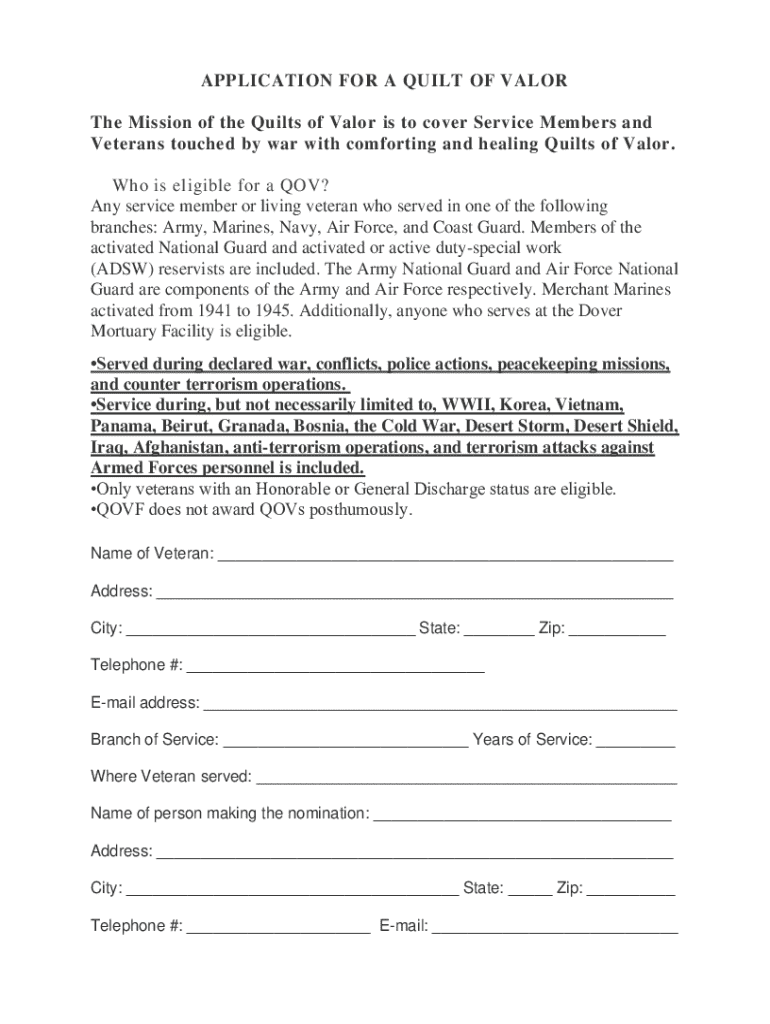







What the Quilt of Valor application means
The Quilt of Valor Application Form is used to request a Quilt of Valor for a Service Member or Veteran who has been touched by war. The form helps organizers gather the information needed to recognize the recipient properly and to coordinate the presentation in a respectful, consistent way.
In most cases, the application functions as a nomination or request form rather than a benefits claim. It is designed to identify who should receive a quilt, why the person qualifies, and how the presentation can be arranged. That makes accuracy important, since the form supports a meaningful, personal recognition process.
A Quilt of Valor is not a ceremonial award in the legal sense, but it carries deep emotional and symbolic value. The application process is therefore centered on eligibility, service history, and contact details rather than on financial information or formal government documentation.
Because the mission is people-centered, the form often asks for practical details that help volunteers connect the quilt with the right person. Those details may include branch of service, current address, preferred contact method, and whether the nominee is aware of the request.
Common reasons people use the form include honoring an active-duty Service Member returning from deployment, recognizing a Veteran after years of service, or arranging a presentation for someone recovering from the visible or invisible effects of war. In each case, the application helps ensure the quilt is matched with a person whose service is being acknowledged.
The form may also be used by family members, friends, unit leaders, or community members who want to nominate someone. In that sense, the application is both practical and ceremonial, since it guides the coordination of an important moment while preserving the dignity of the recipient.
Who usually completes it
The Quilt of Valor Application Form is typically completed by someone who knows the Service Member or Veteran well enough to provide accurate details. That may be a spouse, parent, child, sibling, friend, fellow Service Member, caregiver, or local coordinator.
In some situations, the nominee completes part of the form themselves, especially if the request process allows self-nomination. This can happen when someone has not yet been recognized but wants to ensure the information is current and complete.
Military units, veterans’ groups, and community volunteers also complete or help complete the form. These users often handle multiple requests and may be responsible for submitting applications for group presentations, family events, or local ceremonies.
A recurring use case involves families submitting the form after a Veteran returns home or after a service milestone. Another common example is a volunteer group coordinating quilts for several recipients at a hospital, retirement community, or regional gathering.
The form is especially useful when the recipient’s service history needs to be confirmed in a simple, organized way. For example, if the person served in different branches, had multiple deployments, or retired long ago, the requester can provide context that would otherwise be difficult to collect later.
Because the application can be sensitive, the person filling it out should use information carefully and respectfully. If the nominee is unaware of the request, the form may need to avoid details that could create surprise in an inappropriate setting, such as a public event before the recipient is ready.
Eligibility rules and criteria
Eligibility for a Quilt of Valor generally centers on military service and connection to war. The core idea is to honor Service Members and Veterans who have been impacted by war, whether through direct deployment, combat exposure, or the lasting effects of service.
The exact criteria may vary by organization or local chapter, but many requests focus on these broad categories:
- Active-duty Service Members who have served in a war zone or deployment related to conflict
- Veterans who were involved in war, combat, or war-related service
- Individuals whose service resulted in visible or invisible wounds, including physical injury, trauma, or long-term recovery needs
Some requests may be straightforward, such as a retired Veteran with multiple deployments. Others may require more context, especially when the service record is complex or the person’s wartime experience is less obvious from their discharge status alone.
It is also common for the form to accommodate edge cases. For example, a person may not have combat decorations but may still qualify because they served in a war-related theater. Another example is someone who served during a conflict period but was never deployed overseas; local program guidance may still allow consideration depending on the circumstances.
Family members sometimes assume that only combat veterans qualify, but the application process is often broader than that. The central consideration is whether the person’s military service was touched by war and whether the local Quilt of Valor coordinator can verify that connection.
If the nominee does not clearly fit the standard criteria, it is often helpful to include explanatory notes rather than leaving the form incomplete. That may include service dates, deployment locations, unit assignment, or a brief description of how war affected the person’s service experience.
Key details the form asks for
The Quilt of Valor Application Form usually gathers information that helps identify the nominee and prepare the presentation. The exact layout can vary, but most versions focus on a few core categories.
Typical requested information includes:
- Full name of the nominee
- Military branch, rank, and service status
- Contact information, if appropriate
- Mailing address or presentation location
- Name and contact details of the requester
- Relationship between the requester and the nominee
The form may also ask for service-specific information. That can include dates of service, deployment history, unit information, conflict era, and whether the recipient has already received a Quilt of Valor before. These details help avoid duplicate requests and support proper coordination.
Presentation details are another common section. For example, the form may ask whether the quilt should be presented publicly, privately, or at a family gathering. In some cases, the recipient’s preferences matter just as much as the service history.
Some applications include space for special notes. This can be useful when the nominee has mobility limitations, hearing or vision considerations, privacy concerns, or scheduling constraints. A brief note can help volunteers plan a respectful presentation.
If the form is being used by a chapter or local group, it may also include internal tracking information such as the date received, coordinator assigned, or status of approval. Those fields are often not completed by the nominee, but they are useful for workflow management.
Documents and information to gather
Before completing the Quilt of Valor Application Form, it helps to gather the information that is most likely to be requested. Doing so reduces delays and lowers the chance that the request will need follow-up clarification.
Common supporting details include:
- Nominee’s full legal name and preferred name
- Service branch, rank, and years of service
- Deployment or conflict-era information
- Contact details for the nominee or a household representative
- Requester name, phone number, and email address
- Relationship to the nominee
- Preferred presentation date, if known
If the nominee is deceased, a local coordinator may still accept the request depending on the rules of the organization and the intended presentation format. In that case, it is especially important to confirm what information is needed and who will receive the quilt.
In more detailed applications, supporting information may include a copy of discharge papers, military ID, or other service verification. Not every request will require documents, but having them available can help if the reviewer needs confirmation.
For family-nominated requests, it is often helpful to gather a short summary of the recipient’s service experience. For example, “served two tours in Iraq,” or “was deployed to Afghanistan and later retired from the Army.” Those brief details can make the form more complete and useful.
When the application is for someone with a complicated service record, such as multiple branches or reserve-to-active transitions, it is useful to collect the dates and locations in advance. That helps the reviewer understand the person’s service timeline without needing repeated follow-up.
How to complete it correctly
Completing the Quilt of Valor Application Form is usually a straightforward process, but accuracy matters because the form supports a personal recognition event. The best results usually come from reading each field carefully and providing only the information requested.
A practical approach looks like this:
- Identify the nominee and confirm that the person fits the program’s service-based criteria.
- Gather the service details, contact information, and presentation preferences.
- Fill in each field clearly, using full names and current information where possible.
- Review any sections about privacy, consent, or public recognition.
- Submit the form through the method accepted by the local chapter or coordinating group.
If the application asks for a service summary, the response should be factual and concise. For example, instead of writing “served honorably for many years,” it is more useful to write “U.S. Navy, 1998 to 2006, deployed during Operation Iraqi Freedom.”
If a field does not apply, it is usually better to mark it as not applicable rather than leaving it blank, unless the form instructions say otherwise. That makes the submission easier to review and can prevent processing delays.
Care should be taken with names, especially when a person uses a nickname, maiden name, or preferred name in daily life. The form may need both the legal name and the name used for the presentation so that records and the ceremony information match correctly.
When submitting for someone else, it can be helpful to note whether the nominee knows about the request. In some cases, the presentation is meant to be a surprise, while in others the person prefers advance notice or wants to participate in planning.
Ways to submit the form
Submission methods for the Quilt of Valor Application Form can vary by local group or chapter, but many accept more than one format. The most common methods are online, by email, by mail, or through a local coordinator.
Online submission is often the easiest option when the application is hosted as a digital form or fillable document. It can speed up routing, reduce handwriting issues, and make it simpler for coordinators to track requests.
Mail submission may still be used when the form is printed and completed by hand. This option can be helpful for people who prefer paper records or who are completing the application on behalf of an older Veteran who is not comfortable with digital tools.
In-person submission is less common but may be available through local veteran organizations, quilting groups, or ceremony coordinators. This method can be useful when the requester needs help verifying information or wants to discuss presentation timing directly.
A few practical differences between submission methods include:
- Online forms are often faster to process and easier to store
- Paper forms may be more accessible for users without reliable internet access
- Email attachments can be convenient but may require careful file naming and legibility
- In-person coordination can help resolve questions immediately
No matter the submission method, it is important to keep a copy of the completed form or confirmation of submission. That can be useful if the coordinator needs clarification or if the presentation is scheduled well after the original request.
Approval and timing process
The approval process for a Quilt of Valor request is usually handled by a local or regional coordinator rather than a formal government office. Because of that, timing can vary depending on volunteer availability, quilt inventory, and presentation scheduling.
In many cases, review begins with checking whether the nominee meets the program’s eligibility expectations. If the information is complete and the service connection is clear, the request may move forward without delay. If the details are incomplete, the coordinator may ask for clarification before confirming the presentation.
Processing time can range from a few days to several weeks, depending on the local workflow. Requests for upcoming ceremonies, military retirement events, holidays, or hospital visits may receive priority, especially when volunteers need to coordinate with family members and venue staff.
Several factors can affect timing:
- Whether all required information is included
- Whether the nominee’s service record is easy to verify
- Whether a quilt is immediately available
- Whether the presentation location has scheduling restrictions
- Whether the recipient’s privacy or health situation requires additional planning
Approval is often less formal than it is for government forms. Instead of a strict “approved” or “denied” decision, the coordinator may simply confirm that the request has been accepted and is being scheduled. If a nominee does not meet criteria, the requester may be asked to provide more service detail or consider a different recognition option.
When the presentation date matters, it helps if the request includes that information early. For example, a family may want the quilt presented at a retirement ceremony, reunion, or homecoming. Those details can influence how soon the form should be submitted.
Digital and paper version differences
The Quilt of Valor Application Form may exist in both digital and paper formats, depending on the local chapter or hosting organization. Each version has strengths, and the best choice often depends on the requester’s comfort level and access to technology.
Digital forms are generally easier to read, store, and share. They can also reduce errors caused by handwriting and make it easier to copy service details accurately. In some workflows, a digital form can be routed quickly to the right coordinator.
Paper forms are still useful when a requester prefers manual completion or when a ceremony is being organized in a setting with limited internet access. They can also be helpful for family members who want to review the request together before submitting it.
Some practical advantages of each format include:
- Digital forms: easier editing, clearer legibility, simpler file storage
- Paper forms: useful for offline use, easy to annotate by hand, familiar to older users
- Fillable PDFs: a middle ground for users who want to type but still print a copy
- Scanned copies: useful when paper forms must be shared electronically
Because the form may contain personal service information, both versions should be handled carefully. That means keeping submitted copies secure, limiting unnecessary sharing, and confirming that the recipient’s privacy preferences are respected.
For a people-centered program like Quilt of Valor, the best format is the one that results in the clearest, most complete submission. A simple, well-prepared paper form can be just as effective as a digital one if it contains all the required information.
Common examples and edge cases
There are many ways the Quilt of Valor Application Form may be used in real life, and some situations are more straightforward than others. A typical example is a spouse nominating a retired Army Veteran who served in Iraq and now lives at home with family. In that case, the form would likely include service details, contact information, and a preferred presentation date.
Another common example is a unit member nominating a fellow Service Member who is returning from deployment. The form might be used to organize a small ceremony at a base, family home, or community event. In that situation, the requester may need to indicate whether the nominee knows about the presentation.
A more complex case might involve a Veteran with multiple service periods. For example, someone may have served in the Navy, later joined the National Guard, and then deployed overseas. The form should reflect the full service picture rather than only the most recent role.
Other edge cases include:
- A recipient who is deceased, where the quilt is presented to family members
- A nominee with privacy or mobility needs, requiring a quiet or accessible setting
- A person with no obvious combat decorations, but with qualifying wartime service
- A request submitted long after service ended, where records may need more explanation
- A family that wants a surprise presentation, requiring discreet coordination
There may also be situations where the requester does not have all the military records. In those cases, the form can often still be started with the information available, while additional verification is gathered later. That is especially helpful when family members are completing the request from memory or partial records.
One important pattern in successful applications is clarity. Forms that are concise, complete, and factual are easier for coordinators to review and easier to match with the right quilt presentation. That matters whether the request is for a home visit, a public event, or a quiet family gathering.