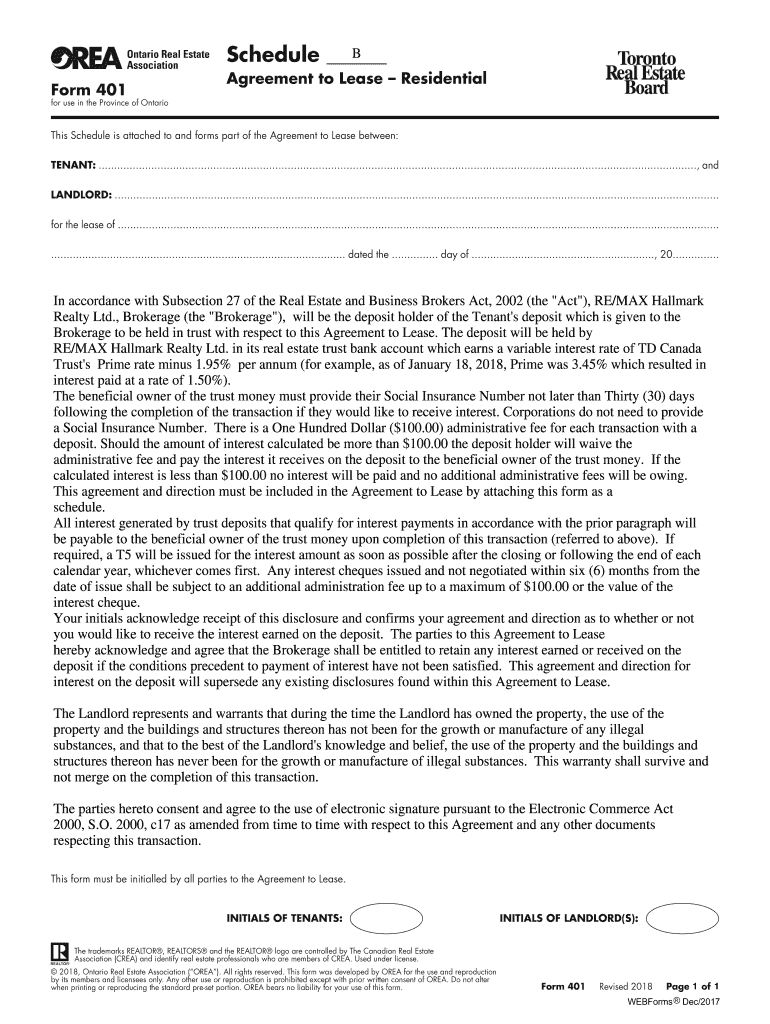







Definition & Meaning
The Ontario Residential Lease Agreement Form 401 is a standardized legal document used to formalize the rental agreement between a landlord and tenant in Ontario, ensuring that both parties adhere to the Residential Tenancies Act. This form outlines the terms and conditions of the lease, including duration, rent amount, and responsibilities of each party.
- Purpose: Establishes rights and obligations, safeguarding interests of both tenant and landlord.
- Scope: Applicable primarily for residential properties in Ontario.
Key Components
- Tenant and Landlord Identification: Essential details like names and contact information.
- Property Description: Precise location and unit details.
- Lease Duration: Specifies start and end dates of tenancy.
- Rent Obligations: Amount, due dates, and accepted payment methods.
How to Use the Ontario Residential Lease Agreement Form 401
Using the Ontario Residential Lease Agreement Form 401 involves several steps, ensuring accuracy and compliance.
- Gather Necessary Information: Tenant and landlord details, rental property address, and lease terms.
- Fill Out the Form: Include every detail required, paying close attention to accuracy.
- Review Terms: Both parties should review conditions to ensure mutual agreement.
- Sign and Date: Finalize the agreement with signatures from both the tenant and landlord.
Practical Tips
- Communication: Discuss specific terms thoroughly to avoid misunderstandings.
- Legal Advice: Consider consulting with a legal professional for clarity on complex terms.
Important Terms Related to Ontario Residential Lease Agreement Form 401
Understanding the terminology within the agreement is crucial to comprehending its provisions.
- Security Deposit: A financial deposit to cover any potential damages.
- Fixed-term Lease: A lease with a specific duration.
- Utilities Responsibility: Details which party is accountable for utility payments.
- Early Termination: Conditions under which the lease can be ended prematurely.
Clarifications and Examples
- Security Deposit Example: Equivalent to one month’s rent, refundable at the lease's end barring damage.
- Utility Clause: Explicitly states if the tenant or landlord pays for services like electricity or water.
Steps to Complete the Ontario Residential Lease Agreement Form 401
Completing the form involves precise attention to detail to ensure all necessary information is accurately recorded.
- Provide Personal Details: Both parties enter full names and contact information.
- Describe Premises: Record the property’s address and specific amenities included.
- Specify Lease Terms: Include duration, rent payment details, and maintenance responsibilities.
- Agree on Additional Clauses: Incorporate any specific agreements beyond standard terms.
- Final Review: Both parties thoroughly review to ensure all provisions are correctly addressed.
- Sign the Document: Affix signatures to formalize the arrangement legally.
Why You Should Use the Ontario Residential Lease Agreement Form 401
Utilizing this official form provides structure and legal assurance to the rental arrangement, ensuring compliance with provincial regulations.
- Legal Protection: Offers a legally binding document that clarifies responsibilities and protects against disputes.
- Standardization: Ensures consistency in rental agreements across Ontario, reflecting commonly recognized standards and practices.
Benefits
- Dispute Resolution: Offers a clear framework for resolving potential disagreements.
- Compliance: Adheres to the Residential Tenancies Act, safeguarding tenant rights.
Key Elements of the Ontario Residential Lease Agreement Form 401
Understanding the core elements of the agreement is essential for a well-rounded grasp of its functions and responsibilities.
- Rent Amount and Payment Terms: Details on how and when rent is paid.
- Maintenance and Repairs: Specifies who is responsible for property upkeep.
- Termination Conditions: Outlines notice periods and conditions for lease termination.
- Pet Policy: States whether pets are allowed and any associated conditions.
Real-world Scenarios
- Rent Payment: Ensures regular payment to maintain tenancy and avoid legal repercussions.
- Maintenance Responsibilities: Clear division of repair responsibilities minimizes conflicts.
Legal Use of the Ontario Residential Lease Agreement Form 401
This form serves as a legitimate document that can be used in legal settings to enforce tenancy agreements.
- Enforceability: Its standardized nature simplifies legal proceedings.
- Regulatory Compliance: Aligns with provincial laws, reducing the risk of non-compliance.
Considerations for Tenants and Landlords
- Tenant Rights: Clearly defined rights prevent unlawful actions.
- Landlord Protections: Safeguards landlords’ investments, ensuring responsible tenancy compliance.
Examples of Using the Ontario Residential Lease Agreement Form 401
To illustrate the utility of the form, here are several practical examples where it proves essential.
- New Tenancy: A landlord and tenant formalize an agreement for a one-year lease of an apartment.
- Lease Renewal: An existing lease is renewed with updated terms regarding rent increases.
- Sub-leasing: A tenant obtains landlord permission to sublet the apartment, using the form to document terms.
Advantages of Documentation
- Clarity in Terms: Every party understands their obligations, reducing potential for disputes.
- Historical Record: Maintains a record of agreements and changes for future reference.