
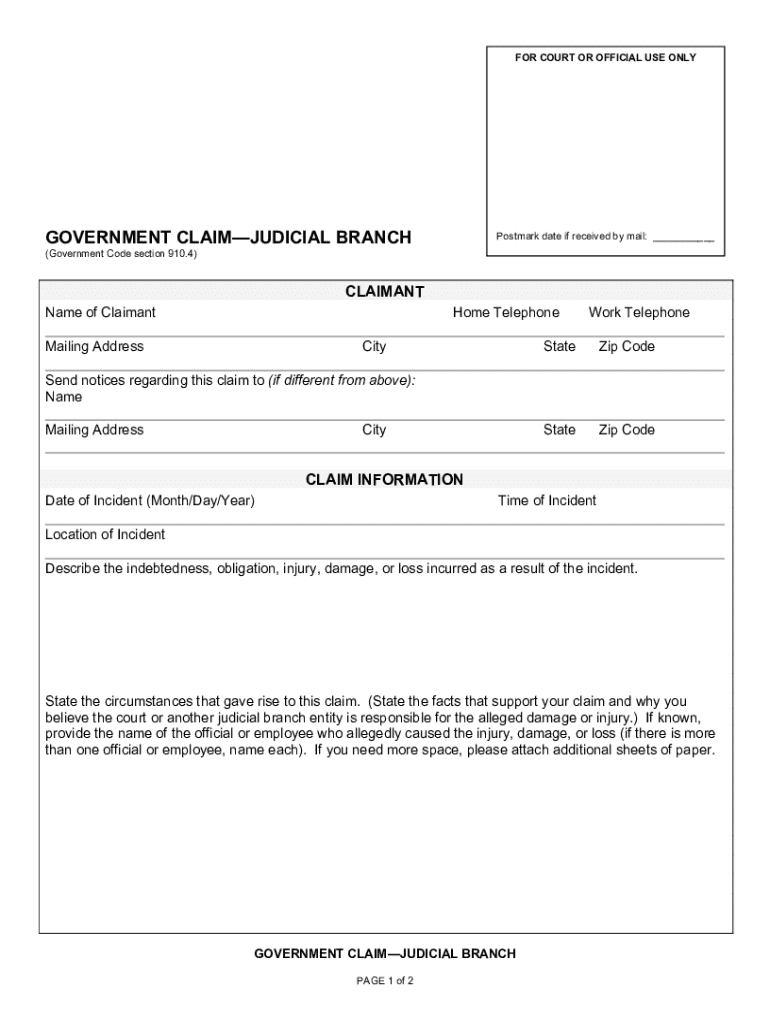







Definition & Meaning
The "Government Claim - Judicial Branch" form allows individuals to submit claims involving incidents with government entities. This form is typically used to report alleged damages or grievances that have occurred due to the actions or negligence of government bodies. It serves as a formal avenue for individuals to declare personal injuries or property damages and seek compensation or resolution. By understanding its function, users can navigate their rights and responsibilities effectively in presenting valid claims.
Steps to Complete the Government Claim - Judicial Branch
Completing the form involves several key steps:
-
Personal Information: Accurately fill in your personal details, such as name, address, and contact information. Ensuring accuracy here is critical to avoid delays.
-
Incident Description: Provide a detailed account of the incident, including dates, times, and locations. Clearly outline the sequence of events leading to the claim, maintaining focus on how government action or inaction resulted in perceived damages.
-
Nature of the Claim: Specify the type of claim you’re filing. This might include personal injury, property damage, or financial losses. It helps establish the basis for your request for restitution.
-
Supporting Documentation: Attach all relevant documents that support your claim, such as photographs, medical reports, invoices for damaged property, and witness statements. Ensure these are up-to-date and clearly labeled.
-
Estimate of Damages: Make a calculated estimation of damages being claimed. Detailed financial records or appraisals that justify your estimated figure are beneficial.
-
Witness Information: List any witnesses who can verify your account of the incident. Include their contact information and a brief description of their connection to the event.
-
Final Declaration: Sign and date the form, affirming the information is true and accurate. Be mindful of the legal ramifications of submitting false information.
Important Terms Related to Government Claim - Judicial Branch
Understanding important terms can clarify the process:
-
Claimant: The person submitting the form, initiating the claim for compensation or adjudication.
-
Liability: The extent to which the government is legally responsible for alleged damages.
-
Damages: Refers to the quantified monetary compensation sought by the claimant.
-
Negligence: Failure to exercise a standard of care that results in harm or damage.
-
Tort Claim: A specific type of claim related to wrongful acts leading to legal liability.
Required Documents
Documents needed to support your claim include:
-
Proof of Incident: Photos, videos, or police reports that establish the occurrence of the incident.
-
Medical Records: Documentation from medical professionals that detail injuries sustained.
-
Repair Estimates or Invoices: Cost estimates or receipts for damages, repairs, or replacements needed.
-
Witness Statements: Written descriptions from witnesses corroborating your version of events.
Ensure all documents are organized and readily available to expedite the review process.
Form Submission Methods
The "Government Claim - Judicial Branch" can be submitted through multiple channels:
-
Online Submission: Many jurisdictions offer electronic filing via government websites, providing a quick and efficient submission route.
-
Mail: Traditional postal submission allows for physical copies of documents. Be sure to use a traceable service for proof of delivery.
-
In-Person: Direct submission at designated government offices. This method can be beneficial for obtaining immediate feedback on the completeness of your submission.
Verify the preferred submission methods for your specific jurisdiction to avoid processing delays.
Legal Use of the Government Claim - Judicial Branch
The form is used to pursue legal remedy against perceived wrongs by a government entity:
-
Claim Filing: Initiates the process for potential compensation or corrective action from the government.
-
Legal Compliance: Ensures adherence to legal requirements in presenting a claim against a public body.
-
Right to Appeal: Allows claimants to formally address grievances, potentially leading to mediation or court proceedings.
Filing a claim holds the government accountable and provides an opportunity for resolution through established legal channels.
Penalties for Non-Compliance
Incorrect or fraudulent claims may lead to:
-
Dismissal of Claim: Incomplete or inaccurate submissions can be rejected outright.
-
Legal Repercussions: Intentionally falsifying claims may result in legal penalties, including fines or criminal charges.
-
Loss of Credibility: Repeated errors may undermine future claims, impacting credibility with adjudicating bodies.
Ensure accuracy and honesty in all submissions to maintain the credibility and effectiveness of your claim.
Examples of Using the Government Claim - Judicial Branch
Real-world scenarios show its application:
-
Property Damage: An individual files a claim after their vehicle is damaged by a government-owned road maintenance vehicle. Documentation includes repair estimates and photographs of the damage.
-
Personal Injury: A pedestrian files a claim after slipping on ice that wasn’t cleared on a government-owned pathway. The claim includes medical bills and witness testimonies.
These examples illustrate how individuals can seek redress and compensation for losses incurred due to government actions or negligence.
State-Specific Rules for the Government Claim - Judicial Branch
Each state may have different protocols:
-
Filing Deadlines: Time frames for submitting claims vary by state. Missing a deadline may result in dismissal, so verify the timeframe for your jurisdiction.
-
Documentation Requirements: States may have specific requirements for the types of supporting documents needed.
-
Appeals Process: Procedures for appealing decisions differ, so familiarize yourself with your state’s rules.
Understanding state-specific rules is essential for successfully navigating the claims process.




