




Definition & Meaning
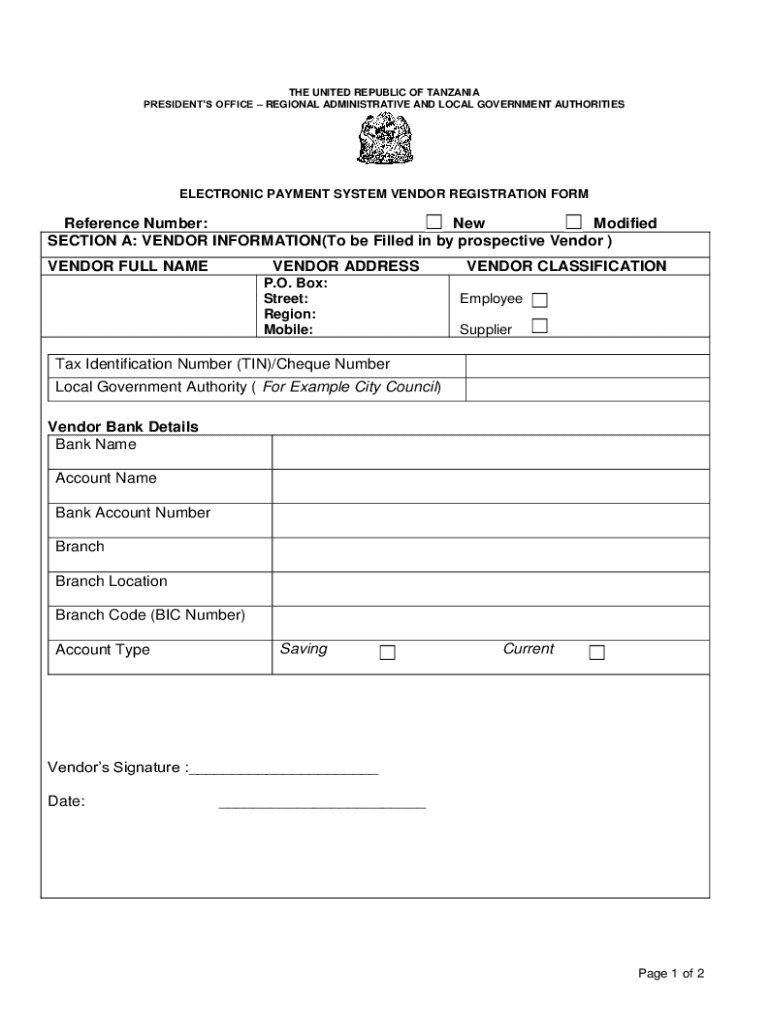
The "Tanzania Electronic Payment System Vendor Registration Form" is a document used to register vendors for electronic payment systems in Tanzania. This form is an essential tool for businesses that want to participate in the electronic financial ecosystem, offering a standardized method to provide necessary information about the vendor, such as company details, authorized representatives, and services provided. It serves to ensure compliance with regulatory requirements and provides the information needed for the company to be correctly integrated into the payment system.
Key Elements
- Company Information: Basic details including name, address, and contact information.
- Authorized Representatives: Names and contact details of individuals authorized to act on behalf of the vendor.
- Service Offerings: Description of the services provided, with specifics on the nature and scope of operations.
- Regulatory Compliance: Sections verifying the vendor has met all necessary legal requirements to operate in Tanzania.
How to Use the Tanzania Electronic Payment System Vendor Registration Form
Completing the form requires attention to detail and accuracy. Begin by gathering all required information, such as company registration documents, contact details, and service descriptions. Follow these steps:
- Acquire the Form: Obtain the registration form from the authorized government website or office.
- Provide Accurate Information: Fill out each section thoroughly, ensuring details are correct and up-to-date.
- Include Necessary Documents: Attach copies of relevant documentation, like business licenses or identification for representatives.
- Review for Accuracy: Double-check all fields for completeness and correctness before submission.
Submission Guidelines
- Ensure contact information for authorized representatives is current.
- Verify that all supplementary documents are attached and legible.
- Contact government offices for clarification if any section is unclear.
Steps to Complete the Tanzania Electronic Payment System Vendor Registration Form
Completing the form requires attention to detail across its various sections:
-
Section A: Vendor Identification
- Enter legal business name, address, and primary contact person.
-
Section B: Business Description
- Detail the nature of your business and the specific electronic payment services provided.
-
Section C: Ownership Information
- Provide details of the company’s ownership and management structure, including percentages of ownership.
-
Section D: Compliance Verification
- Check boxes confirming adherence to relevant laws and regulations.
-
Final Review
- Confirm that all sections are filled correctly, the necessary signatures are included, and the form is ready for submission.
Common Mistakes to Avoid
- Omitting required documents that prove eligibility.
- Providing outdated management or ownership details.
- Misinterpreting regulatory compliance sections.
Required Documents
To ensure the form is accepted, several documents typically accompany it:
- Business License: To verify legal operation within Tanzania.
- Tax Identification: A copy of the company’s tax ID.
- Identity Verification: Passports or ID cards of authorized representatives.
- Proof of Address: Recent utility bills or lease agreements for the business premises.
Verification and Submission
Ensure each document is notarized if required and up-to-date. Submit in person or via specified online platforms, checking that digital copies are clear and legible.
Legal Use of the Tanzania Electronic Payment System Vendor Registration Form
The form is part of regulatory measures to sustain a secure and regulated electronic payment environment. It ensures that:
- Regulatory Compliance: Vendors uphold consumer protection laws and transactional integrity.
- Security Standards: Establishments adhere to required security protocols within financial transactions.
Consequences of Non-Compliance
- Fines and Penalties: Businesses may face financial penalties for false information or failure to comply.
- Business Suspension: Non-compliance can lead to termination of rights to participate in electronic payment processing.
Who Typically Uses the Tanzania Electronic Payment System Vendor Registration Form
The form is essential for various business entities:
- Local Vendors: Seeking to integrate with national electronic payment systems.
- International Firms: Establishing a branch or subsidiary in Tanzania to provide payment solutions.

Examples
- Mobile Payment Solutions: Companies offering mobile money services.
- E-commerce Platforms: Online businesses facilitating electronic transactions.
- Retail Chains: Large-scale operations adopting cashless transaction systems.
Form Submission Methods (Online / Mail / In-Person)
Vendors in Tanzania have multiple methods for submitting their registration form:
-
Online Submission
- Upload scanned copies via the designated government e-portal.
- Ensure digital signatures where applicable.
-
Mail
- Send hard copies with return receipt requested to the relevant government office.
-
In-Person
- Deliver directly to local administrative offices for immediate processing confirmation.
Best Practices for Submission
- Double-Check Completeness: Prioritize a complete and accurate submission to avoid delays.
- Follow-Up: Confirm receipt and keep track of processing timelines with the relevant authorities.
Application Process & Approval Time
After submission, the approval process involves several steps:
- Initial Review: Verification of information accuracy and completeness.
- Background Checks: Ensure compliance history and conduct due diligence.
- Approval Notification: Once approved, vendors receive a confirmation letter with activation instructions.
Standard Processing Time
- Expect a 2-4 week window from submission to approval, though complex cases may require additional time for thorough review.
Versions or Alternatives to the Tanzania Electronic Payment System Vendor Registration Form
Understanding different forms or alternative processes:
- Updated Version: Check for the most recent form updates to ensure compliance with current regulations.
- Supplementary Forms: Depending on business size or type, additional documents might be necessary.
Tips for Keeping Current
- Monitor official announcements from Tanzanian regulatory bodies for any changes.
- Regular consultations with legal advisors ensure compliance with new regulations.