







Definition and Meaning
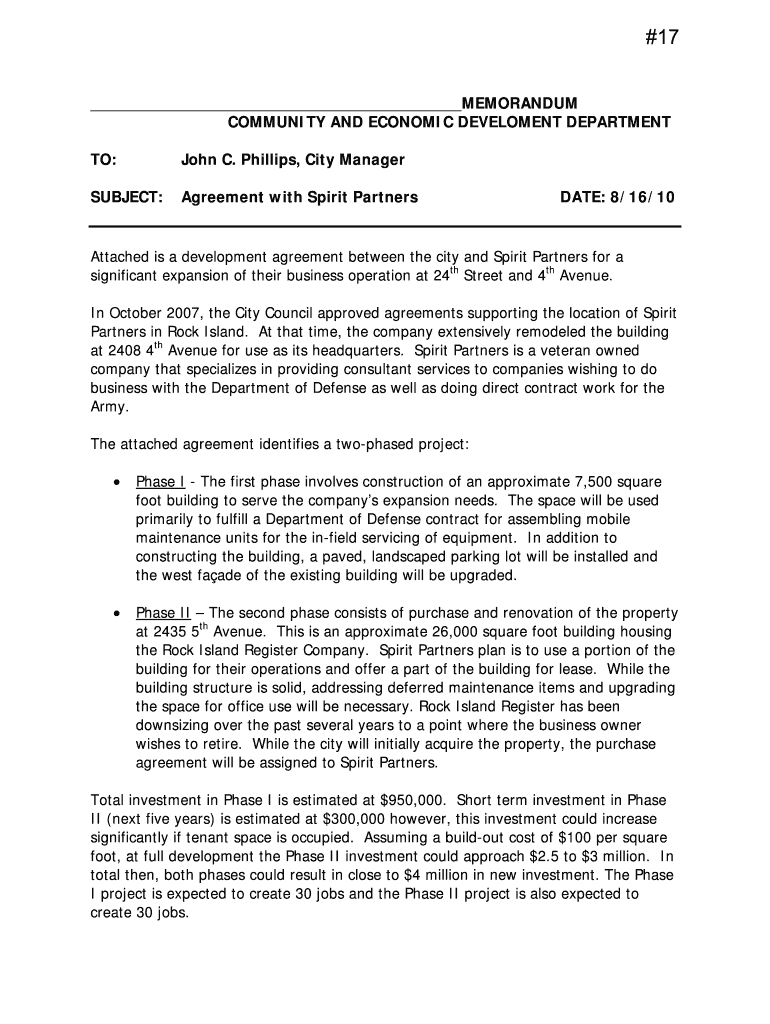
The "Agreement with Spirit Partners" is a formal memorandum detailing a partnership between the City of Rock Island and Spirit Partners to execute a business expansion project. This agreement outlines the roles, responsibilities, and commitments of both parties involved. It consists of two primary phases: Phase I involves the construction of a new building for Department of Defense contracts, while Phase II focuses on the acquisition and renovation of a larger property to support additional operations and leasing activities.
Importance of the Agreement
This agreement serves as a cornerstone for the collaboration aimed at stimulating economic development in Rock Island. With an investment projection of approximately $4 million, the project is set to create around 60 jobs. It highlights the strategic intent of both parties to foster business growth and development within the community through well-defined cooperative efforts.
Key Elements of the Agreement with Spirit Partners
Investment and Financial Commitments
- The agreement includes a total projected investment of about $4 million.
- Financial support from the City involves providing land conveyance, loans, and grants to ensure successful project execution.
- Spirit Partners commits to following through on both phases of the expansion, utilizing the City’s support and resources efficiently.
Construction and Development Phases
- Phase I: Involves constructing a 7,500 square foot facility dedicated to securing Department of Defense contracts. This phase is crucial for establishing an initial operational base.
- Phase II: Focuses on purchasing and renovating a larger property, which will accommodate additional operations and potentially serve a leasing function for other businesses.
Steps to Complete the Agreement with Spirit Partners
- Initial Proposal Development: Draft and refine the project proposal that outlines objectives, expected outcomes, and resource requirements.
- Stakeholder Negotiations: Engage in discussions with City representatives to align project goals with municipal development plans.
- Agreement Drafting: Collaboratively draft the agreement, covering all financial, legal, and operational aspects.
- Approval and Signatures: Obtain necessary stakeholder approvals and legal endorsements before signing the final document.
- Phase Implementation: Start with Phase I of the project, followed by completing obligations for Phase II.
Who Typically Uses the Agreement with Spirit Partners

Targeted Users
- Municipal Authorities: Local government entities use the agreement to foster partnerships and drive economic growth initiatives.
- Private Developers: Companies like Spirit Partners that want to collaborate with public sector entities on community-oriented projects.
- Economic Development Agencies: These entities may use similar agreements to outline mutual objectives and resources earmarked for regional improvements.
Legal Use of the Agreement with Spirit Partners
Regulatory Compliance
The agreement must comply with relevant state and local laws governing business collaborations and public-private partnerships. It adheres to legal standards by ensuring commitments are clearly documented, and all approvals are duly obtained.
Contractual Obligations
- Responsibilities: Explicit roles and responsibilities are outlined for both parties to avoid misunderstandings and ensure project success.
- Binding Terms: The agreement acts as a legally binding commitment, offering recourse in the event of non-compliance by either party.
Important Terms Related to the Agreement
Glossary of Relevant Terms
- Economic Development: Initiatives aimed at improving economic well-being and quality of life for a community.
- Public-Private Partnership (PPP): A cooperative arrangement between public and private sectors.
- Land Conveyance: The transfer of property rights from one entity to another, particularly from the City to a private developer under this agreement.
State-Specific Rules for the Agreement with Spirit Partners
Illinois State Legislation
Given that this agreement involves the City of Rock Island, parties must comply with Illinois state laws related to real estate transactions, public fund usage, and municipal governance. Familiarity with Illinois statutes on public-private partnerships ensures adherence to all legal obligations during both phases of the project.
Examples of Using the Agreement with Spirit Partners
Real-World Scenarios
- Example 1: A municipality aiming to revitalize a downtown area partners with a developer to establish a new tech hub, leveraging agreements similar to the Spirit Partners memorandum to outline mutual investments and returns.
- Example 2: A city collaborates with an educational institution to develop a campus expansion, using an agreement to facilitate property acquisitions and infrastructure development.
Through these examples, the "Agreement with Spirit Partners" underscores the diverse applications of such collaborations in urban and regional development projects.




