




01. Edit your form online
Type text, add images, blackout confidential details, add comments, highlights and more.

Type text, add images, blackout confidential details, add comments, highlights and more.

Draw your signature, type it, upload its image, or use your mobile device as a signature pad.

Send it via email, link, or fax. You can also download it, export it or print it out.
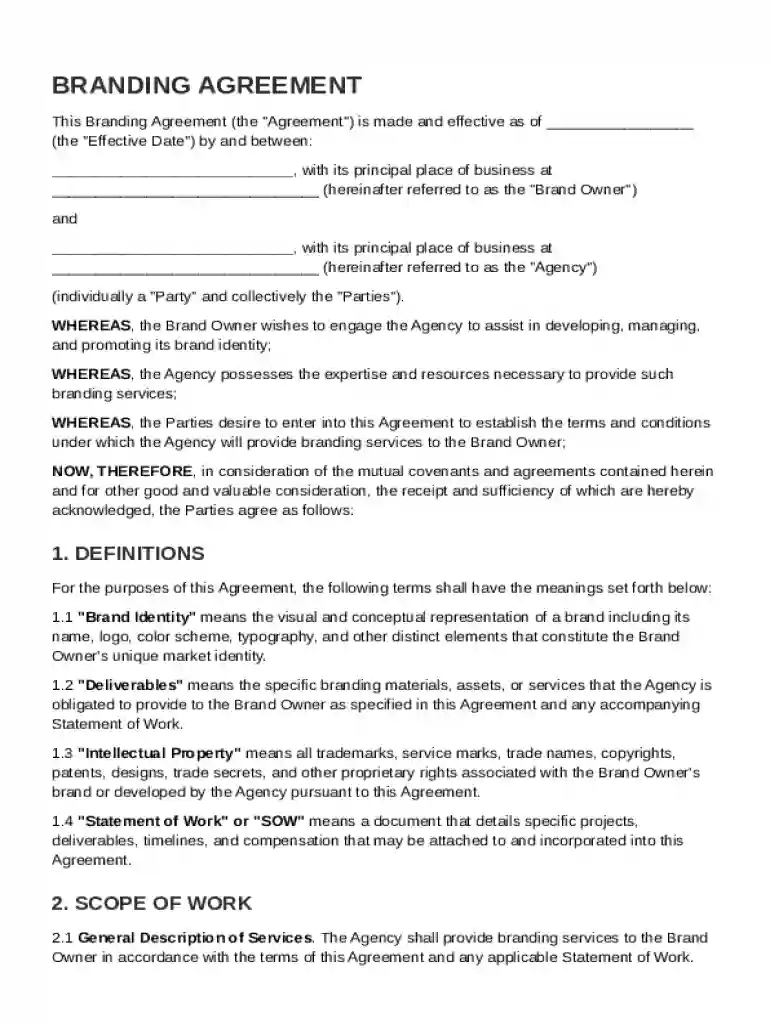
A Branding Agreement Template is a legal document that outlines the terms and conditions between a Brand Owner and an Agency regarding the provision of branding services. This agreement governs the creation and implementation of brand identity, strategy, and creative design elements. It formalizes each party's responsibilities and expectations, ensuring mutual clarity and understanding. By clearly documenting these aspects, the Branding Agreement Template establishes a legal framework that helps prevent potential disputes and fosters a productive working relationship.
The Branding Agreement Template is composed of several key elements that together form the basis of the contractual relationship:
Scope of Work: This section details the specific branding services the Agency will provide, such as logo design, marketing strategies, and visual identity development.
Compensation Structure: It defines how and when the Agency will be compensated for its services. This could involve hourly rates, milestone payments, or a fixed project fee.
Intellectual Property Rights: This crucial element specifies who holds the rights to the creative outputs resulting from the branding services. It ensures that both parties understand the ownership and licensing terms.
Confidentiality Obligations: Here, the agreement addresses the handling of sensitive information exchanged during the project, emphasizing the importance of maintaining confidentiality.
Dispute Resolution Processes: It outlines processes for resolving disputes, often including mediation or arbitration procedures to avoid lengthy legal battles.
Completing a Branding Agreement Template requires careful attention to detail. Follow these steps to ensure all necessary information is accurately captured:
Identify the Parties: Clearly define the Brand Owner and Agency involved, including their official names and contact information.
Define the Project Scope: Detail the specific branding services to be provided, ensuring both parties agree on what the work entails.
Establish Payment Terms: Document the agreed compensation method, payment schedule, and any conditions tied to payment.
Clarify Ownership: Clearly state who will own the resulting intellectual property, and any usage rights or restrictions.
Include Confidentiality Clauses: Highlight how confidential information will be protected during and after the project.
Set Dispute Resolution Terms: Agree on a process for addressing any disputes, considering mediation or arbitration.
Finalize and Sign: Both parties should review the completed document, make necessary amendments, and provide signatures to formalize the agreement.
Understanding the terminology used within a Branding Agreement Template is essential for navigating the document effectively. Key terms and their meanings include:
Brand Identity: A composite of visual elements—such as logos, color schemes, and design that convey the essence and personality of a brand.
Fee Structure: The breakdown of how payment is made, which could be based on hours worked, project completion stages, or a flat fee.
Ownership Rights: Determines who holds the legal rights to the creative outputs produced under the agreement.
Confidential Information: Any non-public information shared between the parties that must be kept private.
Termination Clause: Conditions under which either party may end the agreement before its natural conclusion.
A Branding Agreement Template serves as a legally binding document when executed correctly. It is important to ensure that:
Both parties have the legal capacity to enter into a contract: Only parties with the legal authority can create binding agreements; check the legal status of each party.
The agreement is signed voluntarily: Coercion or undue pressure makes the agreement unenforceable.
The content complies with applicable law: Consult with legal professionals to confirm that the document's terms are within legal mandates specific to branding services.
The document details are accurate and complete: Any missing or incorrect information could undermine the enforceability of the agreement.
The primary users of a Branding Agreement Template include:
Brand Owners: Businesses or individuals looking to develop or enhance their brand identity.
Agencies: Companies or individuals providing professional branding services, including design and strategic consultants.
Freelancers: Independent contractors offering specialized branding services.
Legal Professionals: Lawyers involved in drafting or reviewing agreements to ensure legal compliance.
These users engage with the template to formalize their working relationship, protect their interests, and establish clear expectations from the outset.


Certain types of businesses gain significant advantages from using a Branding Agreement Template:
Startups: Emerging businesses establishing their brand identity and market presence benefit greatly from clearly defined branding terms.
Creative Agencies: Teams offering creative services to multiple clients use the template to standardize agreements and manage client relationships effectively.
Small to Medium Enterprises (SMEs): SME owners looking to rebrand or refresh their market image can use a tailored branding agreement to initiate changes.
E-commerce Brands: Online businesses aiming to improve their competitive edge through branding can leverage the agreement to engage experts in brand development.
Several scenarios illustrate the practical use of a Branding Agreement Template:
A technology startup seeks to establish its brand identity, engaging a design agency to develop visual assets and strategies. The agreement ensures both parties are clear about deliverables, timelines, and ownership of the resulting digital content.
A lifestyle brand collaborates with an external consultant for a rebranding initiative, including market research and creative proposals. The agreement delineates responsibilities and ensures confidentiality of strategic insights.
A creative freelancer undertakes a project to design a new product line's branding for a retail client. The agreement outlines the scope, payment schedule, and intellectual property rights regarding the design work.
Each scenario benefits from the formalized clarity that the Branding Agreement Template provides, facilitating successful project completion and maintaining positive working relationships.
At DocHub, your data security is our priority. We follow HIPAA, SOC2, GDPR, and other standards, so you can work on your documents with confidence.


Branding Principles This document provides guidance to partners on the appropriate use of the VMware logo and visual brand alongside partner branding.
Licensee shall comply with the specifications, standards and directions relating to the Licensed Materials, including their design, manufacture, promotion,


