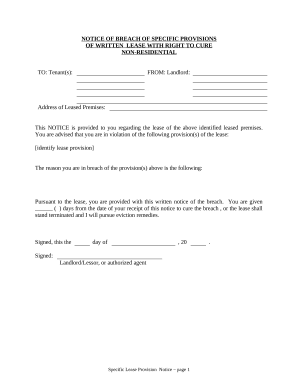
01. Edit your form online
Type text, add images, blackout confidential details, add comments, highlights and more.

Type text, add images, blackout confidential details, add comments, highlights and more.

Draw your signature, type it, upload its image, or use your mobile device as a signature pad.

Send it via email, link, or fax. You can also download it, export it or print it out.
The Letter of Permission for the Release of a Motor Vehicle or Property is a legally binding document that authorizes an individual to take possession of a vehicle or specified property, often stored or impounded by a third party, such as a towing company. This document contains specific details about the vehicle or property, the owner’s identity, and the authorized person, and usually requires notarization to validate its legality.
This form serves as a formal permission slip, allowing a designated person to collect a vehicle or property on behalf of the owner. It is commonly used in instances where the owner cannot personally collect their property due to geographical or personal constraints.
Obtaining this letter involves specific steps which ensure its validity and recognition.
Completing the letter requires attention to detail and adherence to specific protocols.
This letter is crucial in scenarios where direct collection by the owner is unfeasible, ensuring smooth transitions without legal or logistical hiccups.



Understanding the essential components can ensure the form’s effectiveness and acceptance.
Ensuring the form complies with state and federal laws can prevent legal disputes.
Different states might have particular stipulations regarding the form's components and execution.
Practical examples can illustrate typical applications.
We've got more versions of the Letter of Permission for the Release of a Motor Vehicle or Property form. Select the right Letter of Permission for the Release of a Motor Vehicle or Property version from the list and start editing it straight away!
| Versions | Form popularity | Fillable & printable |
|---|---|---|
| 2025 | 4 Satisfied (34 Votes) | |
| 2025 | 4.8 Satisfied (31 Votes) | |
| 2025 | 4.3 Satisfied (34 Votes) | |
| 2025 | 4.2 Satisfied (34 Votes) | |
| 2025 | 4.6 Satisfied (55 Votes) | |
| 2025 | 4.5 Satisfied (44 Votes) | |
| 2025 | 4.2 Satisfied (37 Votes) | |
| 2025 | 4.7 Satisfied (34 Votes) | |
| 2024 | 4.3 Satisfied (21 Votes) | |
| 2024 | 4.6 Satisfied (51 Votes) | |
| 2024 | 4.5 Satisfied (23 Votes) | |
| 2024 | 4.8 Satisfied (29 Votes) | |
| 2024 | 4.1 Satisfied (28 Votes) | |
| 2024 | 4.9 Satisfied (51 Votes) | |
| 2024 | 4.4 Satisfied (31 Votes) |
At DocHub, your data security is our priority. We follow HIPAA, SOC2, GDPR, and other standards, so you can work on your documents with confidence.