




01. Edit your form online
Type text, add images, blackout confidential details, add comments, highlights and more.

Type text, add images, blackout confidential details, add comments, highlights and more.

Draw your signature, type it, upload its image, or use your mobile device as a signature pad.

Send it via email, link, or fax. You can also download it, export it or print it out.
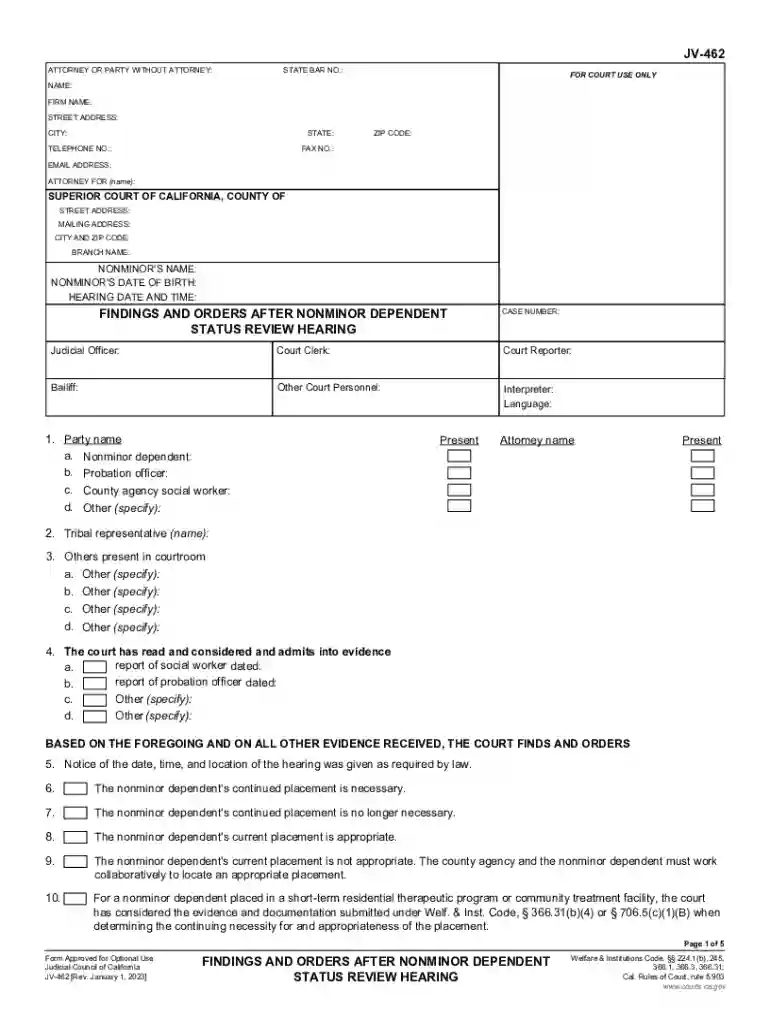
The JV-462 form is an essential document used during Nonminor Dependent Status Review Hearings in the Superior Court of California. It serves as a comprehensive record of the findings and orders from the hearing. This form plays a critical role in outlining the current placement of the nonminor dependent, evaluating their progress towards completing their Transitional Independent Living Case Plan, and assessing the necessity for continued jurisdiction by the juvenile court. By consolidating this information, the form helps ensure that the court can make informed decisions regarding the nonminor's future support and status.
Filling out the JV-462 requires careful attention to detail to ensure accuracy and compliance. The following steps outline how to effectively complete the form:
Gather Necessary Information: Before starting, collect all relevant data, including details about the nonminor's current placement, progress reports, and any pertinent evidence that needs to be addressed in the hearing.
Fill in Personal Details: Enter the personal information of the nonminor, such as their name, date of birth, and case number. Ensure that the spelling and case number are accurate, as these details are crucial for identification purposes.
Document Current Placement: Provide a detailed description of the current living situation of the nonminor. This includes the location, type of placement, and any related observations.
Assess Progress Towards Goals: Include an evaluation of how the nonminor is advancing towards meeting the goals set in their Transitional Independent Living Case Plan.
Outline Court Orders: Record any orders issued by the court during the hearing. These may pertain to changes in placement, required services, or continued jurisdiction.
Review and Confirm: Double-check the form for completeness and accuracy. Confirm all sections are filled correctly before submitting to ensure there are no delays in processing.
The JV-462 form is not just an administrative tool; it has several legal implications that stakeholders must observe:
Compliance with Juvenile Court Procedures: The form ensures adherence to the proper legal framework required by the California juvenile court system.
Documentation of Court Decisions: By recording the court's findings and orders, the JV-462 provides a legally binding document that impacts the nonminor's continued court jurisdiction and support arrangements.
Evidence Presentation: It serves as a formal platform for presenting evidence considered during the hearing, ensuring all relevant data is officially recorded.
Understanding the terminology associated with the JV-462 is crucial for accurate completion and comprehension of the form:
Nonminor Dependent: An individual typically between the ages of eighteen and twenty-one who is under the jurisdiction of the juvenile court due to specific circumstances.
Transitional Independent Living Case Plan: A customized plan developed to assist the nonminor dependent in acquiring the skills and support necessary for independent living.
Jurisdiction: Refers to the court's authority to continue providing oversight and support to the nonminor dependent.
Several critical components must be addressed within the JV-462 form:
Placement Details: Comprehensive information about where and how the nonminor is currently residing.
Progress Updates: A detailed account of the nonminor's achievements and setbacks concerning their personalized goals.
Court Orders: Specific decisions and directives issued by the court that influence the nonminor's support and future proceedings.
The JV-462 form is primarily utilized by a range of stakeholders involved in the juvenile court process:
Juvenile Court Judges: To formally document findings and decrees.
Social Workers: To provide updates and insights into the nonminor's progress and placement.
Attorneys: To offer legal insights and ensure the dependent's rights and needs are represented.


Usage of the JV-462 is governed by unique regulations within California:
California-Specific Guidelines: The form is tailored to meet the specific legal standards and requirements of the California juvenile court system, ensuring compliance with state laws.
Procedural Variances: Differences in how various regions within California may interpret or apply the guidelines, requiring familiarity with localized judicial processes.
Consider how the JV-462 is used in practical scenarios:
Case Study 1: A nonminor transitioning from foster care, using the JV-462 to document progress towards independent living.
Case Study 2: The reassessment of placement due to changes in the nonminor's circumstances, as recorded in the JV-462.
Understanding these examples highlights the form's role in facilitating structured and legally compliant review processes.
Submitting the JV-462 can be done through different channels:
Online: The form can be filled and submitted electronically through designated court e-filing systems, providing efficiency and convenience.
Mail: Alternatively, the completed form can be mailed to the appropriate court address, ensuring it reaches the right department.
In-Person: For those who prefer traditional methods, forms can also be submitted in person at the courthouse.
Each option provides flexibility to meet the varying needs and resources available to users.
We've got more versions of the Jv-462 form. Select the right Jv-462 version from the list and start editing it straight away!
At DocHub, your data security is our priority. We follow HIPAA, SOC2, GDPR, and other standards, so you can work on your documents with confidence.


