




01. Edit your form online
Type text, add images, blackout confidential details, add comments, highlights and more.

Type text, add images, blackout confidential details, add comments, highlights and more.

Draw your signature, type it, upload its image, or use your mobile device as a signature pad.

Send it via email, link, or fax. You can also download it, export it or print it out.
The Hastings Natural History Reservation is a field station associated with the University of California, Berkeley. It serves as a vital location for ecological and biological research and provides opportunities for researchers and students to study natural habitats and ecosystems in detail.
Location and Purpose: Situated in the Carmel Valley, the reservation allows scientists to observe and research natural landscapes, focusing on long-term studies of plant and animal populations. The station's purpose is to enhance scientific understanding of biodiversity and ecological processes.
Research Activities: Researchers conduct various studies, including the effects of climate change on local flora and fauna, interactions between different species, and ecosystem monitoring. Its diverse environment offers a living laboratory for scientific inquiry and education.
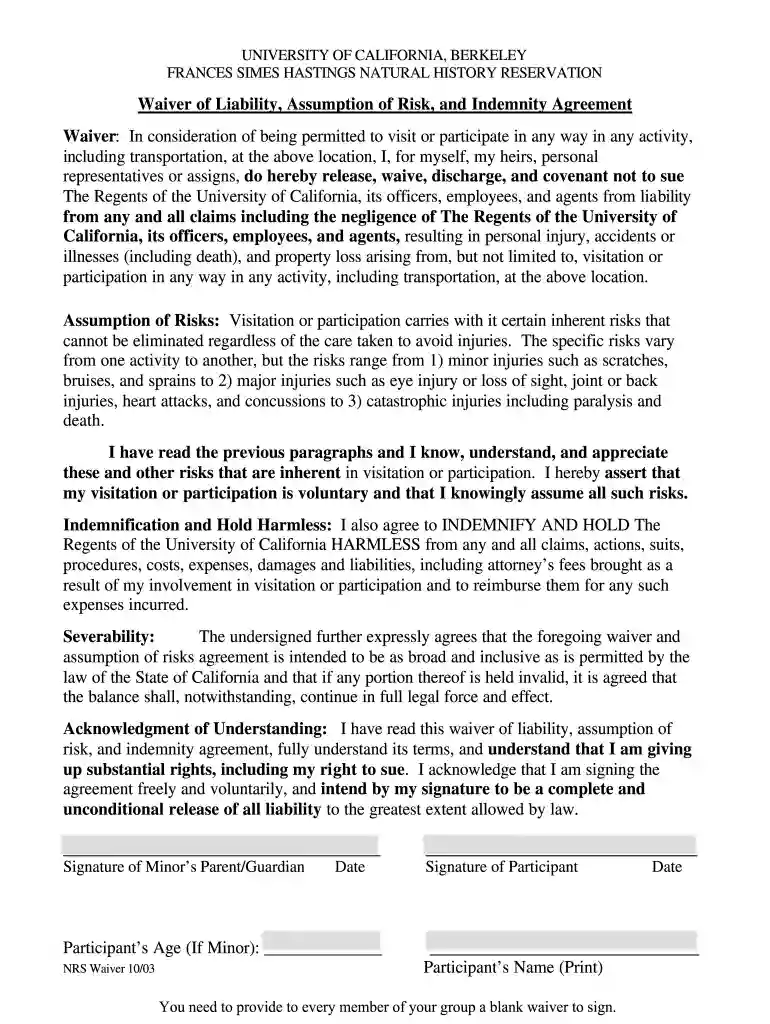
Participants visiting the Hastings Natural History Reservation are required to sign a Waiver of Liability, Assumption of Risk, and Indemnity Agreement. This document outlines the potential risks and responsibilities involved in engaging with activities on-site.
Risk Acknowledgment: Individuals are made aware of the inherent risks associated with research and field activities. These can include exposure to wildlife, uneven terrain, and natural phenomena, which may pose health and safety concerns.
Liability Release: By signing the waiver, participants agree to release the University of California, Berkeley, from liability in the event of injury or damage arising from their involvement at the reservation. This is crucial for legal protection and supports the institution in maintaining operational integrity.
Indemnity Clause: The agreement includes a term where visitors must indemnify the university against claims related to their activities at the site, ensuring that the institution is safeguarded against potential legal disputes resulting from participant actions.
To legally participate in activities at the Hastings Natural History Reservation, potential researchers and students must fulfill specific steps in the agreement process.
Review the Document: Thoroughly read the waiver to understand all terms, conditions, and potential risks before proceeding with any activities at the reservation.
Sign the Waiver: Participants must provide their signature to confirm their understanding and acceptance of the terms outlined in the waiver. This can often be done digitally or on-site, ensuring all documentation is in place prior to any fieldwork.
Submit Required Documents: Ensure all necessary documentation, such as identification and confirmation of research affiliation, is provided to the reservation authorities.
Final Approval: The signed waiver and supplementary documents are reviewed by the reservation administration. Approval allows the participant to engage in specified research activities under the agreed terms.
Access to the Hastings Natural History Reservation is typically granted to individuals affiliated with educational or scientific research institutions, particularly within the University of California system.
Research Affiliation: Applicants must demonstrate a legitimate research proposal or educational purpose. This ensures the reservation’s resources are utilized for their intended academic and scientific objectives.
Approval from Faculty Advisors: Students and researchers generally require endorsement or sponsorship from a faculty member or research advisor, confirming that their proposed work aligns with the reservation’s policies and goals.


The Hastings Natural History Reservation is a resource primarily for researchers, students, and educators from various disciplines focused on ecology, biology, and environmental science.
University Affiliates: Individuals associated with UC Berkeley, along with other academic institutions, often leverage the site for their field studies and scholarly work.
Collaborative Research Teams: Cross-institutional teams frequently collaborate on projects that benefit from the unique natural environment and biodiversity found at the reservation.
Significant research has been conducted at the Hastings Natural History Reservation, contributing valuable knowledge to the fields of ecology and environmental science.
Climate Impact Studies: Longitudinal research on how climate variables are affecting local species has provided insights into adaptation and resilience.
Species Interaction: Studies focusing on predator-prey dynamics have been instrumental in understanding ecological balance and evolutionary change.
Habitat Conservation: Efforts to monitor and preserve native habitats have been guided by data and findings from extensive fieldwork, influencing conservation policies.
Engaging with the Hastings Natural History Reservation includes adhering to legal protocols as mandated by the University of California, Berkeley.
Compliance with University Policies: Participants must follow UC Berkeley's rules related to safety, research ethics, and environmental preservation to maintain access rights.
Adherence to State and Federal Regulations: Researchers are required to comply with broader legal standards regarding wildlife protection, data collection, and fieldwork ethics, ensuring all activities are legally sound and scientifically valid.
While the primary waiver form is standard, variations may exist depending on specific research activities or participant categories.
Customized Agreements: Certain projects might necessitate tailored agreements to address unique risks or responsibilities specific to the research conducted.
Submission Flexibility: The waiver can typically be submitted digitally or in paper form, providing accessibility for participants from different locations and technological capabilities.
Understanding the nuances and requirements of the Hastings Natural History Reservation participation waiver empowers researchers and students to engage responsibly and effectively with this invaluable natural resource.
We've got more versions of the Hastings Natural History ReservationResearch UC Berkeley form. Select the right Hastings Natural History ReservationResearch UC Berkeley version from the list and start editing it straight away!
| Versions | Form popularity | Fillable & printable |
|---|---|---|
| 2025 | 4 Satisfied (34 Votes) | |
| 2025 | 4.8 Satisfied (31 Votes) | |
| 2025 | 4.3 Satisfied (34 Votes) | |
| 2025 | 4.2 Satisfied (34 Votes) | |
| 2025 | 4.6 Satisfied (55 Votes) | |
| 2025 | 4.5 Satisfied (44 Votes) | |
| 2025 | 4.2 Satisfied (37 Votes) | |
| 2025 | 4.7 Satisfied (34 Votes) | |
| 2024 | 4.3 Satisfied (21 Votes) | |
| 2024 | 4.6 Satisfied (51 Votes) | |
| 2024 | 4.5 Satisfied (23 Votes) | |
| 2024 | 4.8 Satisfied (29 Votes) | |
| 2024 | 4.1 Satisfied (28 Votes) | |
| 2024 | 4.9 Satisfied (51 Votes) | |
| 2024 | 4.4 Satisfied (31 Votes) |
At DocHub, your data security is our priority. We follow HIPAA, SOC2, GDPR, and other standards, so you can work on your documents with confidence.


