
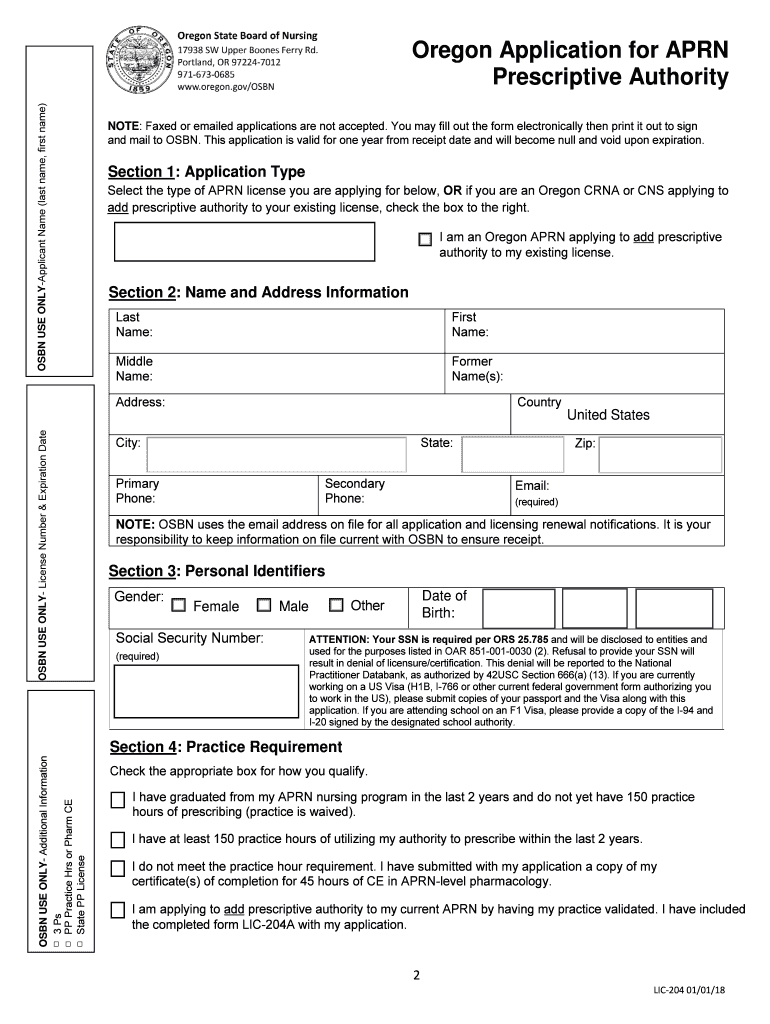







Definition and Purpose of the Oregon Application for Initial Nurse Practitioner
The Oregon Application for Initial Nurse Practitioner is a vital document required for nurse practitioners seeking initial licensure in Oregon. This form is an integral part of the licensing process overseen by the Oregon State Board of Nursing (OSBN). By submitting this application, candidates affirm their readiness to practice as an advanced practice registered nurse (APRN) with prescriptive authority, adhering to state regulations and professional standards.
Nurse practitioners use this form to confirm they have met educational, experiential, and examination requirements, which are prerequisites for practice in Oregon. It's not merely a procedural form; it establishes a formal request for authority to engage in patient care services, including prescription privileges. Understanding the importance of this application is critical for anyone preparing to advance their career in the healthcare field within Oregon.
Important Terms Related to the Application Process
When dealing with the Oregon Application for Initial Nurse Practitioner, several key terms frequently appear, each with specific meanings:
- Advanced Practice Registered Nurse (APRN): A registered nurse who has acquired advanced clinical education and skills in specific areas of patient care.
- Prescriptive Authority: The legal permission enabling nurse practitioners to prescribe medications and other treatments.
- Oregon State Board of Nursing (OSBN): The governing body responsible for licensing nurse practitioners and ensuring adherence to professional standards within the state.
Understanding these terms is crucial as they form the foundational language that outlines professional expectations and regulatory requirements for applicants.
Eligibility Criteria for Obtaining a Nurse Practitioner License in Oregon
To qualify for a nurse practitioner license via the Oregon Application for Initial Nurse Practitioner, candidates must meet a set of stringent eligibility criteria:
-
Education: Applicants must hold a graduate degree from a nurse practitioner program accredited by a national accrediting body recognized by OSBN.
-
Certification: National certification in the nurse practitioner’s specialty area is mandatory. Accepted certifying bodies include the American Nurses Credentialing Center (ANCC) and the American Association of Nurse Practitioners (AANP).
-
Experience: A specific number of practice hours may be required, verified either during the educational program or post-certification clinical experience, depending on the area of specialization.
-
Background Check: An essential part of the application involves undergoing a comprehensive background check, ensuring that practitioners have no criminal history that might bar them from patient care responsibilities.
Meeting these criteria is essential for successful application approval and subsequent practice within Oregon.


Steps to Complete the Oregon Application for Initial Nurse Practitioner
Completing the Oregon Application for Initial Nurse Practitioner involves meticulous attention to detail across several steps:
-
Gather Necessary Documents: Ensure you have all required documents, including proof of graduation, national certification, and any additional documentation requested by OSBN.
-
Complete the Form: Accurately fill out all sections of the application form, ensuring no fields are left blank unless specified as optional.
-
Submit Fees: Include the appropriate fee, which covers both the application processing and background check.
-
Submit to OSBN: Applications can be submitted online or mailed directly to OSBN. Confirmation of receipt will typically be issued by the board.
-
Track the Application: Regularly check the status of your application to ensure timely processing and respond to any requests for additional information.
Completing these steps efficiently aids in reducing potential delays in the application approval process.
Required Documents for Submission
Applicants must submit several essential documents with their Oregon Application for Initial Nurse Practitioner:
- Proof of Education: Copies of transcripts confirming graduation from an accredited nurse practitioner program.
- Certification Verification: Proof of national certification in the relevant specialty area.
- Identification: Government-issued identification for verification purposes, such as a driver's license or passport.
- Fingerprinting and Background Check Authorization: Completed forms that allow OSBN to conduct a background check.
Submitting these documents accurately ensures compliance with OSBN requirements, facilitating a smoother application process.
Form Submission Methods: Options Available to Applicants
The versatility in submission methods for the Oregon Application for Initial Nurse Practitioner accommodates different preferences and logistical needs:
- Online Submission: The primary method recommended by OSBN, allowing for more expedited processing and immediate confirmation of receipt.
- Mail Submission: Applicants may choose to send completed forms and documents via traditional mail to OSBN, requiring postal tracking for security.
Each method requires careful adherence to submission guidelines to prevent misplacement or processing delays.
Application Process and Approval Time
The application process for the Oregon Application for Initial Nurse Practitioner is robust, and candidates should be aware of the following timeframes:
- Processing Period: Typically, the OSBN processes applications within four to six weeks, though times may vary based on complexity.
- Approval Notification: Applicants receive notification via email or postal mail regarding the outcome of their application, delineating either licensure production or a request for additional documentation.
Understanding these timelines helps applicants manage expectations and plan for their transition into practice without unnecessary disruptions.
Legal Use and Compliance Expectations
Legally, obtaining an initial nurse practitioner license via the Oregon Application for Initial Nurse Practitioner subjects the holder to specific regulatory and compliance expectations:
- Adherence to Prescriptive Authority Guidelines: Nurse practitioners must operate within the bounds of established prescriptive authority, ensuring ethical and lawful practice.
- Ongoing Education: Continuous professional development through approved courses is often required to maintain licensure and stay current with healthcare innovations and protocols.
Navigating these legal and compliance frameworks is essential for maintaining good standing as a licensed practitioner in Oregon.




