
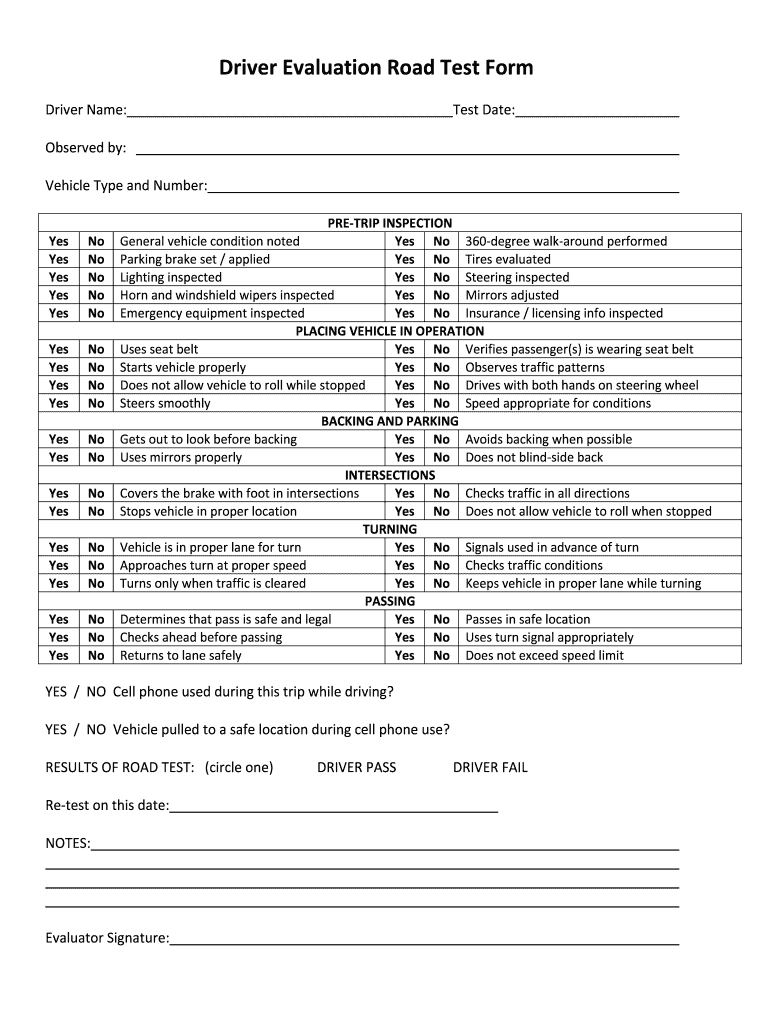







Definition and Meaning of the Driver Road Test Form
The driver road test form is an official document used primarily to assess an individual's driving skills and safety practices during a practical road test. This form plays a pivotal role in evaluating competence behind the wheel and includes various sections that focus on essential driving skills. These sections encompass not only the pre-trip inspection and vehicle operation but also the execution of maneuvers such as backing, turning, passing, and parking. The evaluator records observations to determine whether the applicant passes or fails the test.
The document serves multiple purposes:
- Assessment Tool: It helps driving examiners objectively evaluate a candidate's ability to operate a vehicle safely.
- Record Keeping: It maintains a formal record of the evaluation, which can be referenced in the future if required.
- Legal Compliance: It supports compliance with local and state regulations regarding driver testing and licensing.
Steps to Complete the Driver Road Test Form
Completing the driver road test form involves several key steps. These steps ensure that all relevant information is gathered, facilitating a thorough evaluation of the candidate's driving skills.
-
Pre-Test Preparation
- Ensure that the vehicle is in good working condition, which includes checking tire pressure, brakes, lights, and fluid levels.
- The candidate should have valid identification and any necessary permits.
-
Initial Review
- The evaluator introduces the form to the candidate, explaining the importance of each section.
- Review any specific state requirements or additional sections that might be included.
-
Conducting the Road Test
- The candidate is observed performing various maneuvers. Evaluators typically assess:
- Backing and Parking: Ability to reverse safely and park in designated areas.
- Intersections and Turning: Judgement at stop signs and lights, as well as safe lane changes.
- Passing and Speed Control: Compliance with speed limits and safe passing procedures.
- The candidate is observed performing various maneuvers. Evaluators typically assess:
-
Recording Observations
- The evaluator documents observations within the relevant sections of the form, noting both positive habits and areas needing improvement.
-
Final Assessment
- After the test, the evaluator summarizes the performance and records whether the candidate passes or fails.
- The candidate receives feedback based on their performance.
How to Use the Driver Road Test Form
Using the driver road test form correctly is essential for an objective and comprehensive evaluation of driving competency.
-
Filling Out Information: The evaluator should ensure that all sections of the form are completed with accurate and detailed observations. This includes demographic information about the candidate, the vehicle used, and specific skills assessed during the test.
-
Feedback and Sign-Off: After the test, evaluators should provide constructive feedback, highlighting strengths and areas for improvement. This feedback should be documented on the form itself.
-
Maintenance of Records: The completed form should be stored safely for future reference, as it may be needed for official licensing or verification purposes.
Key Elements of the Driver Road Test Form
Understanding the essential components of the driver road test form is crucial for both evaluators and candidates. Key elements typically include:
- Pre-Trip Inspection Section: This portion evaluates the candidate's understanding of vehicle safety before departure.
- Performance Evaluation Areas: These encompass various driving tasks such as:
- Vehicle operation
- Backing and parking techniques
- Approaching and navigating intersections
- Turning safely and effectively
- Speed management and passing techniques
- Comments Section: An area for evaluators to provide specific observations or recommendations.
These elements ensure a thorough assessment process and enhance the objectivity and usefulness of the form.
Who Typically Uses the Driver Road Test Form
The driver road test form is utilized by several stakeholders:
- Driving Schools: Instructors use this form to grade student performance during practical examinations.
- Government Licensing Authorities: Officially licensed evaluators rely on this document to ensure that candidates meet the required standards for obtaining a driver's license.
- Fleet Companies: These organizations may use similar forms to evaluate new drivers as part of their hiring processes.
Understanding who utilizes the form can help clarify its importance in maintaining roadway safety standards and preparing competent drivers.


Important Terms Related to the Driver Road Test Form
Familiarity with essential terms related to the driver road test form is beneficial for both evaluators and candidates:
- Evaluator: The individual responsible for conducting the road test and assessing the candidate's driving skills.
- Candidate: The person taking the road test, seeking to demonstrate their driving competency.
- Pass/Fail Criteria: Standards used to determine if the candidate meets the necessary skills for safe driving.
- Pre-Trip Inspection: The assessment of a vehicle's condition before beginning the driving test.
Such terms not only enhance clarity but also support better communication among all parties involved in the road testing process.
State-Specific Rules for the Driver Road Test Form
The rules governing the driver road test form can vary significantly from state to state. Understanding these differences is crucial for both candidates and evaluators:
- Documentation Requirements: Certain states may require additional forms or documents to be submitted along with the driver road test form.
- Testing Procedures: Variations exist in how road tests are conducted, including the specific skills evaluated, test duration, and scoring systems.
- Age and Permit Regulations: Different states have specific age requirements for obtaining permits and licenses, which can affect when a candidate takes the road test.
Being aware of these state-specific rules helps ensure compliance and enhances the testing experience.
Examples of Using the Driver Road Test Form
Real-world scenarios illustrate the application of the driver road test form effectively:
- New Drivers: A teenager applying for their first driver's license undergoes a road test where an evaluator uses the form to assess familiarity with vehicle controls and road regulations.
- Professional Driver Evaluations: A trucking company evaluates a candidate applying for a commercial driving position. The driver road test form aids in assessing the candidate's ability to navigate larger vehicles and handle specific road challenges.
- State Licensing Agencies: An official licensed examiner utilizes the form to ensure candidates demonstrate all required driving skills, helping maintain safety on the road.
These examples highlight the practical importance of the driver road test form in various contexts.




