




Here's how it works

01. Edit your dochub com fillable form online
Type text, add images, blackout confidential details, add comments, highlights and more.

02. Sign it in a few clicks
Draw your signature, type it, upload its image, or use your mobile device as a signature pad.

03. Share your form with others
Send subpoena via email, link, or fax. You can also download it, export it or print it out.
How to use or fill out subpoena template word with our platform

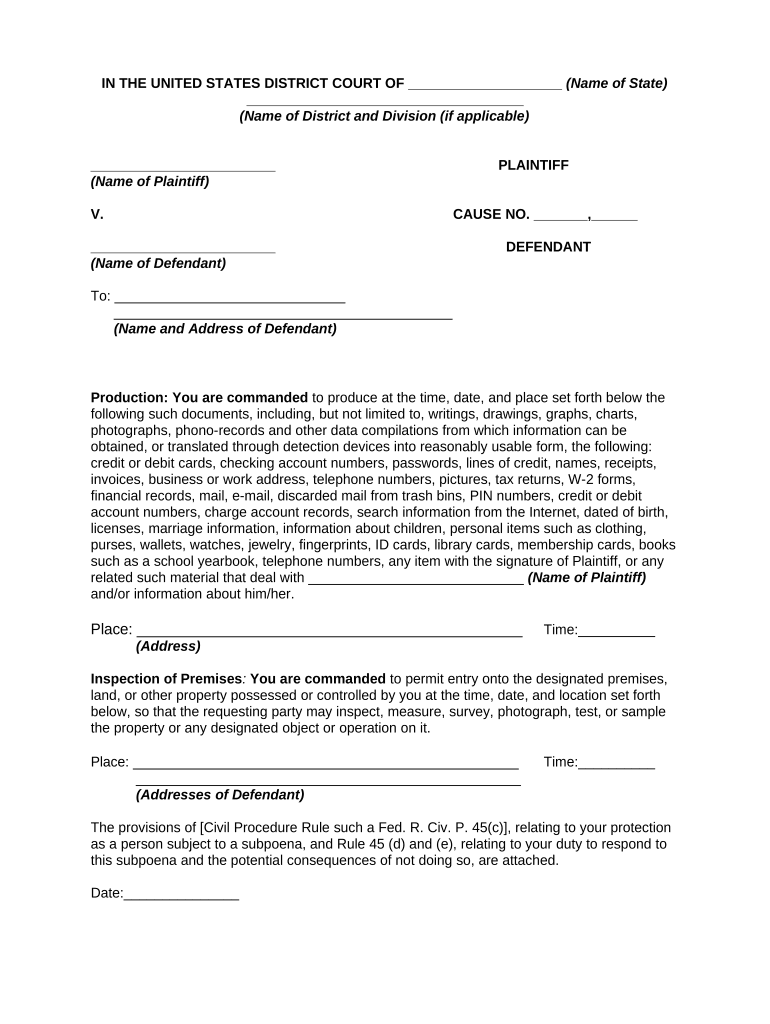
- Click ‘Get Form’ to open the subpoena template in the editor.
- Begin by filling in the name of the state and district at the top of the form. This is crucial for jurisdiction.
- Enter the names of both the plaintiff and defendant in their respective sections, along with the cause number.
- In the 'To' section, provide the name and address of the defendant who is being commanded to produce documents.
- Detail what documents are required from the defendant under 'Production'. Be specific about each item needed.
- Fill in the place and time for document production, ensuring it aligns with legal requirements.
- Complete any additional sections regarding inspection of premises if applicable, including addresses and times.
- Finally, sign off on the document as either a Clerk or Plaintiff’s Attorney, providing contact information as necessary.
Start using our platform today to easily fill out your subpoena template for free!
Fill out subpoena template word online
It's free
See more subpoena template word versions
We've got more versions of the subpoena template word form. Select the right subpoena template word version from the list and start editing it straight away!
| Versions | Form popularity | Fillable & printable |
|---|---|---|
| 2020 | 4.9 Satisfied (42 Votes) |
Got questions?
We have answers to the most popular questions from our customers. If you can't find an answer to your question, please contact us.
Contact us
Can people refuse a subpoena?
Failure to respond to a subpoena is punishable as contempt by either the court or agency issuing the subpoena. Punishment may include monetary sanctions (even imprisonment although extremely unlikely).
What is the rule of 45?
Heres what it is: After researching a number of our clients with revenues greater than $5MM, we discovered that your topline year-over-year growth rate as a percentage, plus your earnings before interest, taxes, depreciation, and amortization (EBITDA) as a percentage of revenue, should not exceed 45 percent if you
How many miles is a Rule 45 subpoena?
Federal Rule of Civil Procedure (FRCP) 45(c) restricts federal courts powers to compel testimony from a third-party witness in civil litigation to locations: (1) within 100 miles of where the person resides, is employed, or regularly transacts business in person; or (2) within the state of residence, employment,
Can a regular person file a subpoena?
Federal Judicial Subpoenas Any person who is at least 18 years old and not a party may serve a subpoena. Serving a subpoena requires delivering a copy to the named person and, if the subpoena requires that persons attendance, tendering the fees for 1 days attendance and the mileage allowed by law.
What is the rule 45 for subpoenas?
Personal Service: Pursuant to FRCP Rule 45(b)(1) a subpoena must be personally delivered to the person whose attendance is required by the subpoena. A person who serves the subpoena must be at least 18 years of age. A person who serves the subpoena cannot be a party to the proceeding under which the subpoena is issued.
Security and compliance
At DocHub, your data security is our priority. We follow HIPAA, SOC2, GDPR, and other standards, so you can work on your documents with confidence.
Learn more


People also ask
How do you write a subpoena for a document?
Heres how: Complete the subpoena form. Prepare a declaration under penalty of perjury. Briefly describe the documents you need and why they are necessary to prove issues involved in the case. Have a subpoena issued by the small claims clerk.
What is the 100 mile rule for subpoenas?
A subpoena may command: (A) production of documents, electronically stored information, or tangible things at a place within 100 miles of where the person resides, is employed, or regularly transacts business in person; and (B) inspection of premises at the premises to be inspected.
How long does it take to respond to a rule 45 subpoena?
Civ. Proc. 45(3)(a). Rule 45 does not define unreasonable time for compliance; however, courts tend to hold seven days or less as unreasonable, and 14 days or more as presumptively reasonable.