

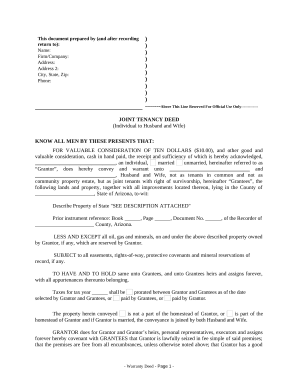
Increase your production with Joint Tenancy Deeds
Document managing consumes to half of your office hours. With DocHub, you can reclaim your time and effort and boost your team's productivity. Access Joint Tenancy Deeds online library and investigate all form templates relevant to your daily workflows.
Easily use Joint Tenancy Deeds:
- Open Joint Tenancy Deeds and apply Preview to obtain the appropriate form.
- Click on Get Form to begin working on it.
- Wait for your form to open in our online editor and start modifying it.
- Add new fillable fields, symbols, and pictures, change pages order, etc.
- Fill out your form or set it for other contributors.
- Download or deliver the form by link, email attachment, or invite.
Improve your daily file managing with the Joint Tenancy Deeds. Get your free DocHub profile today to explore all templates.
Video Guide on Joint Tenancy Deeds management

Commonly Asked Questions about Joint Tenancy Deeds
What is the downside to joint tenancy?
Joint Tenancy Has Some Disadvantages They include: Control Issues. Since every owner has a co-equal share of the asset, any decision must be mutual. You might not be able to sell or mortgage a home if your co-owner does not agree. Creditor Issues.
Which is an advantage of joint tenancy?
The most docHub advantage of joint tenancy is the right of survivorship. When one owner dies, their interest in the property automatically passes to the surviving joint tenant(s), bypassing the probate process.
Why is a joint tenancy better than a tenancy in common?
Key Takeaways: Joint tenants have equal property ownership, share profits and liabilities, and often have a right of survivorship. Tenants in common can have unequal shares, lack a right of survivorship, and can pass their share to chosen beneficiaries.
What is a disadvantage of joint tenancy ownership?
If a co-owner has outstanding debts, their creditors could seize an interest in your home or bank account. Relationship Issues. Holding an asset jointly can complicate a divorce or other relationship problems. If you have a jointly held bank account, your co-owner could withdraw all of the money without your consent.
What is better, joint tenants or tenants in common?
As a (very) general rule of thumb, joint tenancy usually suits married couples, while tenants in common is more applicable to those who are buying as a group but wish to maintain a degree of separation between themselves and their co-owners.
What is a primary benefit of property held in joint tenancy?
Some of the main benefits of joint tenancy include avoiding probate courts, sharing responsibility, and maintaining continuity. The primary pitfalls are the need for agreement, the potential for assets to be frozen, and loss of control over the distribution of assets after death.
What are the rules for joint tenancy in California?
Joint Tenancies are co-ownership interest in real property. A Joint Tenancy must include these four unities: Unity of interest: The interest of each owner is equal. Unity of time: The interest of the owners is acquired at the same time. Unity of possession: The owners have the right of survivorship.
Which is a key difference between tenancy in common and joint tenancy?
A critical difference between tenancy in common and joint tenancy is the absence of the right of survivorship in a tenancy in common when a tenant in common dies, their interest in the property passes to their heirs or designated beneficiaries, as outlined in their will or state intestacy laws, rather than