




01. Edit your metro access application online
Type text, add images, blackout confidential details, add comments, highlights and more.

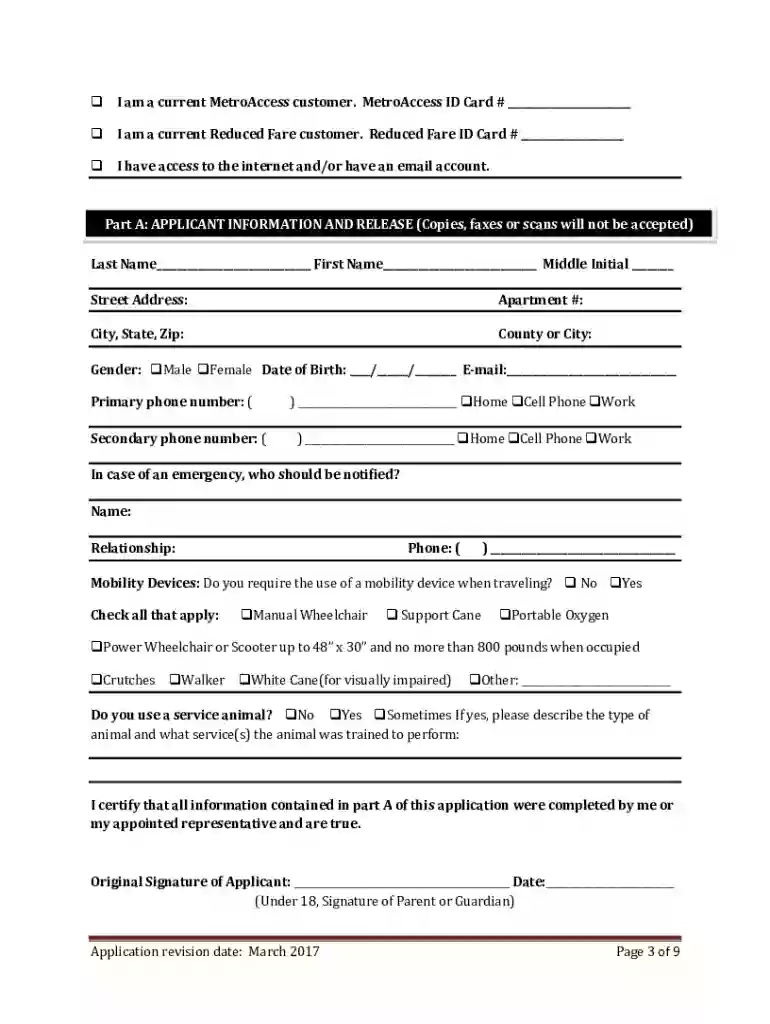
Type text, add images, blackout confidential details, add comments, highlights and more.

Draw your signature, type it, upload its image, or use your mobile device as a signature pad.

Send metro access via email, link, or fax. You can also download it, export it or print it out.
The metro access application is a formal request for Door-to-Door Paratransit Service designed for individuals with disabilities who find it challenging to use standard public transportation. This service primarily serves those who cannot navigate the regular transit system, providing essential support and mobility options. The application is essential for determining eligibility and ensuring that users can access transportation that meets their needs.
The process of obtaining the metro access application is straightforward and can be accomplished in several ways. Individuals seeking the service can access the form through various channels.
Completing the metro access application requires careful attention to detail and adherence to specified guidelines. Below is a structured breakdown of the steps involved:
Gather Required Documentation:
Fill Out the Application Form:
Review for Completeness: Ensure all questions are answered and documentation is attached. Missing information can lead to processing delays.
Submit the Application: Decide on the submission method (online, by mail, or in-person) and send the application accordingly.
Follow Up: After submission, it can be beneficial to check on the application status to ensure it is being processed and to address any potential issues that may arise.
The metro access application consists of several vital components that need to be completed accurately for successful approval. These elements are crucial in assessing eligibility and ensuring the application meets the necessary criteria.
Understanding the eligibility criteria for the metro access application is vital for prospective users to ensure they qualify for the service. The following criteria generally apply:


To facilitate a smooth submission process for the metro access application, several documents need to be prepared and submitted alongside the form. These documents are:
By ensuring all required documents are collected in advance, applicants can expedite the review process and increase their chances of timely approval.
We've got more versions of the metro access application form. Select the right metro access application version from the list and start editing it straight away!
At DocHub, your data security is our priority. We follow HIPAA, SOC2, GDPR, and other standards, so you can work on your documents with confidence.
The Americans with Disabilities Act (ADA) outlines specific criteria to determine eligibility for paratransit service and an application and in-person.Read more
Aug 1, 2019 Metro Access is a door-to-door, shared-ride, public paratransit service for people with disabilities who are unable to use regular,Read more
The SM 240 complements the larger SM 480 to form a complete metro core to metro access solution. It leverages the same hardware and software components.Read more


