






What the Authorization Form Means
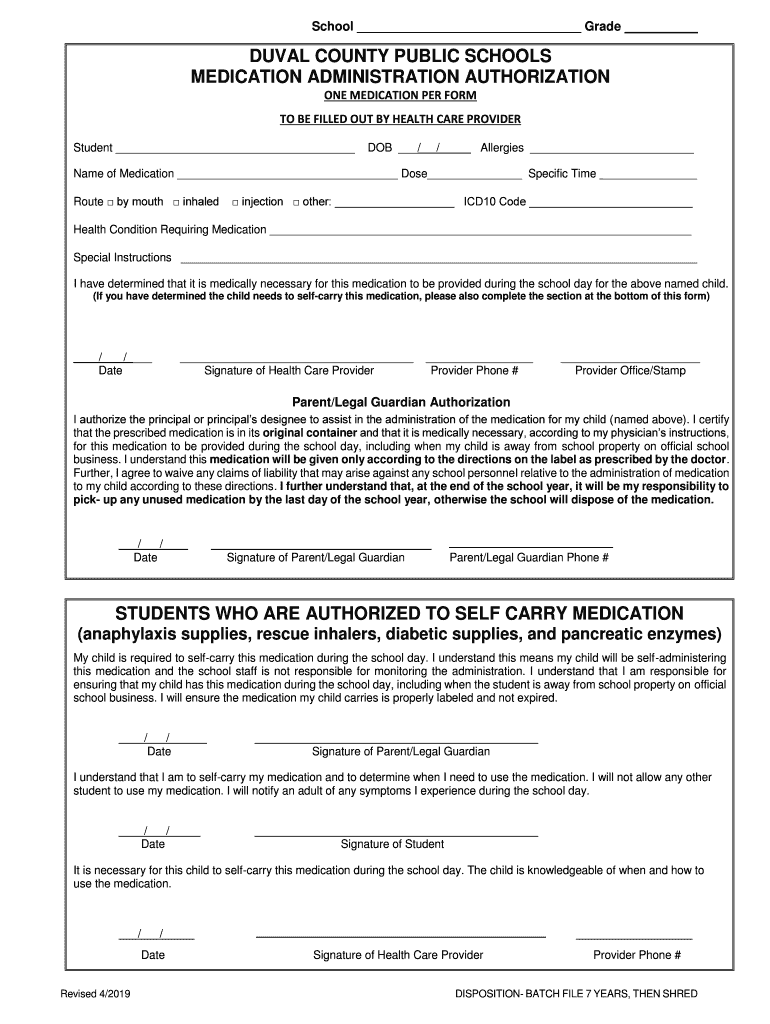
The Duval County Medication Administration Authorization is a school health form that gives Duval County Public Schools permission to administer medication to a student during the school day. It is typically completed by a licensed health care provider and signed by a parent or guardian when required, depending on the medication and school policy. The form helps the school document exactly what medication a student may receive, how much should be given, when it should be administered, and under what conditions it should be withheld.
In practical terms, this form reduces guesswork for school staff. A nurse, clinic assistant, or other authorized staff member can follow the written instructions instead of relying on verbal directions, which helps protect student safety and supports consistent care. The form is especially important for students who need daily medication, emergency medications, or treatment during school hours, field trips, or after-school programs.
The authorization is usually tied to one medication per form, which makes the instructions clear and easier to follow. That structure matters when a student takes several medications, because each one may have a different dose, schedule, route, and safety warning. For example, a child who takes an asthma inhaler and an antibiotic may need two separate authorizations so the instructions are not mixed together.
The form also serves as a record for the school district. If a parent asks how a medication was handled, or if staff later need to review past instructions, the completed authorization creates a written record of provider orders and family consent. That record becomes important for continuity, especially when a student changes campuses, returns after an absence, or has a medical emergency.
For families, the form creates a formal bridge between the medical provider and the school. A prescription label alone is not always enough for school administration, because schools often need more than the pharmacy label provides. They may need specific timing, dosage changes, administration method, and special precautions that only the provider can confirm.
For providers, the form gives a standardized place to communicate care instructions in a school setting. This is especially helpful when the student’s needs are time-sensitive, such as attention medication given before lunch, seizure rescue medication, insulin, or allergy treatment. The clearer the form, the easier it is for school staff to follow the order correctly.
Who Uses This Form
The primary users of the Duval County Medication Administration Authorization are students who need medication during the school day, their parents or guardians, and their health care providers. The school nurse or designated staff member also uses the form to verify instructions before any medication is stored or administered at school.
Parents and guardians usually begin the process because they are responsible for sharing the student’s medical needs with the school. They may need the form when a child starts a new medication, returns to school after a diagnosis, or changes dosage. In many families, the need arises after a pediatrician, specialist, or urgent care provider prescribes medication that cannot be managed entirely at home.
Health care providers complete the clinical details. That may include the medication name, dosage, route of administration, schedule, and any safety notes. In some situations, the provider may also specify whether the medication should be given only as needed, before meals, after symptoms appear, or at a set time each day.
School staff use the form to determine whether the medication can be accepted, stored, and given according to district requirements. A school nurse may review whether the instruction set is complete, whether the medication matches the provider order, and whether any additional documentation is needed. If the form is incomplete, school staff may need to send it back for correction before administering anything.
Students of many ages may rely on this form, including elementary, middle, and high school students. Younger children often need help with chronic conditions such as asthma, ADHD, allergies, diabetes, seizures, or frequent infections. Older students may need medication for migraines, anxiety, acne, hormone treatment, or other health concerns that affect school attendance and concentration.
The form can also matter for extracurricular activities. If a student needs medication during sports, band trips, class outings, or other off-campus school events, the authorization helps ensure the medication can be managed consistently outside the regular classroom setting. In those situations, school policy may require extra planning for transport, custody, and timing.
Key Parts of the Form
The form usually begins with the student’s identifying information. This often includes the student’s full name, date of birth, grade, and school, along with parent or guardian contact details. Accurate identification is essential because medication errors can happen when a form is linked to the wrong student or when two children have similar names.
A central section of the form identifies the medication itself. This includes the medication name, dosage, and the specific instructions for administration. If the medication comes in different strengths or forms, the provider needs to be very clear, such as distinguishing between tablets, liquids, inhalers, injections, or topical medications. A medication called by a brand name in one setting may be better known by its generic name in another, so clarity matters.
Another important area is timing and frequency. The form may state whether the medication is to be given once daily, at lunch, before physical education, every four hours as needed, or according to a specific symptom pattern. Timing can be a practical issue at school, because missed or late doses may affect symptom control or the child’s ability to participate fully in class.
The route of administration is also essential. School staff need to know whether the medication is taken by mouth, inhaled, applied to the skin, injected, placed under the tongue, or given through another method. A written route protects against misunderstanding, especially when multiple medications are stored in the same clinic area.
The form often includes allergies and relevant health warnings. That information helps staff avoid administering a medication that could trigger a reaction or conflict with other conditions. For example, a note about asthma, diabetes, seizure history, or food allergies may affect how the school monitors the student after a dose is given.
In many cases, there is also a section for provider signature, date, and license information. Some versions require a parent or guardian signature as well. That dual approval helps confirm that both the medical provider and the family understand the plan and agree to the school’s role in carrying it out.
How to Complete It Correctly
The first step is gathering the exact medication information from the provider and the pharmacy label. The name on the form should match the prescribed medication and be written clearly. If the medication has both a brand and generic name, using the more recognizable name plus the generic name can help reduce confusion, such as an inhaler label that includes both names.
The second step is entering the dosage with precision. “Take one” is often not enough if the medication comes in multiple strengths. It is better to include the exact amount, such as milligrams, milliliters, puffs, tablets, drops, or units. For liquid medication, the form should state the measured volume and, when needed, the measuring device used.
The third step is specifying the schedule. This part should explain whether the medication is given at a fixed time, with symptoms, before meals, after meals, or as needed under certain conditions. A good instruction is specific enough that two different staff members would interpret it the same way. For example, “give one tablet at 12:30 p.m. after lunch” is clearer than “give at noon.”
The fourth step is explaining any special instructions. These may include shaking the bottle, taking with food, avoiding dairy, monitoring for drowsiness, or checking blood glucose first. If the medication should not be administered under certain conditions, those limits should be written in plain language. The more precise the instructions, the easier it is for school staff to follow them safely.
The fifth step is reviewing the allergy information and related health concerns. This section should not be skipped, even if the student has no known allergies. If there are asthma triggers, past medication reactions, latex sensitivity, or other concerns, they belong on the form because they can change how medication is given or monitored.
The last step is checking all signatures and dates. An authorization without the required signature may delay care. Families should verify that the provider signed the form, the date is current, and any required parent consent is present. A common problem is a nearly complete form with one blank field that prevents school acceptance.
Common completion errors
- Missing dosage units, such as writing “2” instead of “2 mL” or “2 tablets.”
- Using unclear timing, such as “morning” when the school needs a specific administration time.
- Listing more than one medication on a form that only allows one medication per form.
- Omitting the provider signature or date.
- Failing to note allergies, side effects, or special handling instructions.
Rules That Commonly Apply
School medication forms in Florida generally need to align with district policy, provider orders, and safe medication administration standards. Even when a medication is prescribed by a doctor, a school usually cannot give it unless the written instructions meet the district’s documentation requirements. That separation helps ensure the school is following a current and authorized medical order.
The Duval County form is commonly used for medications that must be administered by school personnel during the school day. Routine over-the-counter products, prescription medications, and emergency medications may each be handled differently depending on district rules. The school may require the form even for medications that seem simple, because the district still needs a documented order and consent.
A key practical rule is that the medication must usually be in its original labeled container. This helps staff confirm the name, dose, and expiration date. If a parent brings medication in an unmarked container, or in a pill organizer without supporting documentation, the school may not be able to accept it. Original packaging is one of the most common compliance points in school health procedures.
Another common requirement is that the order must be current. If a child’s dosage changes, the form should be updated to match the most recent instructions. An outdated form can create a safety issue if the school continues to follow an old dose after the provider has changed the plan.
In some cases, the district may have additional rules for controlled substances, inhalers, epinephrine, insulin, or rescue medications. Those medications often require closer documentation, more secure storage, or a different chain of custody. A school might also need backup instructions in case the student is off campus or the nurse is unavailable.
Families should also expect that school staff may ask for clarification when handwriting is unclear or when instructions conflict with the pharmacy label. That is not unusual. The goal is to prevent errors, not to delay care unnecessarily. Clear documentation protects the student and helps the school comply with both health and privacy obligations.
When Schools Need It
Schools usually need the authorization whenever a medication must be administered during school hours, on school property, or during a school-sponsored activity. That includes regular school days, extended day programs, summer programs, field trips, and athletic events when school staff are responsible for the student. The timing can matter as much as the medication itself.
The form is often required when a student cannot safely wait until returning home to take a dose. This may happen with antibiotics, ADHD medications, seizure meds, insulin, allergy medications, or rescue inhalers. In those situations, a missed dose can affect the student’s health, behavior, or ability to stay in class.
It is also commonly used when a medication schedule depends on school-day timing. Some medications work best when given before lunch, after breakfast, or at a specific hour. For a student who needs a mid-day dose, the school needs a formal order so the medication can be tracked and documented properly.
Emergency medications are another important use case. A student with severe allergies may need epinephrine available under a standing school health plan. A student with asthma may need an inhaler quickly in response to symptoms. A student with diabetes may need insulin or glucose treatment. Each of these situations relies on clear written authorization, because response time can be critical.
The form may also be needed after hospital discharge or a new diagnosis. When a child returns to school with a new treatment plan, the school often needs updated paperwork before staff can begin administration. This protects the school from acting on incomplete information and helps the family avoid treatment gaps.
In some cases, the school may permit self-carry or self-administration under specific rules, but that does not always eliminate the need for documentation. Even when a student is allowed to carry an inhaler or epinephrine device, the district may still require a current form to identify the medication and confirm the plan.
How Schools Use It
Once the form is submitted, school staff review it for completeness and consistency. They typically compare the provider’s written order with the medication container, student records, and any parent-provided instructions. If information does not match, the school may contact the family or provider for clarification before accepting the medication.
After approval, the medication is logged into the school’s medication record. That record may include the date received, the amount of medication on hand, the dosage schedule, and the name of the person responsible for administration. This creates accountability and helps staff track each dose accurately.
When it is time to administer the medication, the school follows the written instructions on the authorization and documents the dose afterward. The record usually notes the date, time, amount given, and the staff member who administered it. If a dose is refused, missed, held, or delayed, that may also be documented according to school procedure.
If the student has a reaction, side effect, or symptom change, the school may record that incident and notify the parent or guardian. The form can help staff decide whether the symptom is expected, whether the medication should be withheld, or whether emergency action is needed. For medications with known side effects, this step is especially important.
The form may also be used for communication across school personnel. For example, if a student moves from one classroom to another, has a substitute nurse, or attends an off-campus event, the documented order helps ensure the same directions are followed. That consistency is valuable when several adults share responsibility for the student’s care.
In more complex cases, such as when a student takes multiple daily medications, the school may maintain separate entries for each medication, each with its own schedule and provider order. This reduces confusion and keeps the administration log aligned with the specific medication instructions.
Common Situations and Examples
A student with seasonal allergies may need an antihistamine during the school day. In that situation, the form should specify the medication name, dosage, whether it is daily or as needed, and any limits on repeat dosing. The school can then verify that the timing fits within the provider’s instructions and the parent’s consent.
A student with asthma may need an inhaler at school. The authorization should explain whether the inhaler is for emergency use, pre-exercise use, or both. It should also note whether the student can self-carry, whether staff should supervise, and whether a spacer is needed. These details matter because inhaler use can vary widely from one student to another.
A student with ADHD may take a morning medication that needs to be given after arrival or at a specific time. If the dose is timed for mid-morning, the school needs very clear timing instructions. If the student is often absent, the school may need guidance on whether a missed dose should be skipped or administered later.
A student with diabetes may require insulin or another glucose-related medication. That case is more detailed because the dose may depend on blood sugar, carbohydrate intake, or a treatment plan. The authorization should be precise and complete, since the school may need to follow several connected instructions, not just a simple fixed dose.
A student receiving an antibiotic may need a midday dose for a short period. Even though the treatment is temporary, the school still needs the form to avoid confusion over timing and duration. Once the course is finished, the school generally should stop administering the medication and update records accordingly.
A student who needs medication for migraines, anxiety, or nausea may have an as-needed order. These forms should clearly explain the symptoms that trigger use, the minimum time between doses, and any warning signs that mean the medication should not be given. Without those details, as-needed orders can be difficult for school staff to use safely.
Related Documents and Alternatives
The medication authorization is often only one piece of the school health documentation process. Depending on the medication and the student’s condition, the school may also require a care plan, emergency action plan, asthma form, diabetes management plan, allergy plan, or self-administration agreement. Those documents work together to give the school a fuller picture of the student’s needs.
For emergency conditions, the authorization may be paired with a provider-issued action plan that explains what symptoms to watch for and what steps to take before, during, and after medication administration. This is common for asthma, severe allergies, seizures, and diabetes. In those cases, the medication order alone may not be enough for safe care.
Some schools also use separate forms for over-the-counter medication, medications kept in the clinic, or medication brought on field trips. A student might need one form for a prescription inhaler and another for a temporary medication like ibuprofen or antibiotics. That separation helps the school follow the correct storage and administration rules for each situation.
Older versions of the authorization may exist in school files or district archives. Even if the layout changes over time, the core information usually remains the same: student identity, medication details, dosage, schedule, provider confirmation, and parent consent. When updating forms, schools usually prefer the current district version so the information aligns with current policies.
Digital paperwork may also be involved. Some families and providers exchange forms electronically, while others rely on paper copies. The important point is that the school receives a legible, complete, and signed version that matches the medication being given. A scanned form is only useful if all required details can be read clearly.
If a child’s medication needs change, a new authorization is generally preferable to writing changes on an old copy. That makes the record easier to trust and review. It also reduces the risk that a staff member will follow outdated instructions from an earlier school year or earlier dosage plan.