




Definition & Purpose of the Chicago Tenant-Broker Representation Agreement
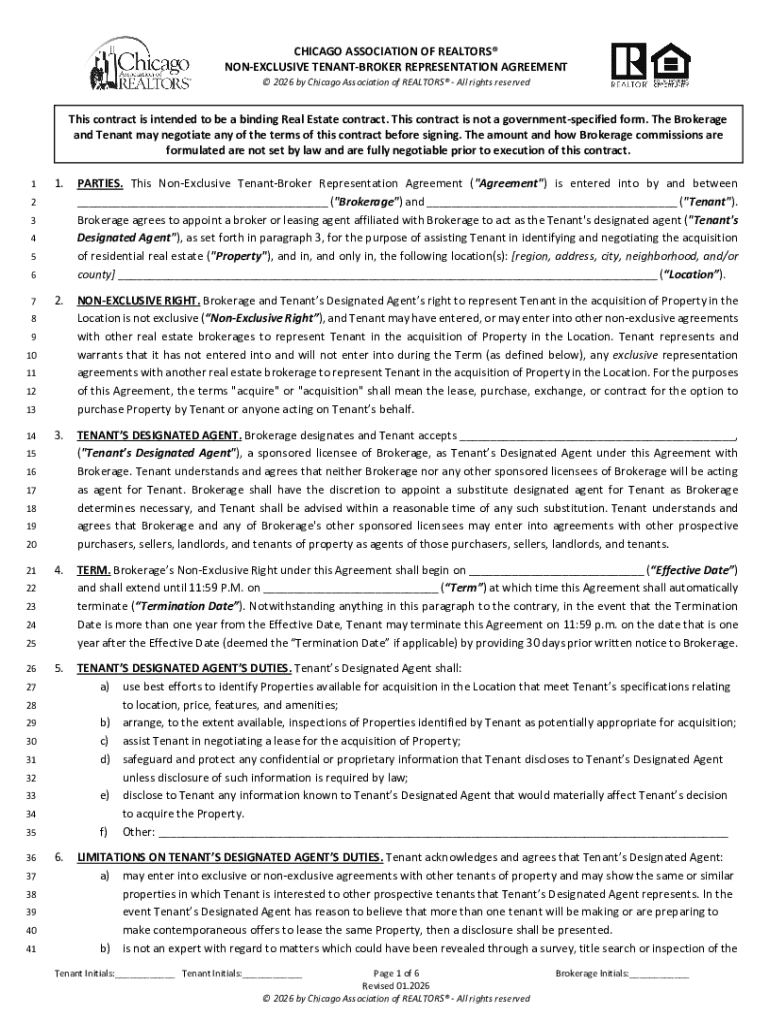
The Chicago Tenant-Broker Representation Agreement is a legally binding contract designed to establish a relationship between a tenant and a real estate broker in Chicago. This agreement outlines the roles and responsibilities of both parties in a real estate transaction, ensuring that the broker will represent the tenant's interests in finding a rental property. By signing this document, tenants can have confidence that their broker will perform tasks such as negotiating lease terms and performing due diligence on potential properties.
Key Objectives
- Representation: The agreement guarantees that the broker will act on behalf of the tenant, providing expert guidance and negotiation skills.
- Scope of Services: It defines the specific services the broker will provide, such as property search, negotiation, and lease review.
- Legal Protection: Establishes legal parameters protecting both parties by clearly outlining duties and obligations.
Importance in Real Estate Transactions
- Facilitates a smooth transaction by defining expectations.
- Reduces conflicts that may arise due to misunderstandings.
- Helps tenants access professional expertise and market knowledge.
Steps to Complete the Chicago Tenant-Broker Representation Agreement
Completing the Chicago Tenant-Broker Representation Agreement involves several important steps to ensure a comprehensive and mutually beneficial contract.
-
Initial Consultation:
- Discuss tenant needs, budget, and preferred locations.
- Broker assesses the tenant's requirements and capabilities.
-
Drafting the Agreement:
- Broker prepares the agreement with input from the tenant.
- Key terms such as services offered, fees, and duration are clearly specified.
-
Reviewing the Terms:
- Tenant and broker review all terms for mutual understanding.
- Clarifications and modifications are made based on discussions.
-
Signing the Document:
- Both parties sign the agreement electronically or in person.
- A fully executed copy is provided to each party for their records.
-
Commencing Services:
- The broker begins the search for properties that meet the tenant's criteria.
- Continuous communication is maintained to update the tenant on progress.
Important Terms Related to the Chicago Tenant-Broker Representation Agreement
A firm grasp of essential terms is crucial for understanding the Chicago Tenant-Broker Representation Agreement. Below are some key terms:
- Exclusive vs. Non-Exclusive Arrangement: Determines whether the broker has the sole right to represent the tenant.
- Commission Agreement: Outlines how and when the broker is compensated.
- Termination Clause: Specifies conditions under which the agreement can be terminated by either party.
- Limitation of Liability: Defines the extent to which each party is liable for any potential disputes or issues.
- Duration of Agreement: Indicates the time span during which the agreement is valid.
Legal Use of the Chicago Tenant-Broker Representation Agreement
The legal framework surrounding the Chicago Tenant-Broker Representation Agreement ensures that it is used appropriately and lawfully.
Compliance and Legal Standards
- Must comply with local real estate laws and regulations.
- Must be executed in good faith, with transparency and accurate representation from both parties.
- Adherence to federal and state anti-discrimination laws when searching for properties.
Benefits of Legal Use
- Protection from legal disputes, as each party's responsibilities are clearly defined.
- Ensures fair practice by obligating brokers to act in the tenant's best interests.
- Provides a formal avenue for dispute resolution if disagreements arise.
State-Specific Rules for the Chicago Tenant-Broker Representation Agreement
State-specific rules in Illinois, particularly in Chicago, affect how these agreements are managed and enforced.
Illinois Specific Regulations
- Brokers must be licensed according to Illinois state law.
- Agreements must be consistent with the Illinois Real Estate License Act.
- Requirement for clear disclosure of any potential conflicts of interest.
Chicago Local Regulations
- Local housing ordinances may affect available properties and tenant rights.
- Required adherence to Chicago's residential rental regulations, safeguarding tenants against unfair treatment.
Examples of Using the Chicago Tenant-Broker Representation Agreement
Real-world scenarios demonstrate how the Chicago Tenant-Broker Representation Agreement can be utilized effectively:
- Case Study 1: A corporate tenant looking to lease office space in downtown Chicago uses the agreement to secure a skilled broker who negotiates favorable lease terms, saving the tenant significant rent and ancillary costs.
- Case Study 2: A family relocating to Chicago utilizes the agreement to engage a broker who assists with finding a child-friendly neighborhood, ensuring proximity to quality schools and amenities.
Who Typically Uses the Chicago Tenant-Broker Representation Agreement
The Chicago Tenant-Broker Representation Agreement is typically utilized by various parties in the real estate sector, each deriving specific benefits.


Common Users
- Individual Renters: Seeking professional assistance in navigating complex rental markets.
- Corporate Clients: Businesses needing organizational relocation or leasing office spaces.
- Investment Firms: Engaging in real estate investment ventures requiring specialized knowledge and negotiation expertise.

Benefits to Different Users
- Individuals: Gain access to a broader range of properties and professional negotiation skills.
- Corporations: Benefit from strategic location selection and lease terms that align with business goals.
- Investors: Optimize property acquisition strategies and benefit from in-depth market analysis.
Digital vs. Paper Versions of the Chicago Tenant-Broker Representation Agreement
The choice between digital and paper versions of the agreement rests on preferences for convenience, accessibility, and security.
Digital Version
- Advantages:
- Easily editable and shareable across platforms.
- Faster execution and storage within digital systems such as DocHub.
- Environmentally friendly and cost-effective.
Paper Version
- Advantages:
- Traditional and tangible, often preferred by those less comfortable with digital solutions.
- May be required by parties or jurisdictions that do not accept digital signatures.
Preferences and Impact
- Many modern brokerages and tenants opt for digital versions due to enhanced efficiency and seamless integration with cloud-based platforms.
- Paper versions may still be necessary in traditional settings or specific legal contexts where digitization has yet to iembed itself fully.