







Definition & Meaning
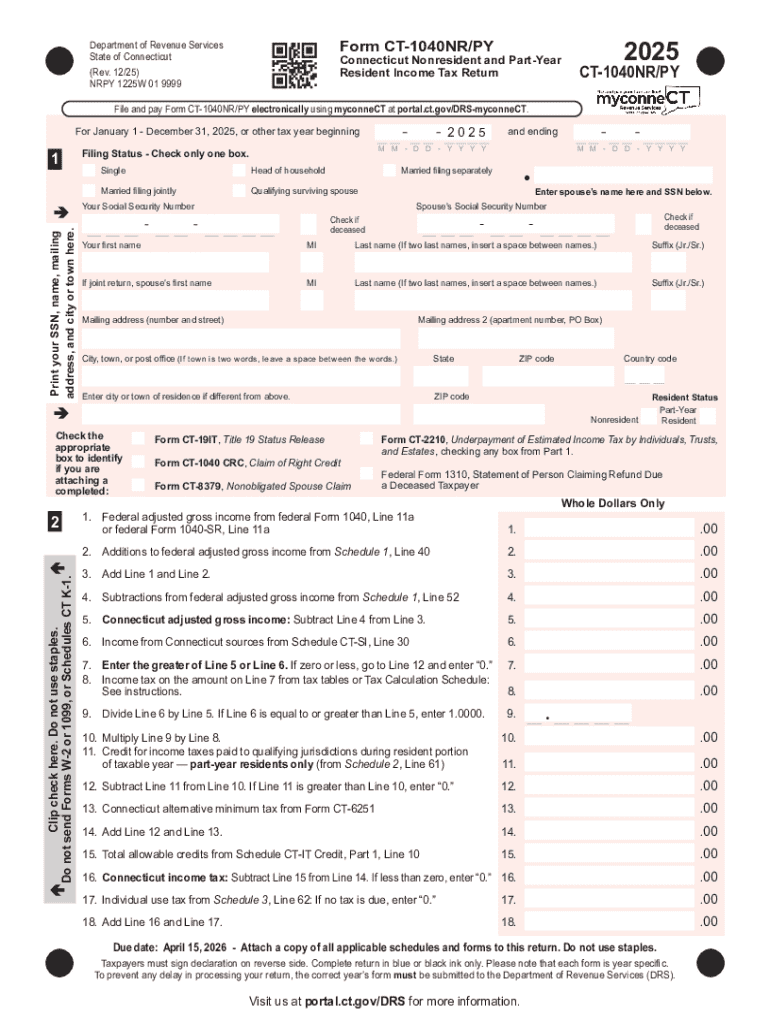
The Connecticut Nonresident and Part-Year Resident Income Tax Return, often referred to as Form CT-1040NR/PY, is a specialized state tax form used by individuals whose residency status in Connecticut is either nonresident or part-year resident. This form is crucial for accurately reporting income earned within the state during the relevant tax period. It ensures compliance with Connecticut's tax regulations by clearly distinguishing between full-year residents and those who have varying degrees of residency within the tax year. Understanding the distinctions and obligations outlined in this form helps taxpayers meet local tax requirements effectively.
How to Use the Connecticut Nonresident and Part-Year Resident Income Tax Return
To effectively utilize the Connecticut Nonresident and Part-Year Resident Income Tax Return, individuals should first confirm their residency status. This form requires:
- Determining the periods of residency within the year.
- Reporting all Connecticut-sourced income appropriately.
- Distinguishing income earned during periods of residency from that earned when non-resident.
The completion of this form involves careful calculation of prorated income and deductions based on residency periods. Accuracy is essential to ensure appropriate tax liabilities are met and potential refunds are claimed.
Steps to Complete the Connecticut Nonresident and Part-Year Resident Income Tax Return
-
Gather Your Financial Documents:
- Collect W-2s, 1099s, and any other relevant income statements.
- Include documentation of any credits or deductions applicable to the Connecticut jurisdiction.
-
Determine Residency Status:
- Identify periods you lived in Connecticut during the tax year.
- Calculate the proportion of the year spent as a resident versus a nonresident.
-
Complete Personal Information:
- Enter your name, Social Security Number, and address.
- Ensure accurate personal identification details to avoid processing delays.
-
Report Income:
- List all Connecticut-sourced income, including part-year and nonresident portions.
- Utilize specific lines on the form for income during resident months versus nonresident months.
-
Claim Deductions and Credits:
- Identify deductions specific to resident and nonresident periods.
- Ensure eligibility for any Connecticut-specific credits.
-
Calculate Tax Liability:
- Use provided schedules to compute total tax obligations.
- Apply any previously made tax payments or withholding amounts.
-
Review and Submit:
- Double-check for errors or omissions.
- Submit the form by mail or electronically by the specified deadline.
Important Terms Related to the Connecticut Nonresident and Part-Year Resident Income Tax Return
- Nonresident: An individual who does not reside in Connecticut but earns income from sources within the state.
- Part-Year Resident: Someone who moves into or out of Connecticut during the tax year.
- Connecticut-Sourced Income: Earnings from work or property located in Connecticut.
- Proration: The method of dividing income and expenses based on residency status.
Understanding these terms is fundamental for accurate form completion, ensuring compliance with state tax laws.
Filing Deadlines / Important Dates
Connecticut tax returns, including the CT-1040NR/PY, are generally due by April 15 following the close of the tax year. If April 15 falls on a weekend or public holiday, the deadline extends to the next business day. Taxpayers requesting extensions must file the appropriate forms before this date, but any due taxes should still be paid by the original deadline to avoid interest or penalties.
Required Documents
When completing the Connecticut Nonresident and Part-Year Resident Income Tax Return, individuals should have access to:
- Personal identification documents.
- Employment income records such as W-2 or 1099 forms.
- Connecticut tax withholding statements.
- Relevant deduction and credit documentation.
- Proof of state residency changes (e.g., lease agreements, utility bills).
These documents support income claims and validate residency changes, helping ensure the accuracy of the submitted tax return.
Form Submission Methods (Online / Mail / In-Person)
Taxpayers can submit the Connecticut Nonresident and Part-Year Resident Income Tax Return via:
- Online: Through the Connecticut Department of Revenue Services website.
- Mail: Sending a completed printed form to the designated state tax office address.
- In-Person: Visiting a state tax office, where guidance on form completion is often available.
Each method offers various advantages, such as expedited processing online or personal assistance during in-person submissions.
Penalties for Non-Compliance
Failure to comply with Connecticut's tax filing requirements for nonresidents and part-year residents can result in:
- Interest Charges: On any unpaid tax amounts not settled by the filing deadline.
- Monetary Penalties: For late submission or incorrect reports.
- Potential Legal Action: If significant noncompliance is detected by state authorities.
Timely and accurate submission of the CT-1040NR/PY form is essential to avoid these penalties, ensuring your tax obligations are met appropriately.




