




01. Edit your who must file form ct 1040nr py online
Type text, add images, blackout confidential details, add comments, highlights and more.

Type text, add images, blackout confidential details, add comments, highlights and more.

Draw your signature, type it, upload its image, or use your mobile device as a signature pad.

Send form ct 1040nr py via email, link, or fax. You can also download it, export it or print it out.
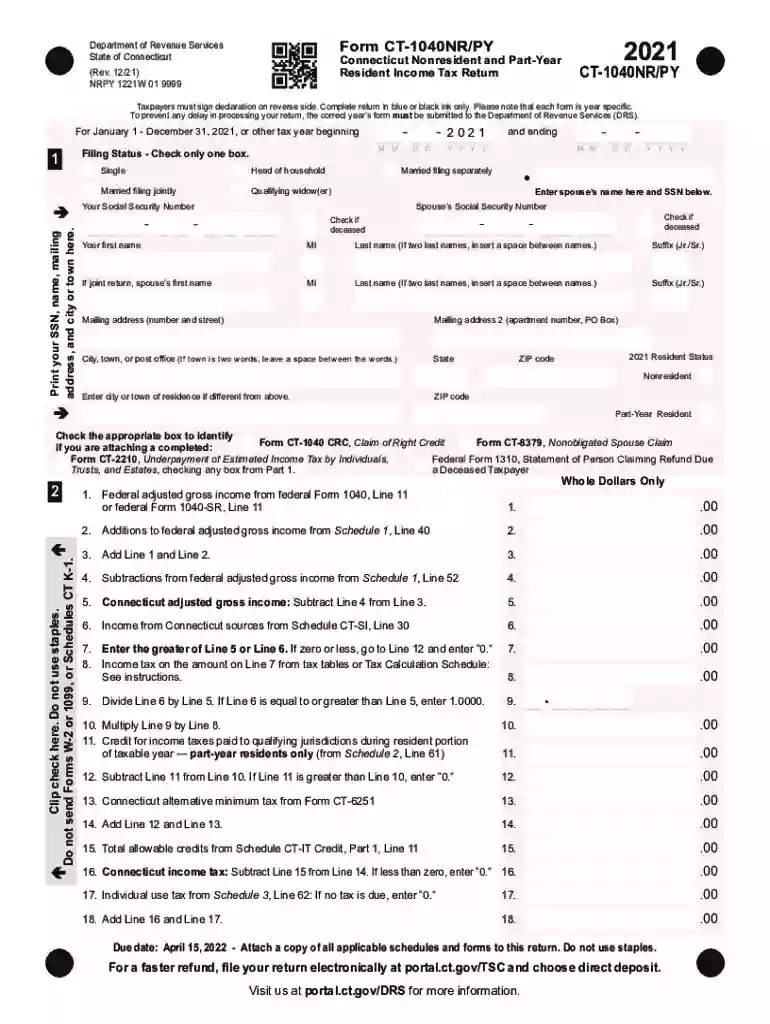
Connecticut Form CT-1040NR-PY, officially known as the Connecticut Nonresident and Part-Year Resident Income Tax Return, is a tax document used by individuals who either reside outside of Connecticut but earn income within the state or who have moved into or out of Connecticut during the tax year. The form is integral for accurately reporting income, calculating state taxes owed, and determining potential refunds. Its primary function is to ensure compliance with Connecticut taxation laws by capturing relevant income and residency information.
Taxpayers can acquire Connecticut Form CT-1040NR-PY through several avenues:
Online Download: Available for download on the Connecticut Department of Revenue Services (DRS) website, where the latest version and instructions are provided.
Official Request: Forms can be requested via mail by contacting the Connecticut DRS. This option might entail a delay compared to digital access.
Tax Preparation Software: Many commercial tax preparation tools automatically integrate this form, facilitating an easier completion process.
Filing the Connecticut Form CT-1040NR-PY involves several detailed steps:
Personal Information Entry: Fill in the taxpayer's identification details, including any applicable spouse information.
Residency Status Declaration: Specify whether you were a nonresident or part-year resident, which determines subsequent sections of the form you must complete.
Income Reporting: Report all income derived from Connecticut sources. Part-year residents must prorate their total annual earnings.
Tax Obligation Calculation: Use the specified tax tables or formulas to calculate the owed tax based on reported income.
Claim Applicable Credits: Enter any deductions or credits applicable to reduce total tax liability.
Review and Sign: Double-check all entries for accuracy, ensuring every section pertinent to your filing status is completed. Sign and date the form.
Familiarity with specific terminology is crucial for thoroughly completing the form:
Part-Year Resident vs. Nonresident: Defines the tax year timeline applicable to income declaration.
Tax Credits: Specific credits may vary; understanding eligibility and correct application is essential.
Understanding critical filing deadlines ensures compliance and avoids penalties:
Standard Filing Due Date: Traditionally, the Connecticut income tax return for the prior year must be filed by April 15.
Extension Requests: Taxpayers can apply for an extension, typically providing an additional six months. It is imperative to understand that this extends the filing time, not the payment deadline.
Accurate completion relies on supporting documentation to validate the information:
Validation: Discrepancies between declared information and supporting documents can lead to audits or penalties.
Safe Keeping: Maintain copies of all filed returns and documentation for personal records and potential future audits.
Deciding between digital and traditional paper filing impacts submission efficiency:
Understanding legal obligations and compliance is critical to avoid ramifications:
By providing this comprehensive guide, users filling out the Connecticut Form CT-1040NR-PY can navigate the complexities of the form with confidence and accuracy.
We've got more versions of the who must file form ct 1040nr py form. Select the right who must file form ct 1040nr py version from the list and start editing it straight away!
| Versions | Form popularity | Fillable & printable |
|---|---|---|
| 2025 | 4.9 Satisfied (53 Votes) | |
| 2024 | 4.1 Satisfied (29 Votes) | |
| 2022 | 4.4 Satisfied (57 Votes) | |
| 2021 | 4.4 Satisfied (21 Votes) | |
| 2020 | 4.8 Satisfied (107 Votes) | |
| 2019 | 4.3 Satisfied (35 Votes) | |
| 2018 | 4.3 Satisfied (60 Votes) | |
| 2016 | 4.4 Satisfied (440 Votes) | |
| 2015 | 4 Satisfied (36 Votes) | |
| 2014 | 4 Satisfied (33 Votes) | |
| 2013 | 4 Satisfied (33 Votes) | |
| 2012 | 4 Satisfied (37 Votes) | |
| 2011 | 4 Satisfied (36 Votes) | |
| 2010 | 3.9 Satisfied (28 Votes) | |
| 2009 | 4.3 Satisfied (56 Votes) |
At DocHub, your data security is our priority. We follow HIPAA, SOC2, GDPR, and other standards, so you can work on your documents with confidence.
Form CT-1040 you should. CT-1040NR/PY). Connecticut Nonresident and Part-Year Resident Income Tax. State of CT filing deadline: April 15, 2026)
CT-1040NR/PY, 2025 Connecticut Nonresident and Part-Year Resident Income Tax Return Line Instructions, 12/2025. Resident Form. Name, Description, Revised DateRead more


