01. Edit your form online
Type text, add images, blackout confidential details, add comments, highlights and more.

Type text, add images, blackout confidential details, add comments, highlights and more.

Draw your signature, type it, upload its image, or use your mobile device as a signature pad.

Send it via email, link, or fax. You can also download it, export it or print it out.
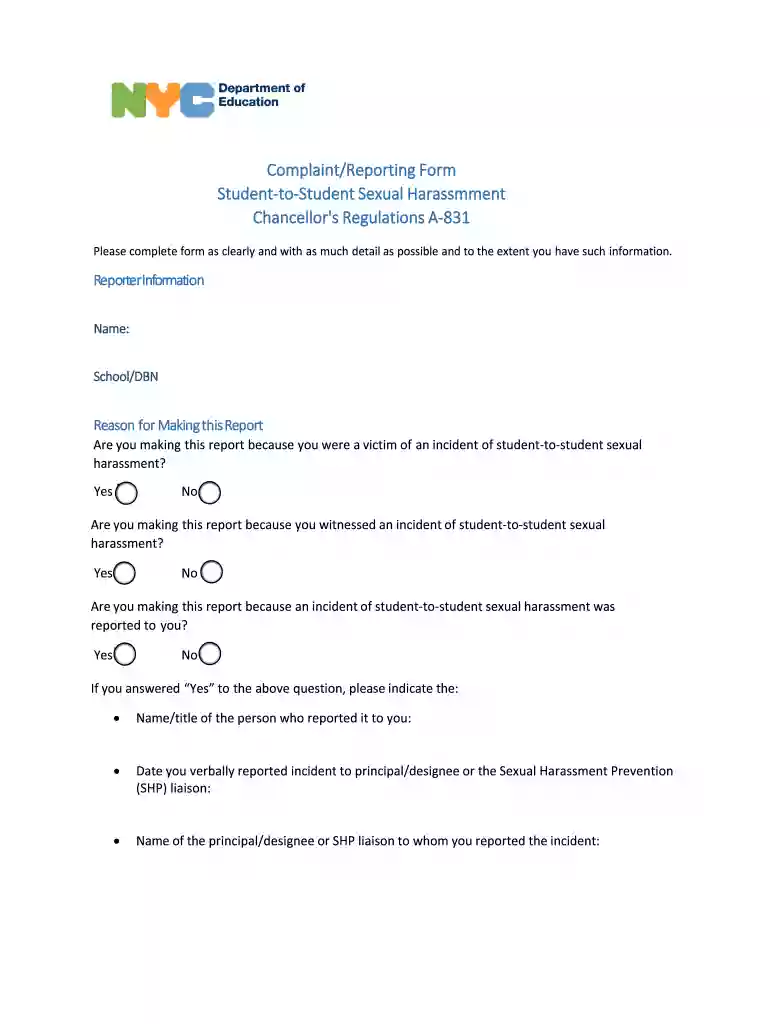
The Complaint Reporting Form for Student-to-Student Sexual Harassment, governed by Chancellor's Regulation A-831, serves as a crucial tool for addressing incidents of sexual harassment among students. The form is designed to capture detailed information about the harassment incident, including participant identities, incident specifics like the date, time, and location, and any potential witnesses. By providing a structured platform for reporting, it ensures that the concerned authorities can conduct thorough investigations and take necessary actions to protect students' rights and safety.
When using the Complaint Reporting Form, users must meticulously fill out each section to provide comprehensive and accurate data. The form typically requires reporters to specify their relationship to the incident, whether they are a victim, witness, or third party. Proper completion involves:
Providing lucid and detailed responses not only facilitates a more efficient investigative process but also ensures that all aspects of the harassment are thoroughly examined.
The form is structured to include several key elements crucial for gathering relevant information:
Each element is essential for a complete understanding of the incident, which enables the appropriate handling, prevention, and mitigation strategies.
Filling out the Complaint Reporting Form requires careful attention to detail. Here are the steps to ensure thorough completion:
Reporting incidents of student-to-student sexual harassment is vital for several reasons:
Filling out the form meticulously helps in addressing the issue at its core, by ensuring the well-being of the students and maintaining a safe educational environment.
The Complaint Reporting Form is primarily used by students, teachers, and school administrators within educational settings. The form empowers:
In the educational context, this form acts as a formal method to raise awareness about harassment and prompt administrative action.


Legal compliance with Chancellor's Regulation A-831 is integral to the form’s use. Schools must adhere to these regulations to:
Understanding and complying with these legal aspects is crucial for the effectiveness of the Complaint Reporting Form and the protection it intends to provide.
There are several methods for submitting the Complaint Reporting Form within the school's protocol. Typical submission methods include:
Each method is designed to accommodate different needs and ensure that reporters can submit their forms securely and conveniently.
At DocHub, your data security is our priority. We follow HIPAA, SOC2, GDPR, and other standards, so you can work on your documents with confidence.