







Definition & Meaning
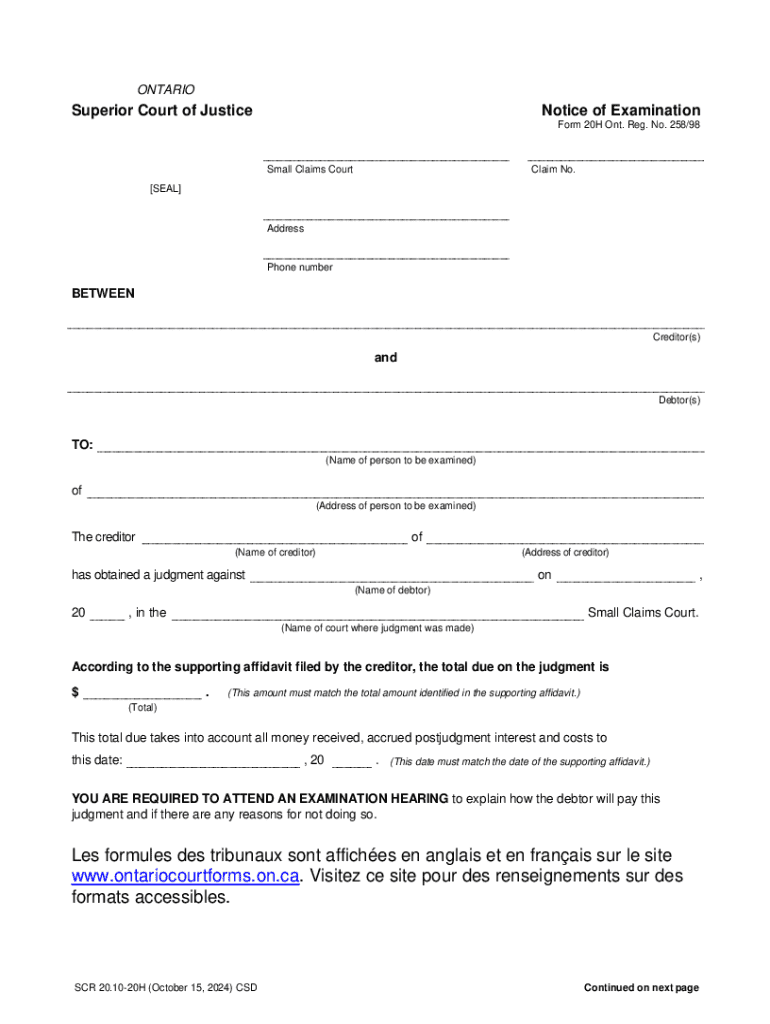
The Ontario Small Claims Court Notice of Examination is a legal document used in the process of debt collection within the Ontario Small Claims Court system. This document allows a creditor to summon a debtor to court for questioning under oath about their financial situation. By doing so, it aims to uncover the debtor's assets, income sources, and overall financial capacity to satisfy an outstanding judgment. The Notice of Examination is a critical tool for creditors seeking to enforce a court decision requiring debt repayment.
Key Features
- Legal Tool: Facilitates debt recovery efforts by compelling debtors to provide financial information.
- Court Involvement: Requires debtor attendance at a court-scheduled examination.
- Oath-Bound: Debtors must disclose truthful financial details under oath to avoid contempt of court.
Practical Examples
- A car loan company uses the Notice of Examination after winning a judgment to identify a debtor's assets.
- A small business owner, victorious in a payment dispute, requests a Notice to examine a delinquent client for asset disclosure.
How to Use the Ontario Small Claims Court Notice of Examination
Utilizing the Notice of Examination involves several procedural steps that ensure the process adheres to legal standards.
Step-by-Step Use
- Obtain the Notice Form: Download the official form from the Ontario Superior Court of Justice website or obtain it from the local court office.
- Complete the Form: Fill in details such as the court file number, creditor and debtor names, and the examination date.
- File with Court: Submit the form at the court handling your claim to schedule an examination date.
- Serve the Debtor: Deliver the notice to the debtor with adequate time for preparation, adhering to service rules.
Real-World Scenario
- A creditor files a Notice after repeated attempts to collect payment fail, documenting all relevant details before serving the debtor through registered mail.
How to Obtain the Ontario Small Claims Court Notice of Examination
Securing the Notice form requires understanding the judicial structure and accessing the appropriate resources.
Access Points
- Court Office: In-person visit to the nearest Ontario court to request the document.
- Online Download: Retrieve the Notice from the Ontario government website.
Detailed Process
- Visit the Ontario Superior Court website, navigate to forms, and select the Notice of Examination from Small Claims resources.
- Print the downloaded form, or secure a copy directly from a court office if internet access is unavailable.
Case Example
- A legal assistant downloads the Notice form for a law firm specializing in debt recovery, ensuring all parts needed for court proceedings are available.
Steps to Complete the Ontario Small Claims Court Notice of Examination
Properly completing the Notice ensures compliance with legal procedures, facilitating the examination process.
Detailed Instructions
- Fill in Identification Information: Accurately enter names, addresses, court number, and reference numbers.
- Schedule Examination Date: Coordinate with court officials to determine an appropriate date.
- Detail Examination Purpose: Clearly state the intent, focusing on debt collection and specific information needed about the debtor's financial state.
- Sign and Date: Authenticate the document with signatures and accurate dating.
Practical Illustration
- A creditor accurately completes the form, ensuring no omissions, to streamline the court's acknowledgment and scheduling process.
Who Typically Uses the Ontario Small Claims Court Notice of Examination
The Notice is most commonly utilized by parties involved in financial disputes, particularly creditors.


Typical Users
- Creditors: Individuals or businesses owed money enforcing debt collection.
- Legal Representatives: Attorneys representing clients in debt recovery.
- Financial Institutions: Banks or credit companies pursuing unpaid loans.
User Example
- A sole proprietor hires a paralegal to submit a Notice of Examination after unsuccessfully obtaining payment on delivered goods.
Key Elements of the Ontario Small Claims Court Notice of Examination
Understanding the core components of the Notice ensures proper preparation and execution of the examination process.
Primary Sections
- Creditor and Debtor Information: Basic identification details.
- Court Details: The precise court managing the claim.
- Examination Date and Location: Scheduled hearing specifics.
- Purpose Explanation: Brief statement of the examination's aim.
Detailed Breakdown
- Confirm information is consistent with court records.
- Outline inquiry areas, like income verification and asset identification.
Legal Use of the Ontario Small Claims Court Notice of Examination
The Notice performs an essential function in legal debt recovery, adhering to judicial guidelines.
Legal Aspects
- Judicial Sanction: Requires court approval to proceed.
- Compliance Mandate: Legally obligates the debtor to appear and testify.
Scenario Illustration
- A lawyer explains to a client that failure to comply with the Notice might lead to additional court-imposed penalties.
Form Submission Methods (Online / Mail / In-Person)
Submitting the Notice involves following prescribed methods to ensure processing.
Submission Options
- In-Person: Direct submission at the courthouse for processing and verification.
- Mail: Sending the completed form to the designated court address.
- Online (where available): Leveraging digital submission forms on the Ontario Superior Court's platform.
Example Execution
- A business chooses postal submission to accommodate geographical challenges, tracking the package to confirm prompt delivery.




