




01. Edit your form online
Type text, add images, blackout confidential details, add comments, highlights and more.

Type text, add images, blackout confidential details, add comments, highlights and more.

Draw your signature, type it, upload its image, or use your mobile device as a signature pad.

Send it via email, link, or fax. You can also download it, export it or print it out.
Understanding the term "form online" is essential for navigating digital documentation processes. "Form online" refers to electronic forms that are accessible and fillable via the internet. These forms often replace traditional paper forms, allowing users to complete, submit, and manage them conveniently from any device. Online forms are commonly used for applications, surveys, registrations, and other submissions where user input is required. They offer benefits such as ease of access, efficiency, and the ability to automate data collection and processing. These attributes make online forms integral to modern digital workflows, particularly in sectors like government, education, and commerce.
Navigating online forms requires familiarity with their digital interface. Users typically begin by accessing the form through a web browser, often via a direct link provided by the form issuer. Online forms are organized into fields for inputting data, which may include text boxes, dropdown menus, and checkboxes. Follow these steps to use forms online efficiently:
Access the Form: Use the provided link or search for the form on the issuing organization’s website.
Read Instructions: Carefully review any guidelines or notes accompanying the form for specific requirements or instructions.
Fill Out Necessary Information: Enter required data into the respective fields, paying attention to mandatory fields marked with an asterisk.
Review Details: Double-check the information for accuracy and completeness to avoid submission errors.
Submit the Form: Click the submit button to send your responses, often receiving a confirmation email or message as acknowledgment.
The decision to transition to forms online stems from several distinct advantages. Electronic forms offer enhanced convenience and flexibility, allowing users to complete necessary paperwork from anywhere with an internet connection. This reduces the need for physical presence and expedites processes that typically require cumbersome paper handling. Additionally, digital forms enable automated data entry and processing, significantly reducing human error and improving accuracy. Online forms also facilitate better data management, as information can be stored securely in digital formats, easily accessed and retrieved when needed.
Filling out forms online can seem daunting without preparation. By understanding the following steps, users can complete forms accurately and efficiently:
Prepare Required Information: Gather any necessary documents or information before starting the form to ensure completeness.
Open the Form: Use a browser to access the form, ensuring internet connectivity for seamless interaction.
Accurate Data Entry: Input all information carefully, focusing on precision to minimize revision needs.
Utilize Validation Features: Many forms have built-in error-checking or validation functions to guide data entry.
Save Your Progress: If available, use the option to save your work periodically, especially for long forms, to avoid data loss.
Final Review and Submission: Conduct a thorough review and submit once all information is verified for accuracy.
Forms online serve a myriad of functions across different sectors. They are extensively used in educational applications such as student registration and course enrollment. In commerce, online forms are vital for order placements and feedback collection. Healthcare settings utilize them for patient intake and consent processes, while government agencies employ online forms for tax filings, benefits applications, and license renewals. The versatility and adaptability of online forms make them an indispensable tool in digital transformation for industries focused on improving efficiency and user experience.
Various real-world examples highlight the utility of online forms. Universities like Harvard employ online forms for managing scholarship applications. Retail giants such as Amazon use electronic forms to streamline customer service surveys and feedback collection. Similarly, the IRS provides taxpayers with online versions of forms, like Form W-9, accessible and fillable directly from their website. Each of these examples demonstrates how forms online simplify complex processes and enhance user engagement.
Completing forms online includes important legal considerations. For compliance, it is critical to ensure that all data captured aligns with regulations like the Electronic Signatures in Global and National Commerce Act (ESIGN Act), which establishes legal recognition for electronic signatures and records. It's also essential to verify the authenticity of the website or platform hosting the form to protect personal information from phishing attempts. Legal agreements like terms of service often accompany forms, outlining rights and responsibilities that users must accept before submission.
Software compatibility plays a critical role in the utility of online forms. To ensure seamless interaction, forms should be designed to work across multiple platforms and devices, including desktop computers and mobile devices. Popular software solutions like TurboTax and QuickBooks offer compatibility with government forms, enabling direct import and export capabilities. This compatibility extends the utility of online forms, offering integration options and ensuring ease of processing and submission in various digital ecosystems.
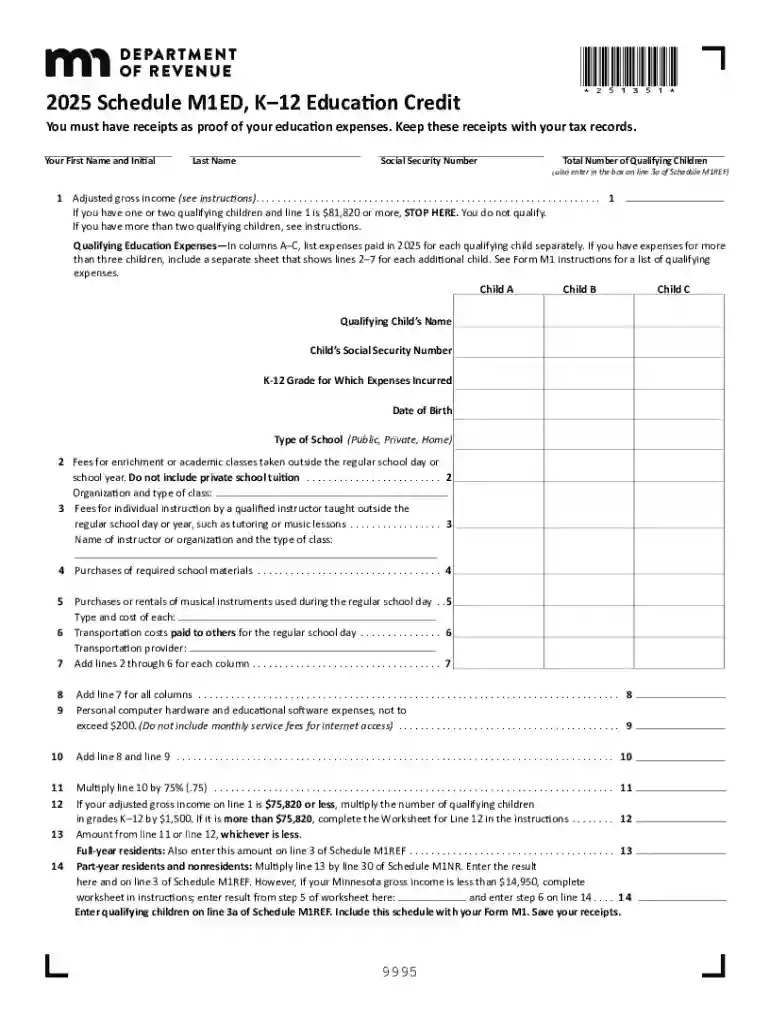
We've got more versions of the 2025 Minnesota K-12 Education Credit Form form. Select the right 2025 Minnesota K-12 Education Credit Form version from the list and start editing it straight away!
At DocHub, your data security is our priority. We follow HIPAA, SOC2, GDPR, and other standards, so you can work on your documents with confidence.
Pdf Form Online Mktg Materials FormOnlineMktgMaterials s page s.
Mar 23, 2026 This page lists the USCIS forms that are currently available to file online. Visit the File Online page to learn about the benefits of filing a form using ourRead more
Access Google Forms with a personal Google account or Google Workspace account (for business use).


