Definition & Meaning
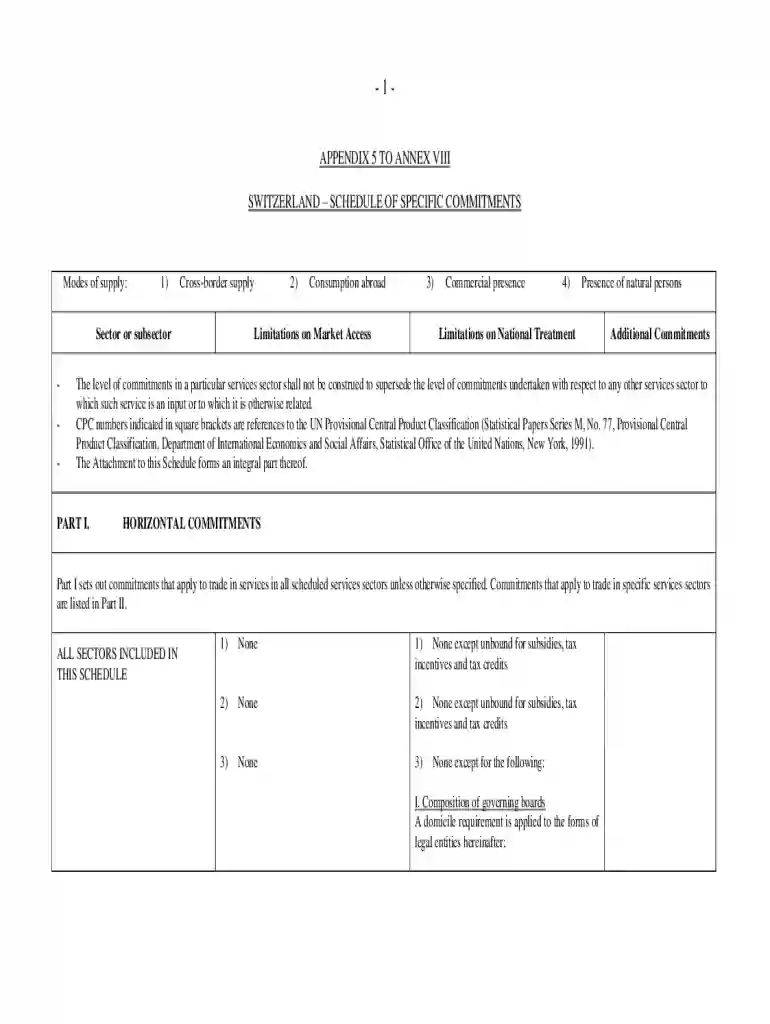
The "EFTA-CL, Appendix 5 to Annex VIII Switzerland Schedule of Specific Commitments" refers to a document that outlines specific commitments made by Switzerland concerning the trade of services under the European Free Trade Association (EFTA) agreements. These commitments include various service sectors and detail conditions related to market access, national treatment, and additional adherence requirements required by signatory countries.
Key Features
- Scope of Services: Includes sectors such as professional, business, communication, construction, distribution, educational, financial, tourism, and transport services.
- Market Access Limitations: Defines constraints on the entry of foreign service providers.
- National Treatment: Addresses treatment parity between domestic and foreign service providers.
Important Terms Related to EFTA-CL
Understanding certain terms is key to effectively navigating the document. Here are some crucial definitions:
Core Terminologies
- Cross-Border Supply: Services provided from the territory of one country into the territory of another without physical movement of the supplier or recipient.
- Commercial Presence: The establishment of a business within the territory of a foreign country for service delivery.
- Payment Services: A subset of financial services focusing on the facilitation of transactions.
Key Elements of the EFTA-CL
The document is structured to cater to specific commitments across service sectors, impacting various professional fields and industries.
Essential Sections
- Horizontal Commitments: These apply universally across all sectors, establishing baseline regulations.
- Sector-Specific Commitments: Details obligations unique to each service sector, such as educational services requiring specific qualifications or accreditations.
- Residency Requirements: Certain services necessitate residential status for service providers to be compliant.
Steps to Complete the EFTA-CL
Filling out the EFTA-CL form requires careful attention to detail and adherence to specific steps to ensure compliance.
- Review Service Categories: Identify applicable service categories that pertain to your business or profession.
- Understand Market Access: Assess any limitations that may impact your ability to operate within Switzerland.
- Gather Required Documentation: Compile necessary documents, which might include proof of residency or professional credentials.
- Complete Form Fields: Enter all relevant data, ensuring that sensitive fields are completed accurately.
- Submit for Approval: Follow procedures for submission as outlined, typically involving Swiss regulatory bodies.
How to Use the EFTA-CL
The document serves as a critical tool for businesses and individuals engaged in services that fall under the EFTA agreement.
Application Tips
- Verify Eligibility: Check preconditions related to business type and service category.
- Consult Regulatory Bodies: Engage with trade regulatory representatives to clarify complex stipulations.
- Leverage Legal Expertise: Consider acquiring legal counsel for complicated sectors like financial and professional services.
Legal Use of the EFTA-CL
Engagement with the EFTA-CL form must align with legal frameworks to maintain compliance and avoid penalties.
Compliance Essentials
- Residency and Employment Laws: Ensure all activities respect local residency requirements and employment laws.
- Documentation Retention: Maintain a thorough record of all submitted documents and communications with regulatory bodies.
- Periodic Reviews: Regularly revisit commitments to ensure ongoing compliance, particularly when service or market conditions change.
Examples of Using the EFTA-CL
Real-world applications of the EFTA-CL can provide clearer insights into its functionality.
Case Studies
- Professional Services Firm: A law firm expanding service offerings into Switzerland uses the EFTA-CL to navigate market entry barriers and residency requirements.
- Educational Institution: A university establishing a campus abroad under the EFTA agreement utilizes the document to align with educational standards and staff regulations.
- Financial Service Provider: A bank offering international payment solutions ensures compliance with financial commitments through meticulous application of the EFTA-CL.
Software Compatibility
Navigating the EFTA-CL can be facilitated using various software tools for document management and compliance tracking.
Useful Software
- TurboTax: While primarily focused on tax-related documentation, it can serve as a supplementary tool for financial calculations related to services.
- QuickBooks: Useful for managing accounting tasks that comply with specific trade financial commitments outlined in the form.
- DocHub: A practical solution for editing, signing, and managing documents pertaining to EFTA-CL compliance.
Versions or Alternatives to the EFTA-CL
While the EFTA-CL document is a staple for certain actions within the EFTA framework, it's crucial to be aware of other related forms or versions.
Related Documents
- Annexes within EFTA Agreements: These may provide additional or supplementary regulations related to specific commitments.
- EU Equivalents: Forms that might be required when similar trade agreements apply within the European Union context.
Business Types That Benefit Most from EFTA-CL
Understanding the business entities that gain the most from the EFTA-CL is crucial for maximizing its utility.
Applicable Business Entities
- Corporations with International Reach: Firms with operations across EFTA countries benefit from streamlined operations.
- Small-to-Medium Enterprises (SMEs): Those providing niche services find the EFTA-CL beneficial for expanding market outreach.
- Joint Ventures: Partnerships that incorporate international member firms can leverage the EFTA-CL to navigate market-specific regulations.
State-Specific Rules for EFTA-CL
Although generally applicable across Switzerland, there may be state-level nuances that affect the application of specific commitments.
Regional Considerations
- Regulatory Variations: Certain Swiss cantons might enforce unique interpretations of commitments, necessitating local regulatory consultation.
- Service Sector Preferences: Some regions may provide incentives for specific services under the EFTA agreement, enhancing competitive advantage.