




01. Edit your form online
Type text, add images, blackout confidential details, add comments, highlights and more.

Type text, add images, blackout confidential details, add comments, highlights and more.

Draw your signature, type it, upload its image, or use your mobile device as a signature pad.

Send it via email, link, or fax. You can also download it, export it or print it out.
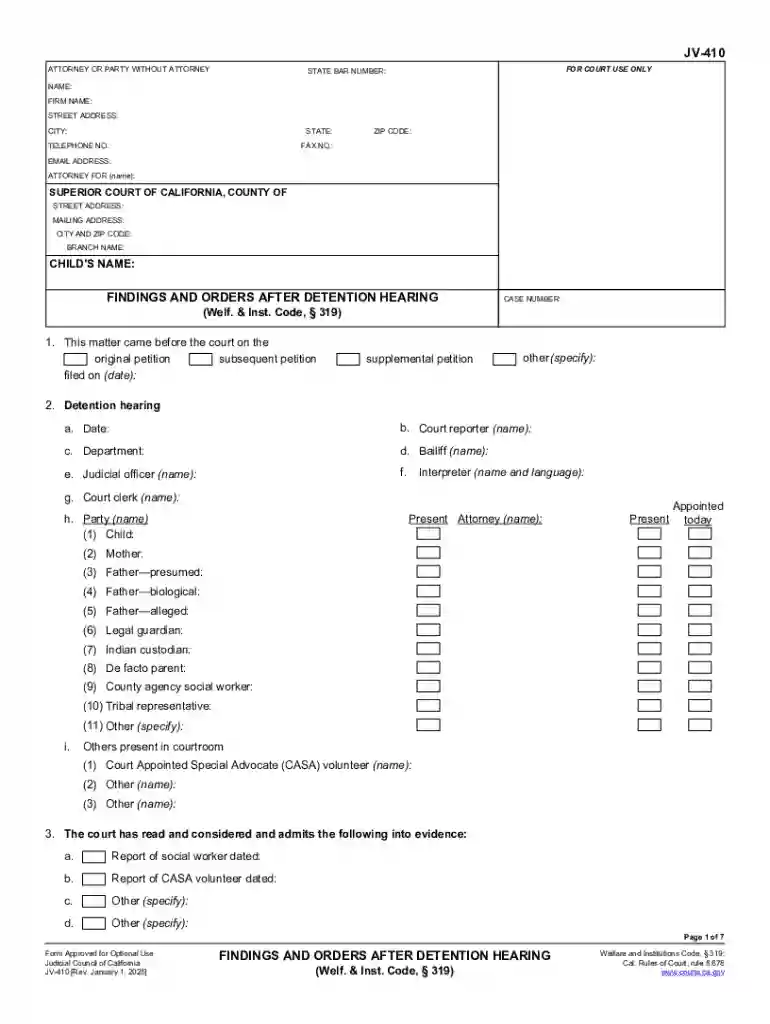
The JV-410 Findings and Orders After Detention Hearing (Welf and Inst Code, 319) Judicial Council form is essential in California's Superior Court system. It is primarily used to document the court’s decisions following a detention hearing related to a minor. Detention hearings are a pivotal part of juvenile court proceedings, especially when the state considers whether a child should be placed in a new living arrangement for their safety.
The form includes detailed findings about the nature of the detention hearing, listing the attending parties, discussing any evidence presented, and declaring the court’s decisions pertaining to the child's custody. Key areas covered are:
This documentation serves as a record to ensure that the court’s findings and decisions are meticulously noted and legally compliant, offering a clear path for future proceedings and any required follow-up actions.
Before completing the JV-410 form, it is crucial for legal practitioners or involved parties to thoroughly review all sections to understand the requirements and ensure accuracy in the data entered. The form is divided into specific sections that correlate with the unique aspects of a detention hearing, making it easier for users to input the necessary information.
It is critical to review the completed form for errors or omissions. Once confirmed, submit the document according to the prescribed method by the issuing court, whether electronically or in paper form.
The JV-410 form is vital in safeguarding a child's welfare during judicial proceedings. It systematically records the court’s rationale for any decisions impacting a child's living situation, providing a transparent and accountable trail for all stakeholders involved in the child's case.
Not only does it ensure that legal mandates are adhered to, but it also supports the fair administration of justice by documenting the rights of parents and the findings necessary for compliance with broader child welfare laws.
Lawyers, social workers, or involved parties can obtain the JV-410 form from:
It is critical to ensure that the most current version of the form is used to comply with any updates or changes in legal obligations.
Certain elements are mandatory for the form to be considered complete:
As a state-specific form, the JV-410 adheres to California's legislative and judicial statutes. Other states may have different forms and processes for juvenile detention hearings. For those practicing law or working within juvenile systems in California, familiarity with this form is essential, alongside understanding state-specific rules, such as the requirements of the California Code of Regulations.
Legal representatives should align the JV-410 form content closely with relevant state laws, particularly focusing on issues like proper notification of proceedings to interested parties and adherence to custody protocols.
The JV-410 form is primarily used by:
Understanding this form’s significance and accurate completion can greatly benefit all parties involved, supporting streamlined court processes and safeguarding children's rights in legal settings.


To lawfully utilize the JV-410 form, legal practitioners must ensure:
Failure to accurately complete or timely file the JV-410 form can result in judicial delays, miscommunication, or non-compliance penalties that affect case outcomes. Therefore, diligence in preparation and submission is necessary to avoid legal complications.
We've got more versions of the JV-410 Findings and Orders After Detention Hearing (Welf and Inst Code, 319) Judicial Council forms form. Select the right JV-410 Findings and Orders After Detention Hearing (Welf and Inst Code, 319) Judicial Council forms version from the list and start editing it straight away!
At DocHub, your data security is our priority. We follow HIPAA, SOC2, GDPR, and other standards, so you can work on your documents with confidence.



blizzard of lawsuits alleging that the accumulation of those billions had led to the deaths of hundreds of thousands of people.
After Detention Hearing (Welf. Inst. Code, 319)) (JV-410) States the courts decisions (orders) at a detention hearing. Get form


