Illinois form 700 2003-2026

Get Form
illinois form 700 2003 Preview on Page 1

Here's how it works

01. Edit your form online
Type text, add images, blackout confidential details, add comments, highlights and more.
02. Sign it in a few clicks
Draw your signature, type it, upload its image, or use your mobile device as a signature pad.
03. Share your form with others
Send it via email, link, or fax. You can also download it, export it or print it out.

How to use or fill out Illinois Form 700 2003 with our platform

Form edit decoration
9.5
Ease of Setup
DocHub User Ratings on G2
9.0
Ease of Use
DocHub User Ratings on G2
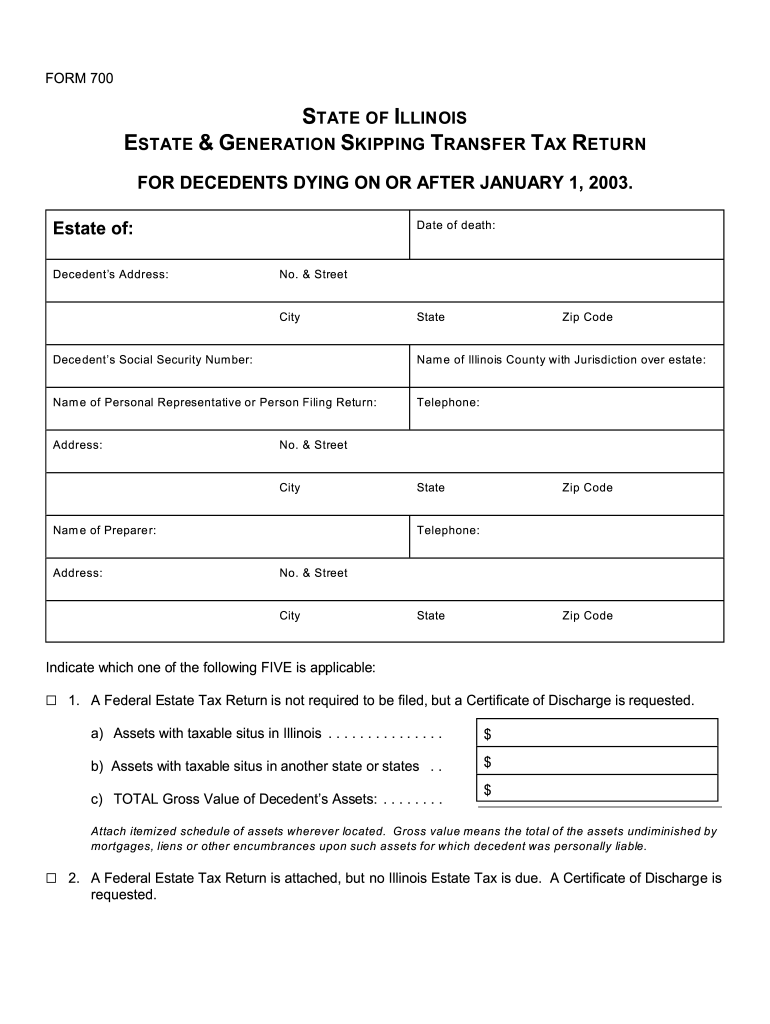
  1. Click ‘Get Form’ to open Illinois Form 700 in the editor.
  2. Begin by entering the decedent's date of death, name, and address in the designated fields. Ensure accuracy as this information is crucial for processing.
  3. Fill in the decedent’s Social Security Number and the name of the Illinois County overseeing the estate. This helps establish jurisdiction.
  4. Identify and select one of the five applicable options regarding federal estate tax returns. Each option requires specific details; ensure you provide accurate financial figures for assets.
  5. Complete Schedule A or B based on whether the decedent was a resident or non-resident. Input gross values and calculations as instructed, ensuring all figures are correct.
  6. Review all sections for completeness before signing. Use our platform’s tools to add signatures where required, ensuring compliance with legal standards.

Start filling out your Illinois Form 700 today for free using our platform!

See more illinois form 700 2003 versions

We've got more versions of the illinois form 700 2003 form. Select the right illinois form 700 2003 version from the list and start editing it straight away!
Versions Form popularity Fillable & printable
2023 4.9 Satisfied (36 Votes)
2022 4.2 Satisfied (27 Votes)
2021 4.9 Satisfied (45 Votes)
2020 4.3 Satisfied (88 Votes)
2015 4.3 Satisfied (51 Votes)
2014 4 Satisfied (29 Votes)
2011 4 Satisfied (32 Votes)
2003 3.7 Satisfied (36 Votes)
be ready to get more

Complete this form in 5 minutes or less

Get form

Got questions?

We have answers to the most popular questions from our customers. If you can't find an answer to your question, please contact us.
Contact us
An estate tax return (Form 706) must be filed if the gross estate of the decedent (who is a U.S. citizen or resident), increased by the decedents adjusted taxable gifts and specific gift tax exemption, is valued at more than the filing threshold for the year of the decedents death, as shown in the table below.
You or a joint fiduciary file Form 1041 for the estate every year if the estate has gross income of $600 or more or if one or more of the beneficiaries of the estate are nonresident aliens, you must file Form 1041. This is true even if the gross income of the estate is less than $600.
If the gross estate of an Illinois resident has a value of more than $4 million, the personal representative or executor of the estate must file a state estate tax return. (Smaller estates wont need to file a return.)
The federal estate and gift tax exemption is $13.99 million per individual in 2025, and will increase to $15 million in 2026 under the One Big Beautiful Bill Act. This new exemption level is permanent and will be adjusted annually for inflation starting in 2027.
If you dont file taxes for a deceased person, the IRS can take legal action by placing a federal lien against the Estate. This essentially means you must pay the federal taxes before closing any other debts or accounts.

Security and compliance

At DocHub, your data security is our priority. We follow HIPAA, SOC2, GDPR, and other standards, so you can work on your documents with confidence.

Learn more
ccpa2
pci-dss
gdpr-compliance
hipaa
soc-compliance
be ready to get more

Complete this form in 5 minutes or less

Get form

People also ask

For Estate Taxes: During the years 2002 through 2009, the estate tax applicable exclusion amount was $1 million in 2002 and 2003, $1.5 million in 2004 and 2005, $2 million in 2006 through 2008, and $3.5 million in 2009.
California estate taxes are due and payable by the estates executor on or before nine months following the date of death.
Crafting proper beneficiary designations on accounts like retirement plans and life insurance can bypass the probate process, directly transferring these assets to your chosen beneficiaries. This strategy reduces the estate size, thereby minimizing estate tax implications.

Related links