01. Edit your form online
Type text, add images, blackout confidential details, add comments, highlights and more.

Type text, add images, blackout confidential details, add comments, highlights and more.

Draw your signature, type it, upload its image, or use your mobile device as a signature pad.

Send it via email, link, or fax. You can also download it, export it or print it out.
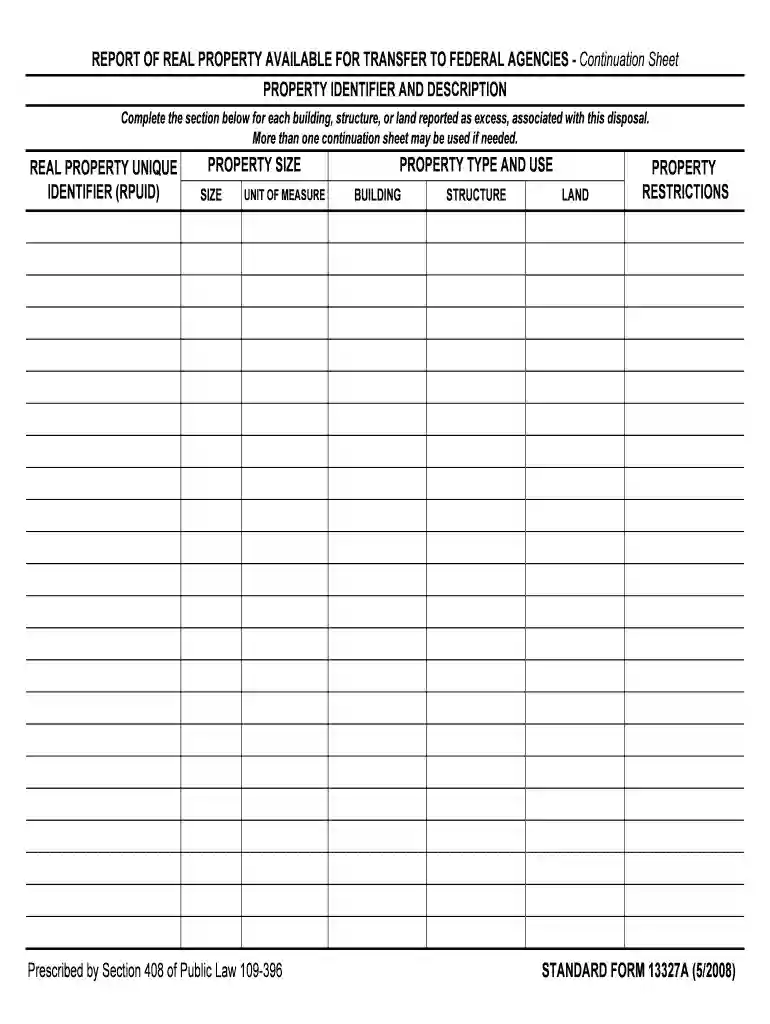
The REAL PROPERTY STATUS REPORT SF-429 (COVER PAGE) serves as a critical record used primarily for detailing the status of real property holdings. It facilitates the reporting of properties available for potential transfer to federal agencies, thus ensuring transparency and proper management of federal property assets. The form provides a comprehensive overview, including details on property identifiers, descriptions, sizes, types, uses, and any associated restrictions.
Completing the REAL PROPERTY STATUS REPORT SF-429 (COVER PAGE) requires precision to ensure all necessary data is accurately documented. Here are structured steps to assist in filling out the form:
Acquiring the REAL PROPERTY STATUS REPORT SF-429 (COVER PAGE) can be done through several methods. These straightforward options ensure easy access to the necessary documents for compliance and reporting.
The use of the REAL PROPERTY STATUS REPORT SF-429 (COVER PAGE) is essential for the effective management and transfer of federal real properties. Here’s why it holds significant importance:
The REAL PROPERTY STATUS REPORT SF-429 (COVER PAGE) is typically used by various groups and entities involved in federal property management. Understanding who utilizes this form can provide insights into its applications.


Understanding the fundamental components of the REAL PROPERTY STATUS REPORT SF-429 (COVER PAGE) can aid in its correct completion:
Property Identifiers: Unique numbers or codes assigned to each property.
Current Usage Details: Information on how the property is presently utilized.
Transfer Eligibility: Conditions under which the property can be transferred to another agency.
Considerations for Completeness:
Compliance with legal frameworks is a critical aspect of using the REAL PROPERTY STATUS REPORT SF-429 (COVER PAGE). It is imperative to understand the legal responsibilities associated with this report.
Federal Regulations: Adhering to guidelines set by federal property governing bodies.
Confidentiality: Ensuring sensitive property information is handled securely.
Accuracy: Legally required to provide accurate and truthful information on property status.
Practical Compliance Tips:
Though the REAL PROPERTY STATUS REPORT SF-429 (COVER PAGE) is federally oriented, there might be state-specific considerations to make. Understanding these nuances can be crucial for context-specific accuracy.
Reporting Requirements: Differences in how states expect property information to be reported.
Interpretative Guidelines: Variations in the application of federal guidelines based on state practices.
Suggestions for Navigating State Differences:
This guide provides detailed insights into how to effectively utilize the REAL PROPERTY STATUS REPORT SF-429 (COVER PAGE), ensuring accurate and compliant property management across federal agencies.
We've got more versions of the REAL PROPERTY STATUS REPORT SF-429 (COVER PAGE form. Select the right REAL PROPERTY STATUS REPORT SF-429 (COVER PAGE version from the list and start editing it straight away!
| Versions | Form popularity | Fillable & printable |
|---|---|---|
| 2008 | 4.8 Satisfied (105 Votes) |
At DocHub, your data security is our priority. We follow HIPAA, SOC2, GDPR, and other standards, so you can work on your documents with confidence.