
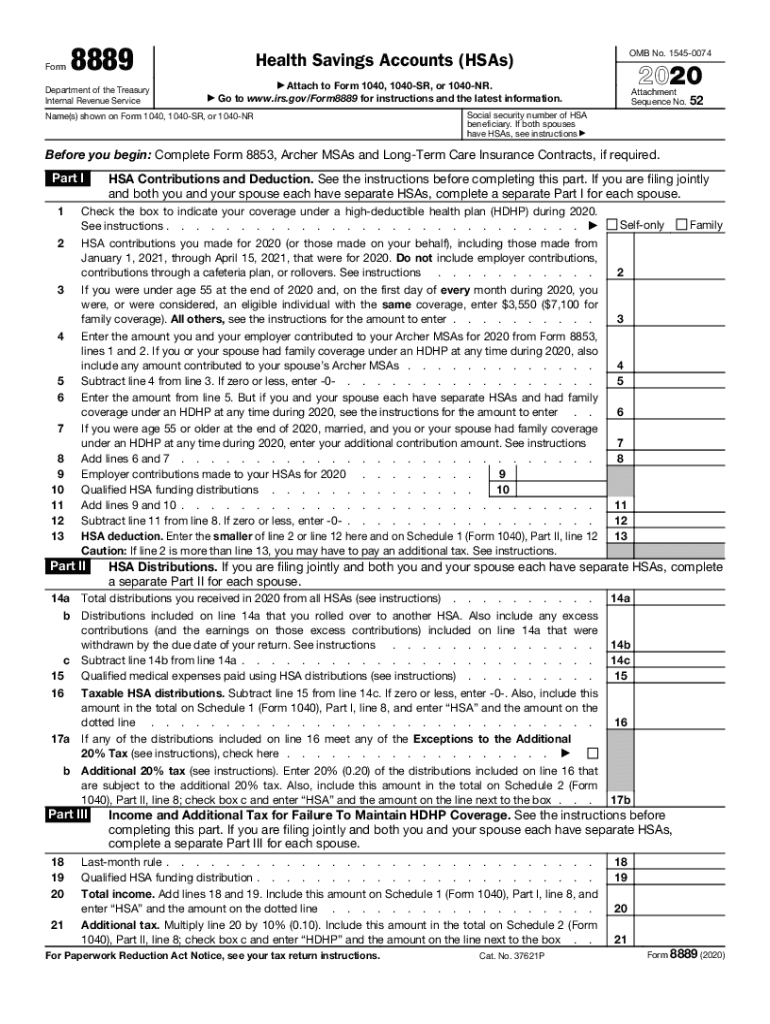







Definition and Meaning of IRS Form 8889
IRS Form 8889 is an essential tax form utilized by individuals with Health Savings Accounts (HSAs). This form is a crucial component in reporting HSA contributions, deductions, and distributions to the Internal Revenue Service (IRS). Its primary purpose is to ensure accurate tax reporting related to HSAs, thereby helping taxpayers determine their taxable income and any applicable deductions. Understanding the intricacies of Form 8889 can enhance tax compliance and maximize possible benefits.
Key Aspects of the Form
- Contributions: The form details contributions made to an HSA, whether by the taxpayer, employer, or both.
- Deductions: Provides a section for individuals to calculate deductions tied to HSA contributions.
- Distributions: Tracks funds withdrawn from the HSA for medical expenses.
How to Use IRS Form 8889
To utilize IRS Form 8889 effectively, individuals should first gather pertinent information regarding their HSA. This data typically includes the total contributions made to the account throughout the tax year and any distributions used for medical expenses.
Steps to Complete the Form
- Fill Out Personal Information: Include your name and Social Security Number.
- Calculate Contributions and Deductions: Enter all HSA contributions and compute allowable deductions accordingly.
- Record Distributions: Detail any sums removed from the HSA, specifying qualified medical expenses.
- Determine Additional Taxes: If distributions were not used for qualified expenses, calculate any additional taxes owed.
How to Obtain IRS Form 8889
IRS Form 8889 can be obtained in various ways. Taxpayers can download the form directly from the IRS website, ensuring they have the most current version. It may also be available through tax preparation software or services that provide forms for filing federal taxes.
Ways to Access the Form
- Online Download: Accessible on the IRS website for free download.
- Tax Software: Platforms such as TurboTax or QuickBooks often include the form for users preparing their taxes.
- Physical Copies: Request a printed version to be sent by mail if preferred.
Steps to Complete IRS Form 8889
Completing IRS Form 8889 requires attention to detail and accurate reporting of HSA activities over the tax year. Ensuring the form is filled correctly can prevent errors and audit risks.
Detailed Completion Process
-
Part I: HSA Contributions and Deductions
- Enter contributions made by both the individual and their employer.
- Compute any permissible deductions based on IRS limits.
-
Part II: HSA Distributions
- Document any distributions used for medical expenses.
- Confirm if those distributions were for qualified expenses to avoid tax penalties.
-
Part III: Income and Additional Tax
- Calculate income related to excess contributions.
- Determine if additional taxes are necessary for unqualified distributions.
Important Terms Related to IRS Form 8889
Familiarity with specific terminology can significantly aid in understanding and correctly completing Form 8889. These terms include:
Key Definitions
- High-Deductible Health Plan (HDHP): A health insurance plan with higher deductibles, qualifying holders for HSA contributions.
- Qualified Medical Expenses: Expenses permitted by the IRS for HSA distributions without incurring penalties.
- Excess Contributions: Contributions made beyond the allowable limit, subject to additional tax.
IRS Guidelines for IRS Form 8889
Adhering to IRS guidelines is vital for taxpayer compliance when using Form 8889. These guidelines ensure that taxpayers correctly report HSA contributions and distributions in alignment with federal tax regulations.
Important Guidelines
- Contribution Limits: Annual limits set by the IRS must not be exceeded to avoid penalties.
- Penalty Avoidance: Ensure distributions are strictly for qualified medical expenses to sidestep additional taxes.
- Maintaining Records: Retain receipts and statements that substantiate HSA transactions.
Filing Deadlines and Important Dates
As with any tax-related documentation, timely filing of Form 8889 is crucial. Filing in accordance with IRS deadlines ensures compliance and helps avoid penalties or interest charges.
Key Deadlines
- Tax Day: Typically due by April 15, coinciding with the deadline for individual tax returns.
- Extensions: Be mindful of extension times if filed alongside a request for an extension on tax returns.
Penalties for Non-Compliance with IRS Form 8889
Neglecting to accurately report on Form 8889 can result in penalties from the IRS. It is crucial to ensure that contributions, deductions, and distributions are correctly recorded.
Potential Penalties
- Excess Contributions: Subjected to a six percent excise tax.
- Incorrect Distributions: Non-qualified expenses lead to a 20% penalty on the distribution amount.
- Late Filing: May incur additional penalties or interest on unpaid taxes.
By adhering to these detailed insights and guidelines, individuals can navigate the complexities of IRS Form 8889 with greater ease and confidence.




