Definition & Meaning
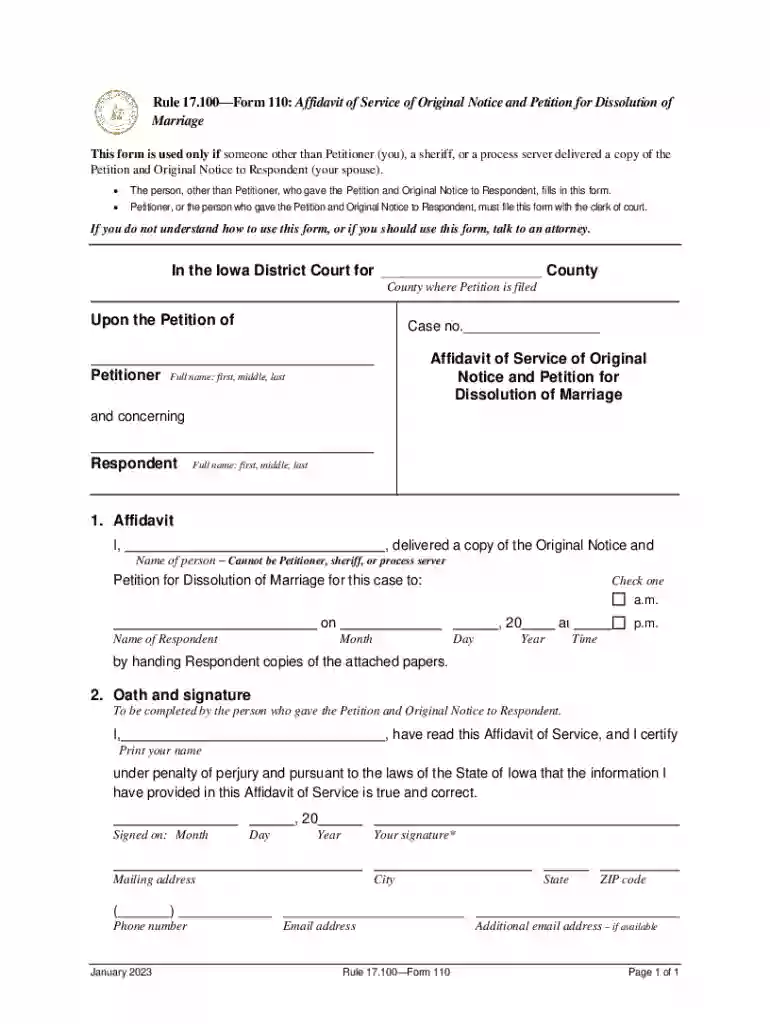
The "17 110 Affidavit of Service of Original Notice and Petition for Dissolution of Marriage" is a legal document used in the state of Iowa. This affidavit confirms the delivery of the original notice and petition for dissolution of marriage to a respondent, who is the spouse in divorce proceedings. It is an essential component that proves the respondent has been formally notified about the initiation of divorce proceedings.
Key Functions
- Proof of Service: This affidavit serves as undeniable evidence that the necessary documents have reached the respondent.
- Legal Compliance: Filing this document is crucial to meet legal standards and ensure any subsequent proceedings are valid.
Importance in Divorce Proceedings
- Ensures fair process by providing the respondent an opportunity to respond.
- Avoids potential legal disputes regarding lack of notification.
How to Use the 17 110 Affidavit of Service
The affidavit is completed by an individual (other than the petitioner, sheriff, or process server) who delivers the legal documents to a respondent. Usage steps include:
- Completion: Include the individual's name who performed the service, details of the respondent, and date and method of delivery.
- Signing and Oathing: The serving individual must take an oath of truth and sign in the presence of a notary.
- Filing: Submit the signed affidavit to the court clerk to complete the legal procedure.
How to Obtain the 17 110 Affidavit of Service
Sources
- Court Office: Available at local courthouses or by request from the court clerk.
- Online Resources: Various legal aid websites may offer downloadable versions.
Considerations
- Ensure to obtain the most current version as required by the state of Iowa.
- Verify compatibility if you choose to fill it digitally using tools like DocHub.
Steps to Complete the 17 110 Affidavit of Service
- Fill Personal Information: Enter the name and address of the individual serving the documents.
- Detail Service Actions: Specify details such as when, where, and how the documents were served.
- Complete Affidavit Sections: Follow all instructions to ensure each necessary segment of the affidavit is filled accurately.
- Notarization: The affidavit must be notarized to be considered valid.
Filling in Specific Fields
- Service Details: Ensure precise information about the service date, time, and location.
- Oath and Signature: Must be signed in the presence of a notary public who will verify the oath and sign as well.
Why Should You Use the 17 110 Affidavit
This affidavit is mandatory for legal proceedings in divorce cases to ensure all parties are informed fairly and legally. It assists in maintaining a transparent process and aids in preventing claims of insufficient notice which could void proceedings.
Benefits
- Avoid Legal Delays: Ensures that no delays occur due to improper notice.
- Protects Legal Rights: Safeguards the legal rights of both parties involved in the divorce.
Who Typically Uses the Affidavit
The document is often used by individuals tasked with serving legal documents in a divorce case. This typically includes:

- Court-appointed process servers
- Registered legal document service providers
- Individuals authorized by the court
Participants in the Process
- Petitioner: Initiates the divorce and arranges serving of documents.
- Respondent: Receives the documents to prepare a response.
Key Elements of the Affidavit
The 17 110 Affidavit contains several crucial components, each essential for its legal validity:
- Affirmation of Service: A detailed account of how documents were served.
- Certifying Individual's Signature: A verifying signature under oath to ensure authenticity.
- Notarial Acknowledgment: A notary’s signature, confirming the document’s legality.
State-Specific Rules
In Iowa, specific guidelines govern the use of this affidavit. Notably, the form demands adherence to Rule 17.100—Form 110. It requires filing with the clerk of court and must comply with Iowa's jurisdictional requirements.
Iowa-Specific Considerations
- Only individuals legally allowed by Iowa law can serve documents in divorce proceedings.
- Variations in form details may exist due to evolving state mandates.
Examples of Using the Affidavit
Consider a divorce case where a spouse disputes receiving court papers. The 17 110 Affidavit serves as documented proof resolving this potential dispute effectively.
Scenarios
- Contentious Divorces: Where one party might deny receiving notice.
- Cross-jurisdiction Deliveries: Affirming document delivery across state lines.
Form Submission Methods
The affidavit can be submitted through various methods to the clerk of the court:
- In-Person: Directly at the courthouse in the presence of the clerk.
- Mail: Sent through a courier service ensuring it reaches within stipulated deadlines.
- Online: When filing systems support digital submissions, platforms like DocHub facilitate secure digital filing.