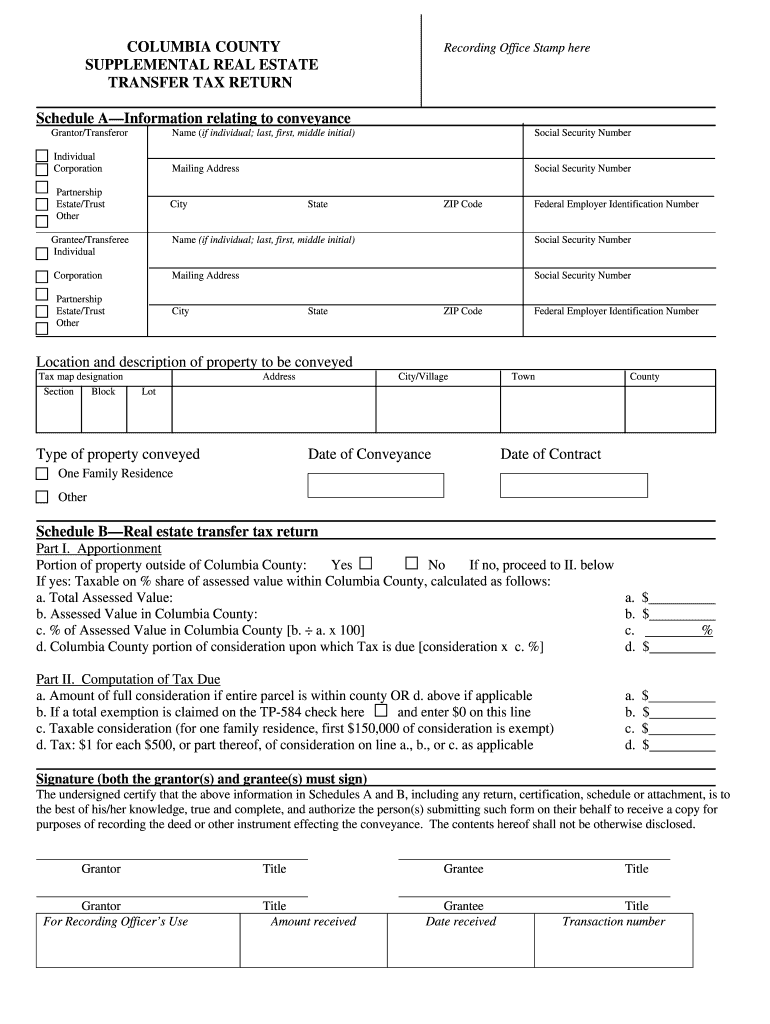
Columbia county supplemental transfer tax form 2026

Get Form
columbia county supplemental transfer tax form Preview on Page 1

Here's how it works

01. Edit your columbia county supplemental transfer tax form online
Type text, add images, blackout confidential details, add comments, highlights and more.
02. Sign it in a few clicks
Draw your signature, type it, upload its image, or use your mobile device as a signature pad.
03. Share your form with others
Send columbia county transfer tax form via email, link, or fax. You can also download it, export it or print it out.

How to use or fill out Columbia County Supplemental Transfer Tax Form with DocHub

Form edit decoration
9.5
Ease of Setup
DocHub User Ratings on G2
9.0
Ease of Use
DocHub User Ratings on G2
  1. Click ‘Get Form’ to open the Columbia County Supplemental Transfer Tax Form in our editor.
  2. Begin with Schedule A, entering the grantor's information. Fill in the name, social security number, and mailing address. Select the appropriate entity type (Individual, Corporation, etc.) and provide the Federal Employer Identification Number if applicable.
  3. Next, input the grantee's details in a similar manner. Ensure accuracy in names and addresses as this information is crucial for processing.
  4. Proceed to describe the property being conveyed. Include tax map designation, address, and type of property. Be sure to specify the date of conveyance and contract.
  5. In Schedule B, start with Part I by indicating if any portion of the property is outside Columbia County. If yes, calculate the taxable share based on assessed values provided.
  6. Complete Part II by determining the tax due based on consideration amounts. Remember to sign at the bottom of the form once all fields are filled out correctly.

Start using our platform today to fill out your Columbia County Supplemental Transfer Tax Form easily and for free!

be ready to get more

Complete this form in 5 minutes or less

Get form

Got questions?

We have answers to the most popular questions from our customers. If you can't find an answer to your question, please contact us.
Contact us
In Washington DC, Deed Transfer Tax The 2024 rate is 1.1 % of consideration or fair market value for residential property transfers less than $400,000 and 1.45% of consideration or fair market value on the entire amount, if transfer is greater than $400,000.
You buy a home and pay the taxes upon closing. The property taxes you pay at closing will be based on the sellers property tax amount, since the property tax roll does not immediately get updated.
In the vast majority of real estate transactions, the seller pays the transfer taxes. The only real exception is in new developments where they are part of the negotiation (but still usually paid by the seller, especially in softer markets).
Either the seller or buyer may pay the real property transfer tax during the transfer or sale. If it is not paid, the seller and buyer are jointly and severally liable to the City for the payment of the tax.
Understanding Transfer Taxes A transfer tax on real estate may be imposed by state, county, or municipal authorities for the privilege of transferring real property within the jurisdiction. The government is effectively taxing the transfer of a legal deed, certificate, or title from a seller to a buyer.

Security and compliance

At DocHub, your data security is our priority. We follow HIPAA, SOC2, GDPR, and other standards, so you can work on your documents with confidence.

Learn more
ccpa2
pci-dss
gdpr-compliance
hipaa
soc-compliance
be ready to get more

Complete this form in 5 minutes or less

Get form

People also ask

A supplemental tax on the conveyance of residential real property, or interest therein, when the consideration is $2 million or more. The tax rate is an incremental rate between . 25% and 2.9% based on the purchase price.
Who is Exempt from the Tax? A foreign government, a person acting on behalf of a foreign government, or the head of a foreign governments diplomatic mission. The premises must be used exclusively for diplomatic or consular purposes. Other usage may result in the payment of tax.

Related links