Ct agreement 2025

Get Form
ct agreement Preview on Page 1

Here's how it works

01. Edit your form online
Type text, add images, blackout confidential details, add comments, highlights and more.

02. Sign it in a few clicks
Draw your signature, type it, upload its image, or use your mobile device as a signature pad.

03. Share your form with others
Send it via email, link, or fax. You can also download it, export it or print it out.

How to use or fill out ct agreement with our platform

Form edit decoration
9.5
Ease of Setup
DocHub User Ratings on G2
9.0
Ease of Use
DocHub User Ratings on G2
  1. Click ‘Get Form’ to open the ct agreement in the editor.
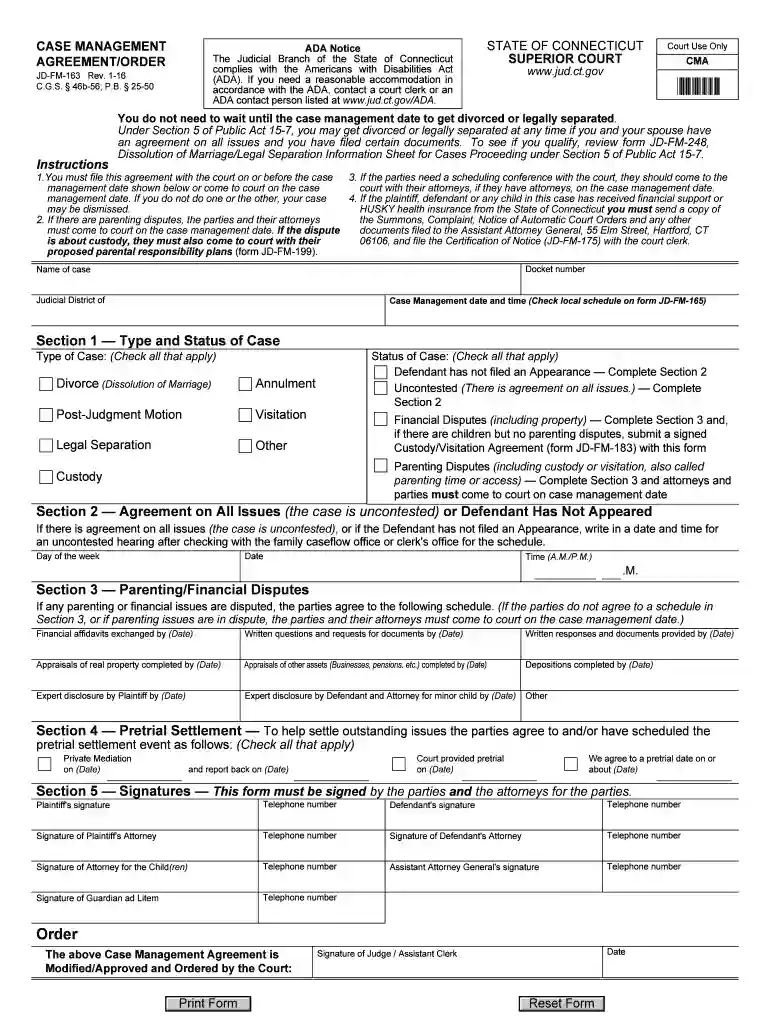
  2. Begin by filling out Section 1, where you will select the type and status of your case. Check all applicable boxes for Divorce, Annulment, or other options.
  3. In Section 2, if your case is uncontested, indicate a date and time for an uncontested hearing after confirming with the family caseflow office.
  4. Proceed to Section 3 if there are any parenting or financial disputes. Fill in the schedule for exchanging financial affidavits and other necessary documents.
  5. Complete Section 4 by checking any pretrial settlement events that have been scheduled, such as private mediation or court-provided pretrial.
  6. Finally, ensure all parties sign in Section 5. Include signatures from both parties and their attorneys before submitting the form.

Start using our platform today to streamline your ct agreement process for free!

See more ct agreement versions

We've got more versions of the ct agreement form. Select the right ct agreement version from the list and start editing it straight away!
Versions Form popularity Fillable & printable
2020 4.8 Satisfied (200 Votes)
2016 4.3 Satisfied (245 Votes)
2012 4.3 Satisfied (174 Votes)
be ready to get more

Complete this form in 5 minutes or less

Get form

Got questions?

We have answers to the most popular questions from our customers. If you can't find an answer to your question, please contact us.
Contact us
A lawsuit is a formal case that has been filed in the appropriate court of law, while a tort claim is usually an informal notice of claim that may trigger an informal resolution without the cost of litigation.
Tort Law in Connecticut: What Is It? Connecticut tort law is the foundation upon which the court decides whether a party or entity is held liable for injuries that are caused to a claimant. Connecticut tort law is primarily governed by General Statutes Title 52 and Title 38a.
A Connecticut LLC Operating Agreement is a written contract between the LLC Members (LLC owners). It is the LLCs governing document. This legal document includes detailed information about LLC ownership structure, who owns the company and how the LLC is managed.
4 types of torts that can harm your business Negligence torts: A slippery slope. Product liability: A fault in the assembly line. Intentional torts: Deliberate harm, unwanted consequences. Torts against property: Guarding against intrusions.
There are numerous specific torts including trespass, assault, battery, negligence, products liability, and intentional infliction of emotional distress. There are also separate areas of tort law including nuisance, defamation, invasion of privacy, and a category of economic torts.
be ready to get more

Complete this form in 5 minutes or less

Get form