




What this declaration means
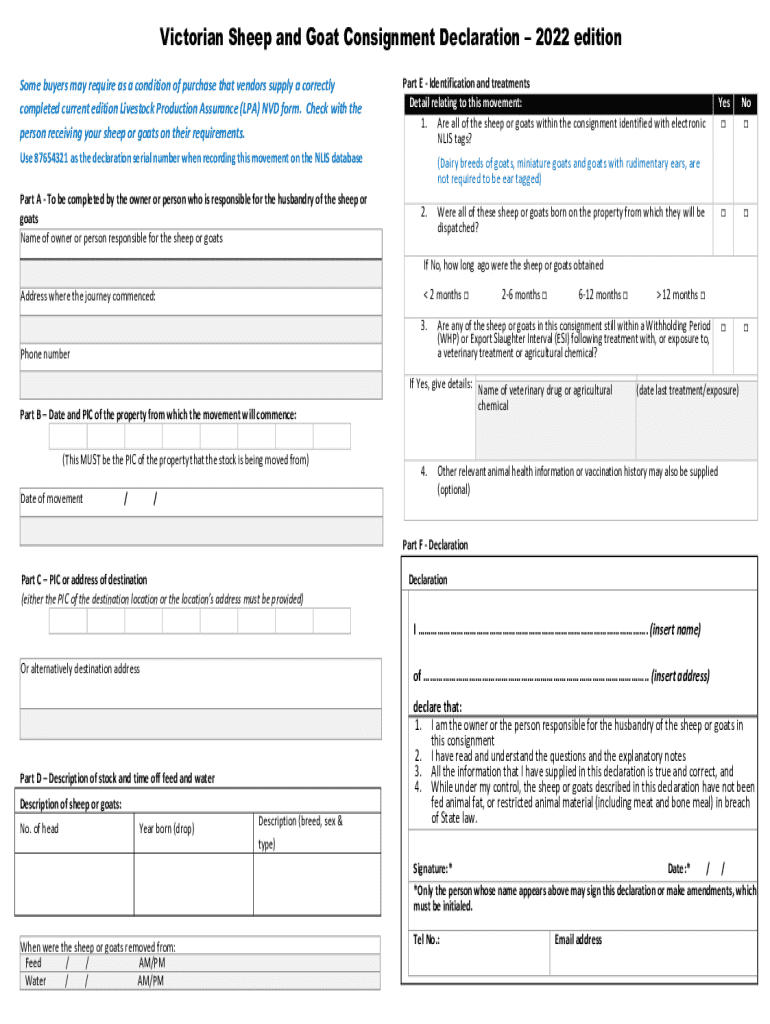
The Victorian Sheep and Goat Consignment Declaration is a livestock movement and assurance document used when sheep or goats are consigned in Victoria. It records essential details about the animals, the vendor, the destination, and the compliance statements that support lawful and traceable movement through the supply chain.
In practical terms, the form helps show that the consignment has been prepared with the required health, property, and biosecurity information. Buyers, agents, saleyards, processors, and transport participants may rely on it to verify that the stock being moved matches the declaration made by the vendor.
The declaration is closely tied to livestock traceability and quality assurance expectations. In many transactions, it functions as part of the standard paperwork expected before animals can be accepted, sold, transported, or processed. A missing or incomplete declaration can delay pickup, cause rejection at a receival point, or create compliance issues later.
The form also supports transparency in animal trading. It captures details that help the next holder understand where the animals came from, whether they have been exposed to particular risks, and whether any additional management or segregation is needed. That is especially important when sheep and goats are moved between properties, through markets, or into processing facilities.
For smaller producers, the declaration may be completed only occasionally, such as when a draft is sold to a local buyer. For larger operations, it can become part of a repeated livestock movement workflow, especially when multiple consignments leave a property in the same season.
Because the form is used in a regulatory and commercial environment, accuracy matters. Information should reflect the actual consignment at the time of movement, not an earlier draft, estimate, or generic property record. Any differences between what is declared and what is loaded can affect acceptance and accountability.
Who typically uses it
The Victorian Sheep and Goat Consignment Declaration is typically used by livestock vendors, producers, agents, brokers, saleyards, transport operators, and receiving buyers. Each party uses the information differently, but all of them benefit from a clear and complete record of the consignment.
Vendors are usually the primary people completing the declaration. This includes sheep producers selling lambs, wool growers moving cull ewes, goat producers conscripting breeding stock, and mixed-farm operators sending animals to a market or processor. In many cases, the vendor or an authorised representative signs the form on behalf of the property.
Agents often help prepare the form, especially where animals are sold through an intermediary or where several producers are consigning stock through the same sale channel. An agent may collect property details, vendor identifiers, and stock information, then ensure the paperwork accompanies the movement.
Saleyard operators and processors use the declaration to confirm the consignment’s identity and acceptability. They may compare the form against NVD or other movement paperwork, check vendor declarations, and confirm any special handling requirements. If the paperwork is inconsistent, the load may be held for clarification.
Transporters use the document to understand who is responsible for the animals, where they came from, and where they are going. This can matter when there are loading disputes, destination changes, or questions about the exact consignment being carried.
Recipients such as buyers or feedlot operators may also review the form after arrival to confirm chain-of-custody details and ensure the stock matches purchase expectations. In larger commercial operations, the declaration may be archived with other livestock records for audit and reconciliation purposes.
How to obtain the form
The Victorian Sheep and Goat Consignment Declaration can usually be obtained through livestock industry channels, government-adjacent livestock documentation sources, saleyards, agents, and supply-chain participants who regularly handle sheep and goat movements. In practice, many producers receive it from the buyer, agent, or receiving facility that requires the paperwork.
Some versions may be made available as a printable paper form, while others may be provided through electronic document systems used by producers and agents. The format depends on how the seller or receiving business manages livestock documentation.
A producer may obtain the form in advance of sale to prepare stock details before loading day. This is common when multiple lots are being moved, because it allows time to verify property identifiers, head counts, vendor details, and destination information without last-minute errors.
In some situations, the form may be bundled with related livestock paperwork. For example, a sale packet may include a consignment declaration, movement documentation, and vendor assurance forms together, so that the stock can be received without delay.
If the form is being completed digitally, the source may be a document management platform, a livestock software system, or a shared file from an agent. In those cases, it is important to confirm that the edition being used is current and that any fields align with the latest requirements from the receiving party.
Where an older printed version exists in a file cabinet or truck folder, it should be checked carefully before use. Form names, field labels, and certification statements can change over time, and outdated paperwork may not satisfy current acceptance criteria even if the overall purpose looks similar.
Main details it records
The Victorian Sheep and Goat Consignment Declaration usually collects the core facts needed to identify the consignment and support compliance. While exact field names can vary by edition, the form generally focuses on the vendor, property, stock description, destination, and declaration statements.
Typical details include the vendor’s name, property identification, and contact information. This allows the form to be tied back to the source property and the person responsible for the stock at the time of dispatch.
The form also commonly records the number and type of animals consigned. That might include sheep versus goats, age or class of stock, whether the animals are lambs, ewes, rams, wethers, kids, does, or bucks, and any counts by draft or lot. Accurate head counts matter because they affect movement records, payment, receival, and reconciliation.
Destination information is another central element. The declaration may identify the saleyard, processor, buyer, or other receiving point. This helps support traceability and clarifies where the consignment is intended to go if questions arise after loading.
A declaration section is also important. This is where the vendor typically confirms that the information provided is true and complete to the best of their knowledge. Depending on the form version and the transaction, this may include statements about health status, property status, or other management assurances.
Some versions also contain space for signatures, dates, and in some cases supporting identifiers or references from related livestock documentation. These details may seem routine, but they are often the elements that determine whether the consignment can move without administrative delay.
How to complete it correctly
Completing the Victorian Sheep and Goat Consignment Declaration begins with confirming the exact version requested by the buyer, agent, or receiving site. The version should match the current transaction requirements, since the wrong edition can create avoidable problems at delivery.
The first step is to enter the vendor and property information exactly as it should appear on the records. Names should be consistent with other livestock paperwork, and property identifiers should be checked against established farm records rather than entered from memory.
Next, the stock details should be reviewed against the actual animals being loaded. This is where counts, classes, and any distinguishing notes need to match the physical consignment. If a draft has changed since the sale was arranged, the form should be updated before signing.
The destination and transaction details should then be completed. If animals are being sent to a saleyard first and then onward, the paperwork should reflect the intended movement as requested by the receiving party or agent. Ambiguous destination entries can create delays during unloading or resale.
Once all information has been entered, the declaration statements should be read carefully. This part is important because it is usually the legal and commercial attestation that the details are accurate and that the consignment meets the stated conditions. Any uncertainty should be resolved before the form is signed.
A practical example is a producer sending 80 merino wethers to a regional saleyard. The form should show the correct vendor name, property details, head count, stock class, destination, date, and signature. If the count changes to 78 because two animals were left off the truck, the form should be corrected before departure or updated as required by the receiving process.
Another example is a goat breeder consigning does to a processor after a temporary agistment move. The declaration should reflect the actual source property, the right count, and any relevant movement details. If the animals were held across more than one location, the vendor should be careful that the form matches the movement being declared, not a previous holding pattern.
Legal and compliance role
The Victorian Sheep and Goat Consignment Declaration has an important compliance function because livestock movement records are used to support traceability, animal management, and market integrity. It is not just an administrative page; it is part of the documentary record that supports lawful handling of the consignment.
In many livestock transactions, a correctly completed declaration helps demonstrate that the vendor has provided truthful information about the animals and their movement. That can matter if a load is later questioned by a buyer, a saleyard operator, or a regulatory authority.
The form can also support biosecurity response efforts. If there is a disease or movement investigation, records associated with the consignment may help trace where the animals came from, where they went, and who handled them. In that context, the precision of the document becomes especially important.
For commercial buyers, the declaration may be a condition of purchase. If that condition is stated in advance, failing to provide the form may mean the stock cannot be accepted, even if the animals themselves are otherwise suitable. This makes the form part of the trading contract in practical terms.
There may also be broader livestock identification or movement obligations connected to sheep and goats in Victoria. The declaration should be viewed alongside any accompanying identification, movement, or assurance paperwork rather than as a standalone document with no other recordkeeping impact.
If information on the declaration is false, incomplete, or inconsistent with the actual consignment, consequences can include refusal of the load, correction requests, payment delays, or further compliance review. The legal risk is often highest where the form is signed without checking the loading details.
State rules and local practice
Because the form is Victorian, the requirements and expectations around it are shaped by Victoria’s livestock movement rules, commercial practice, and supply-chain standards. Even where the document is used in a broader national trade context, the local Victorian process is what usually determines how it is completed and accepted.
One practical feature of state-specific practice is that vendors may need to use the form in combination with other movement or assurance paperwork accepted in the Victorian sheep and goat sector. The exact combination can vary depending on whether the destination is a saleyard, processor, or another property.
Local practice also matters because different receiving sites can apply slightly different administrative checks. A processor may focus on consistency between declarations and truck manifests, while a saleyard may focus on vendor identification and lot accuracy. The declaration has to satisfy the specific receiving pathway in use.
Another state-level consideration is record retention. Even when the form is completed only once, the business may need to keep a copy as part of farm, sale, or compliance records. That is especially important for regular sellers who need to trace prior consignments later.
If a property sits near a border or animals are sold to interstate buyers, the Victorian form may still be used for the initial movement, but other state or destination-specific documentation may also be needed. This can create added complexity where one consignment crosses multiple jurisdictions.
Producers with mixed livestock enterprises should also be careful not to assume that a sheep and goat declaration functions the same way as cattle or pig movement paperwork. Each species group can have its own records, declarations, and receiving expectations, so the correct Victorian form should always be matched to the correct species and transaction.
Important terms to know
The Victorian Sheep and Goat Consignment Declaration uses livestock industry language that may be familiar to regular producers but less obvious to occasional sellers. Understanding the common terms reduces the chance of mistakes when completing the form.
A “consignment” usually means the group of animals being moved together under the same paperwork. This might be a single draft from one paddock or multiple pens loaded as one shipment, depending on how the stock is handled.
“Vendor” refers to the person or business offering the animals for sale or movement. In many cases, this is the property owner, but it may also be an authorised manager, agent, or enterprise representative.
“Destination” means the place the animals are going. That can be a saleyard, abattoir, feedlot, another property, or a holding point if the route is staged. The form should reflect the actual intended destination, not a guessed or temporary one.
“Lot” or “draft” can refer to a subset of the consignment. Where several groups of animals are moving together, accurate lot descriptions help ensure that the right animals are assigned to the right records, price, or treatment plan.
“Declaration” is the statement of truth by the vendor. Signing it means the information provided is being affirmed as accurate, so the signer should be certain that the animal count, property details, and movement information are all correct before signing.
“Traceability” is the ability to track where the animals came from and where they moved. This is one of the main policy and commercial reasons the form exists, because livestock records are most useful when they can be traced back through the chain.
Examples of real use
A common example is a family farm selling 40 mixed-age ewes through a regional saleyard. The vendor completes the declaration with the property details, stock count, date, and destination. The saleyard uses the form to match the load to the vendor record and ensure the consignment is accepted without documentation problems.
Another example is a goat enterprise sending breeding does to a buyer who wants assurance that the animals are coming from a clearly identified source. In this case, the declaration helps the buyer reconcile what was purchased with what was loaded and delivered. If the buyer later notices a discrepancy, the form provides the starting point for review.
A more complex case is a producer who has sheep agisted on a second property and wants to consign them after a sale. The declaration must describe the actual consignment accurately, and the vendor should be careful that property details and movement notes match the correct holding arrangement. If the stock has moved between locations, the paperwork should not blur the source of the consignment.
A mixed-lot example might involve lambs and cull ewes leaving the same farm on the same day but going to different destinations. In that situation, separate declarations or clearly separated lot details may be needed so that each receiving party gets the correct record. Combining them incorrectly can cause pricing disputes or receival confusion.
For a processor-directed consignment, the form may be reviewed before unloading to confirm consistency with the truck manifest. If the head count, class, or property details do not align, the processor may request clarification before the load is processed. That is one reason a careful final check before dispatch is so valuable.
An occasional seller, such as a landholder clearing a few goats from a property, can use the form in the same general way as a commercial producer. The scale is smaller, but the need for accuracy is the same. Even a small consignment can create issues if the paperwork is incomplete or mismatched.
Required documents and records
The Victorian Sheep and Goat Consignment Declaration is often used alongside other records that help confirm identity, ownership, movement, or sale details. The exact bundle depends on the receiving party and transaction structure, but a complete file usually includes more than just one form.
A vendor should generally have the current declaration completed, signed, and ready to accompany the stock or be available electronically where accepted. If the declaration is separate from transport records, both sets should be checked for consistency before dispatch.
Supporting records may include property identification details, vendor account information, sale instructions, or other movement documentation requested by the buyer or agent. Where electronic systems are used, a digital copy of the signed declaration may be stored with transaction notes or sale confirmations.
If the animals are being moved through a saleyard, the vendor may also need sale documents, lot references, or receival paperwork. These records help prevent confusion where several consignments arrive on the same day from different properties.
Where a buyer requires specific assurances, additional documentation may be requested. That can include health-related declarations, quality assurance statements, or other property-level confirmations depending on the risk profile of the stock and the nature of the sale.
It is also useful to retain a copy of the final signed form after the movement is complete. In practice, that copy may be needed later to answer a buyer query, reconcile payment, verify a dispatch, or respond to an audit or traceability question.
Paper and digital use
The Victorian Sheep and Goat Consignment Declaration can be managed on paper or in digital form, depending on the workflow of the producer, agent, and buyer. Both formats can be effective if they are complete, legible, and accepted by the receiving party.
Paper forms are still common in livestock environments because they are easy to carry, sign, and hand over at loading or delivery. They are especially useful where internet access is limited, multiple parties are on-farm, or the consignment process happens quickly in a yard or truck-side setting.
Digital forms are often preferred for recordkeeping and remote coordination. They can be shared by email, completed on a computer or mobile device, and stored with other transaction files. This can reduce errors from handwriting, especially where names, property details, or counts are complex.
A digital workflow is particularly helpful when a producer manages several consignments at once. The form can be saved, duplicated where appropriate, and updated with different lot counts or destinations without retyping all the basic property details each time.
Paper still has advantages in the field. If a buyer or transport operator needs a physical copy at loading, a printed declaration can be reviewed immediately, signed by hand, and kept with the stock documents. This can be preferable in busy sale yards or remote farm operations.
In either format, the key issue is version control. A digital form that is out of date, or a paper copy from an old folder, can be just as problematic as a blank form. The content should reflect the current accepted version for the transaction and should be complete before the animals leave the property.