






Definition and Meaning
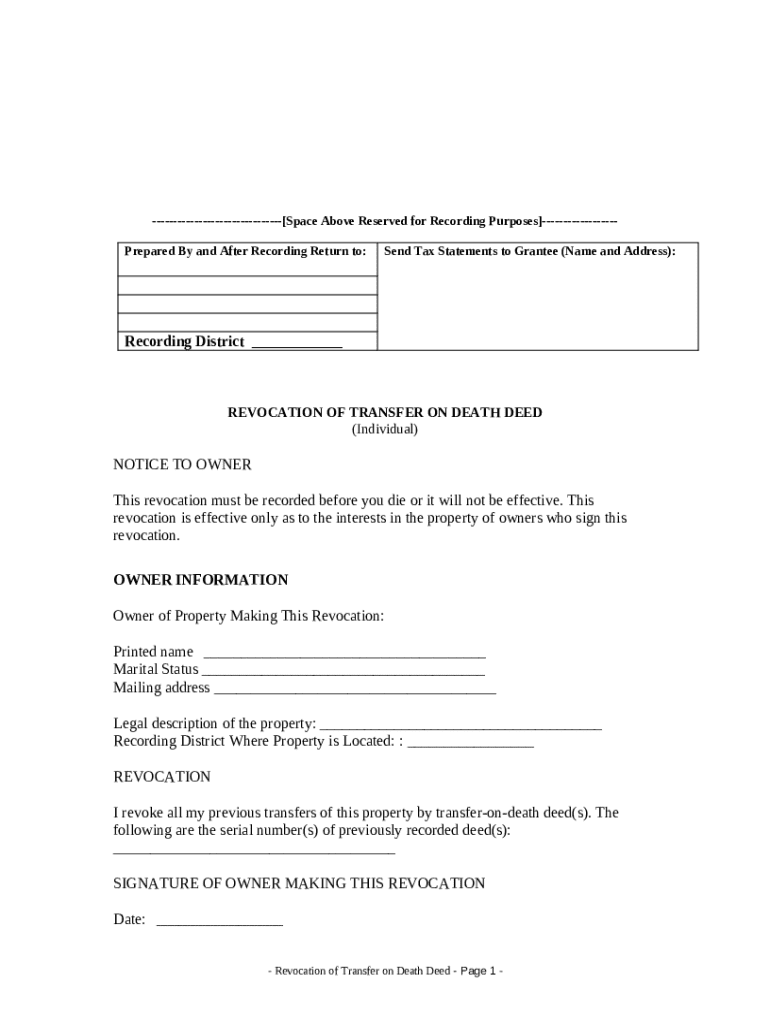
The "Revocation of Transfer on Death Deed" is a legal document used to nullify the transfer of property outlined in a previously executed Transfer on Death (TOD) deed. A TOD deed allows property to be transferred directly to a beneficiary upon the owner's death without the need for probate. The revocation ensures that the intended transfer does not occur, giving the original owner continued control over the property.
Key Features
- Cancels Prior Transfer: Nullifies any prior beneficiary designations made in a TOD deed.
- Maintains Owner Control: Keeps property ownership with the original owner until a new decision is made.
- Recorded with Local Authority: Must be filed at the county recorder's office to be valid.
How to Use the Revocation of Transfer on Death Deed
Using the revocation form involves several steps to ensure that the cancellation is legally valid. Proper execution is critical to preventing the automatic transfer upon the owner's death.
Steps to Follow
- Fill Out the Form: Complete all sections of the revocation form accurately, including property details and your personal information.
- Notarization: The form typically requires notarization to verify the identity of the individual executing the revocation.
- Record the Deed: Submit the completed and notarized form to the county recorder's office where the property is located.
- Confirmation: Verify that the recorder's office has properly recorded the revocation deed.
Importance of Revoking a Transfer on Death Deed
Revoking a TOD deed can be crucial for various personal and legal reasons. Removing the deed can alter inheritance plans and ensure that property is handled according to updated wishes.
Reasons for Revocation
- Change of Intent: New beneficiaries may be desired due to personal or familial changes.
- Estate Planning Alterations: Updates to estate strategies that no longer align with the terms of the original TOD deed.
- Avoid Unintended Transfers: Prevents property from automatically passing to someone who no longer is intended as the recipient.
Key Elements of the Revocation of Transfer on Death Deed
Understanding the essential parts of this legal document is necessary to make informed decisions and ensure proper execution.
Components
- Grantor Identification: The original owner who is revoking the TOD deed.
- Property Description: Legal description of the property as recorded in the original deed.
- Declarative Statement: A clause that clearly states the intention to revoke the TOD deed.
- Signatures and Dates: Must be properly signed and dated to be effective.
- Notary Acknowledgment: Official notarization is often required to finalize the document.
State-Specific Rules for the Revocation of Transfer on Death Deed
Each state may have unique regulations governing the revocation of a TOD deed, influencing the process and requirements for validity.
Common Variations
- Filing Requirements: Different states have distinct rules regarding where and how to file.
- Notification Obligations: Some states may require notifying the former beneficiary of the revocation.
- Time Restrictions: Specific deadlines by which a revocation must be filed to be effective.
Legal Use of the Revocation of Transfer on Death Deed
Utilizing this form legally ensures compliance with state laws and aligns property management with the owner's current intentions.
Legal Considerations
- Compliance with Statutes: Adhere to state laws governing TOD deeds and revocations.
- Proper Execution: Legal effectiveness requires correct completion, filing, and recording processes.
- Advisor Consultations: Engaging legal experts to ensure that all legal requirements are met can be beneficial.
Examples of Using the Revocation of Transfer on Death Deed
Practical scenarios highlight the utility and impact of revoking a TOD deed, showcasing various contexts in which revocation might be necessary.
Real-World Scenarios
- Inheritance Planning: Adjustments in inheritance plans to exclude previously designated beneficiaries.
- Divorce Settlements: Removal of an ex-spouse as a beneficiary following legal separation or divorce.
- Business Decisions: Revocation of property transfer to adapt to changes in business ownership or partnerships.
Required Documents for Revocation
Accurate and complete documentation is essential to ensuring the effective cancellation of a TOD deed.
Necessary Documents
- Completed Revocation Form: The primary document nullifying the original TOD deed.
- Original TOD Deed Copy: A reference to the previously recorded document.
- Proof of Identity: Legal identification for notarization and verification purposes.
Filing these documents correctly is essential to effectively revoke the TOD deed and uphold the current property owner's intentions.