




01. Edit your form online
Type text, add images, blackout confidential details, add comments, highlights and more.

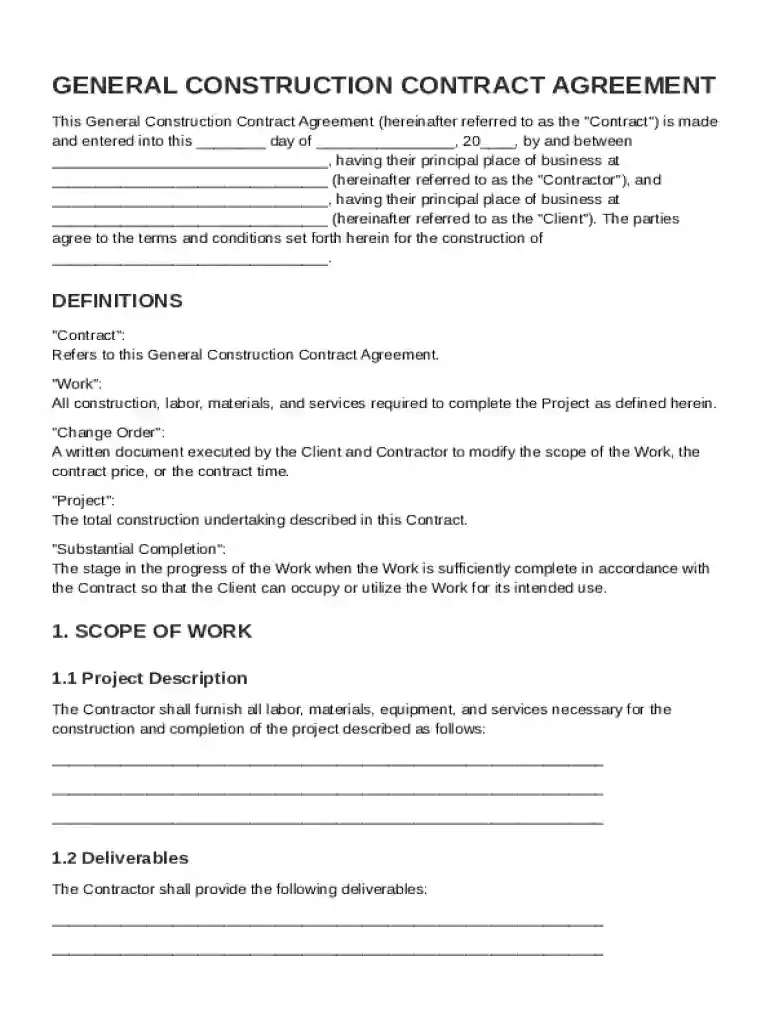
Type text, add images, blackout confidential details, add comments, highlights and more.

Draw your signature, type it, upload its image, or use your mobile device as a signature pad.

Send it via email, link, or fax. You can also download it, export it or print it out.
A General Construction Contract Template is a pre-structured document that outlines the terms and conditions between a contractor and a client for a construction project. This form serves as a foundational agreement, establishing the scope of work, payment schedules, timelines, and responsibilities of both parties involved in the undertaking.
Scope of Work: This section defines the specific tasks and responsibilities to be carried out by the contractor. It helps in clarifying expectations and ensuring that all parties are aligned on the project's requirements.
Contract Price and Payment: Outlines the total cost of the project and sets a clear schedule for payments. This ensures transparency and helps manage cash flow throughout the project's duration.
Project Schedule: Establishes the timelines for project initiation, milestones, and completion. This aids in coordinating efforts and managing resources efficiently.
By providing a comprehensive overview, this template helps mitigate potential conflicts through clarity and mutual understanding.
The template contains several vital components, each serving a unique purpose to protect the interests of both the client and the contractor.
Compliance with Laws: Ensuring adherence to local, state, and federal regulations to avoid legal complications and project delays.
Insurance Requirements: Specifies the necessary insurance coverage to protect against liabilities during the construction process.
Performance Guarantees: Assurance that the completed work will meet the agreed standards.
Material Warranties: Covers the quality and durability of the materials used, thereby providing security for the client.
Termination Procedures: Outlines the process for contract termination under various circumstances, protecting the rights of both parties.
Dispute Resolution Methods: Provides strategies such as mediation or arbitration to resolve conflicts without resorting to litigation.
Creating an effective contract requires careful consideration of several important steps.
Review and Customize: Begin by reviewing the template to understand its structure. Tailor the sections to fit the specific needs of your project, ensuring that all relevant details are accurately captured.
Define Key Terms: Clearly define terms such as "client," "contractor," and "project" to ensure all parties have a common understanding.
Enter Specific Details: Fill in project-specific information, including the scope of work, payment terms, and project timeline.
Include Legal Provisions: Insert necessary legal terms that comply with state-specific laws and regulations.
Collaborate and Review: Work with legal advisors and stakeholders to review the document, identifying and addressing any potential issues.
Finalize and Sign: Once all parties agree on the terms, finalize the contract with signatures from the client and contractor, making it legally binding.
Understanding the terminology used in the contract is vital for the effective execution of a construction agreement.
These terms facilitate a common language for communication and decision-making among involved parties.
This template is widely utilized by various stakeholders within the construction industry.


These users rely on the template to establish a foundation of trust and responsibility, essential for successful project completion.
Certain states in the U.S. have specific regulations that influence how construction contracts are drafted.
Understanding these nuances is crucial for compliance and minimizing legal issues. Contractors and clients should consult with local legal counsel to ensure their contracts meet state-specific requirements.
Real-world scenarios demonstrate the practical application of construction contracts:
These examples highlight the template's adaptability across different contexts, reinforcing its importance as a versatile contractual tool.
A General Construction Contract Template serves as a legally binding document and must be used with careful attention to the legal stipulations it entails.
By recognizing the legal weight of the template, parties can confidently engage in construction projects, knowing they are protected by a robust legal framework.
At DocHub, your data security is our priority. We follow HIPAA, SOC2, GDPR, and other standards, so you can work on your documents with confidence.




This includes, but is not limited to, equipment, operating costs, business costs, employment costs, taxes, Social Security contributions/payments, disability.
Contract: the Agreement, the Conditions and the Schedules all as amended by Contract shall remain unaffected notwithstanding any such sub-contracting.
Construction Contract Templates. Long Form Contract Templates For Complex Project scopes or Lump Sum Contracts over $1Million.


