
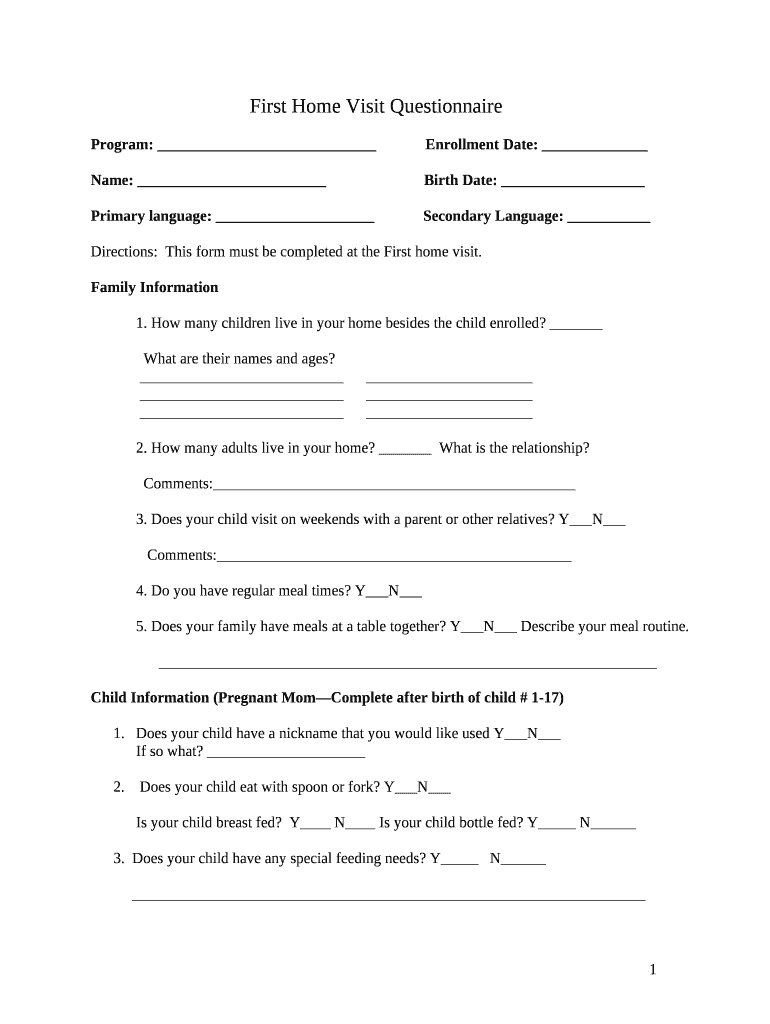







Key Elements of the First Home Visit Questionnaire
The First Home Visit Questionnaire is designed to collect comprehensive data about a family's situation during the initial home visit. The form typically includes the following key elements:
- Family Information: Collects basic details such as family size, structure, and primary contact details.
- Child Development: Assesses the developmental milestones and needs specific to the child.
- Parental Insights: Gathers parent insights on the child's behavior, routines, and other relevant observations.
- Health Information: Covers healthcare details, including immunizations and medical history.
- Support Systems: Identifies any community or familial support currently in place.
Each section is crucial for painting a detailed picture of the family situation, ensuring services are tailored to meet their specific needs.
Steps to Complete the First Home Visit Questionnaire
Completing the First Home Visit Questionnaire effectively requires attention to detail. Follow these steps to ensure all necessary information is accurately captured:
- Gather Preliminary Information: Start by collecting basic family demographics and contact information.
- Assess Child Development: Document developmental milestones and any concerns related to the child's growth.
- Consult with Parents: Engage parents to gather comprehensive insights on routines, behaviors, and special needs.
- Review Health Records: Ensure that medical history, including vaccinations, is accurately filled.
- Identify Support Networks: Note any existing support systems the family might be relying on.
Carefully following these steps can lead to a thorough understanding of the family's needs, which is essential for effective follow-up services.
How to Use the First Home Visit Questionnaire
The questionnaire serves various purposes depending on the intended use case. Primarily, it facilitates:
- Needs Assessment: Helps identify specific family needs for tailored service delivery.
- Program Monitoring: Assists in tracking developmental progress and service impact over time.
- Family Engagement: Encourages family participation and input, fostering a collaborative support environment.
Using this form appropriately ensures that the data collected is beneficial for program development and evaluation.
Who Typically Uses the First Home Visit Questionnaire
This form is used by professionals and organizations involved in:
- Child Development Services: Used to understand the child's growth and development context.
- Healthcare Providers: To assess child health needs and track medical histories.
- Social Services: Organizations to evaluate the overall support and resources required by the family.
- Educational Institutions: To tailor educational plans based on individual child needs.
These entities utilize the form to gain comprehensive insights into family dynamics and child development and to provide necessary support services.


Examples of Using the First Home Visit Questionnaire
Several practical scenarios illustrate the application of the First Home Visit Questionnaire:
- Case Study A: A social worker uses the form to assess the needs of a family with a newborn, identifying necessary healthcare and developmental resources.
- Case Study B: An educational consultant employs the form to tailor an individualized learning plan for a child with special needs.
- Case Study C: A public health nurse completes the questionnaire during a home visit, ensuring all health records are current and accurate.
These examples show the questionnaire's flexibility across different professional disciplines and its ability to support customized service delivery.
Legal Use of the First Home Visit Questionnaire
Using the First Home Visit Questionnaire involves understanding its legal implications:
- Confidentiality: Ensure that any information gathered is kept confidential and complies with local privacy laws.
- Informed Consent: Obtain necessary consent from families before gathering any private information.
- Data Use and Storage: Utilize secure methods for storing collected data, adhering to relevant legislation such as HIPAA in the U.S.
Following these legal standards helps protect the privacy and rights of individuals involved in the data collection process.
State-Specific Rules for the First Home Visit Questionnaire
The use of the First Home Visit Questionnaire might vary according to specific state regulations:
- California: Requires strict compliance with state privacy laws and data protection standards.
- New York: May require additional components related to family income and educational background.
- Texas: Implements specific guidelines for consent procedures when gathering health-related information.
Understanding these variations is essential for professionals to implement the questionnaire accurately according to local guidelines.
Software Compatibility for the First Home Visit Questionnaire
Users can benefit from various digital resources to manage the questionnaire:
- DocHub: Facilitates real-time editing and collaboration on the document.
- Google Workspace: Integrates well with Google Drive for file storage and sharing.
- Form-Filling Apps: Many platforms offer specific tools for creating and managing fillable forms.
Software compatibility enhances the workflow, allowing for efficient data collection and management processes.
Digital vs. Paper Version of the First Home Visit Questionnaire
Choosing between digital and paper formats involves considering each's advantages:
- Digital Version: Provides easy editing, accessibility, and secure data storage, with no need for physical storage.
- Paper Version: Offers a tangible option for those requiring hard copies, though less environmentally friendly and harder to share instantly.
Choosing the right version depends on the user’s accessibility to technology and their preference in data handling and management.




