




01. Edit your form online
Type text, add images, blackout confidential details, add comments, highlights and more.

Type text, add images, blackout confidential details, add comments, highlights and more.

Draw your signature, type it, upload its image, or use your mobile device as a signature pad.

Send it via email, link, or fax. You can also download it, export it or print it out.
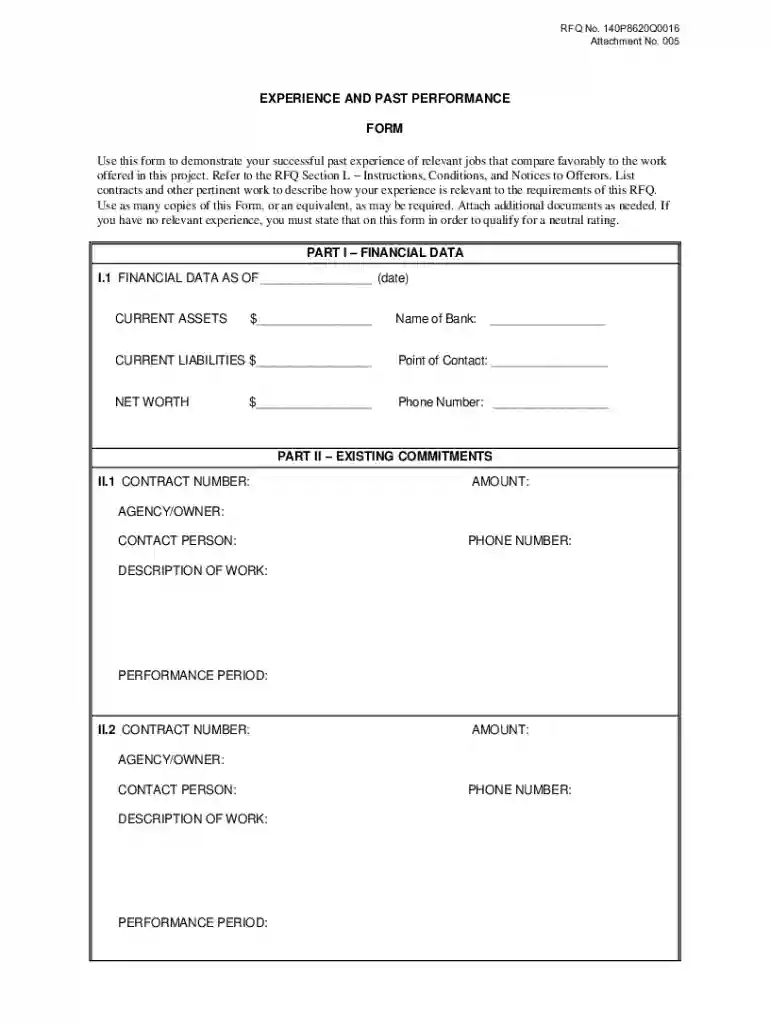
The Experience and Past Performance Form is a critical document used by organizations and individuals to outline their professional history and achievements. Essentially, it acts as a comprehensive record that showcases specific projects, roles, and performance metrics that highlight one's qualifications and capabilities in relation to a particular task or bid. This form is often employed in competitive bidding processes, where demonstrating past success is crucial to securing new opportunities. Typically, the form contains areas to detail previous contracts, involved parties, financial scope, and the impact of completed work. Understanding the nuances of this form is key to utilizing it effectively, as it bridges the gap between past work and future opportunities.
The Experience and Past Performance Form serves as a structured approach to articulating one's work history and accomplishments. To effectively use the form, begin by gathering all pertinent details of past projects, such as client names, project outcomes, and financial figures. The form will often have sections for specific data points like contract numbers and dates, which require accuracy for credibility. Once all necessary information is at hand, follow the form's structure to fill out each section succinctly. Ensure that each entry accurately reflects the scope and success of the projects to paint a clear picture of your capabilities. Through strategic use of this form, you can significantly bolster your profile in any professional setting.
Acquiring the Experience and Past Performance Form typically involves accessing it through the issuing body that requires or uses it. Often, this body could be a governmental organization, corporation, or institution with a formal submission process. Forms can generally be requested directly from the agency's website or obtained by contacting their office. In some instances, these forms are also available through industry networks or associations that cater to specific sectors. Always ensure you have the latest version of the form by checking official channels, as requirements may change over time.
Accurate completion of the form is paramount to conveying professionalism and reliability. Start by thoroughly reading the provided instructions to understand each section's requirements. Populate the form with detailed past project information and ensure consistency in data presentation. Before submitting the form, it is wise to review the entries for any errors or omissions. Consider seeking feedback from mentors or peers to verify the form’s completeness and clarity. Submission often requires adhering to specific guidelines, whether electronic or physical, so confirm those details beforehand to ensure proper delivery.
Using the Experience and Past Performance Form effectively communicates to potential clients or employers your track record of success. This form is essential in sectors where bidding for projects is competitive, as it provides a tangible measure of capability. Apart from aiding in securing new contracts, the form also serves as a personal record of accomplishments, facilitating self-reflection and strategic career planning. Having a detailed account of past performances helps in identifying strengths and areas for improvement, thus influencing professional growth.
Several critical components make up the Experience and Past Performance Form, each designed to capture different facets of past work. Key elements often include:
These components are structured to provide a holistic view of one's past engagements, ensuring a comprehensive presentation of capabilities.
The Experience and Past Performance Form is predominantly used by professionals in sectors where competitive bidding is standard. This includes construction, information technology, consultancy, and government contracting. Bidders, project managers, contractors, and consultants find this form indispensable for presenting their qualifications against others in the field. By leveraging this form, they demonstrate their ability to deliver on promised outcomes based on historical data. Additionally, corporations looking to verify a vendor's or subcontractor's legitimacy may also request this form as part of their due diligence process.


Legally, the Experience and Past Performance Form is a binding document, and accurate representation of all details is crucial. Misrepresentation or falsification within this form can result in disqualification from bidding processes or legal repercussions. Therefore, users must ensure adherence to truthfulness and transparency in every entry. The form also often aligns with confidentiality agreements, ensuring sensitive information is appropriately protected during submission and review. Adhering to legal and ethical standards while filling out this form not only builds trust but also upholds professional integrity.
Understanding the jargon associated with the Experience and Past Performance Form can facilitate better completion and comprehension. Terms often encountered include:
Familiarity with these terms enhances the user's ability to effectively communicate their past experiences, thereby maximizing the form's utility in professional settings.
At DocHub, your data security is our priority. We follow HIPAA, SOC2, GDPR, and other standards, so you can work on your documents with confidence.


It may rely solely on the past performance and experience of the mentor or non-similarly situated joint venture partner, or it may require some level of pastRead more
Emphasizing past performance in source selection, helps ensure that the Government will contract with firms likely to meet performance expectations. OFPPRead more


