
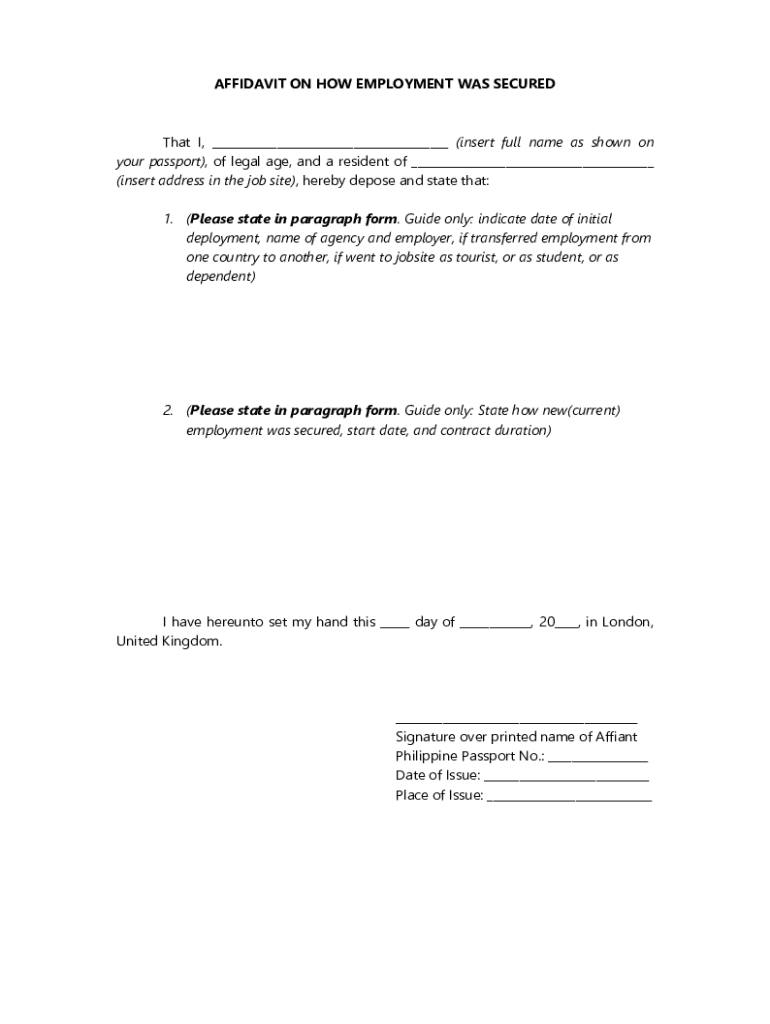







Definition and Meaning of the Affidavit on How Employment was Secured
An affidavit on how employment was secured serves as a legal document wherein the affiant, typically an employee or job applicant, provides a sworn statement regarding their employment history. This affidavit clarifies the specific details surrounding their hiring process, covering the initial deployment, the agency or employer's information, and the methods used to secure their current employment. It serves to validate the employment status of an individual by detailing pertinent information, and is often required in various legal or administrative situations, such as visa applications or loan approvals.
This document is a sworn declaration, meaning that the affiant must sign the affidavit before a notary public or other authorized official. It typically requires personal identification details including the affiant's full name, date of birth, and Social Security number, along with the signature of the notary to authenticate the affidavit. The purpose is to provide a verifiable account of the individual’s employment process, which can be crucial for background checks or legal proceedings.
Steps to Complete the Affidavit on How Employment was Secured
Completing the affidavit on how employment was secured involves several detailed steps to ensure accuracy and compliance with legal requirements.
-
Gather Required Information:
- Collect personal information: full name, Social Security number, and contact information.
- Compile employment history: names of former employers, dates of employment, job titles, and reasons for separation.
-
Draft the Affidavit:
- Use clear and concise language. Begin by stating the purpose of the affidavit.
- Include detailed statements about how the employment was obtained, mentioning sources such as job postings, recruitment agencies, or referrals.
-
Include Necessary Signatures:
- Ensure that the affidavit is signed in the presence of a notary public or another authorized official. This adds a layer of authenticity to the document.
-
Review and Revise:
- Thoroughly review the affidavit to ensure all information is accurate and complete. Address any legal jargon or unnecessary complexities to maintain clarity.
-
Submit the Affidavit:
- Depending on its purpose, file the document with the required agency or keep it for personal records. Ensure that copies are retained for future reference.
By following these steps, individuals can effectively create an accurate affidavit that serves its intended legal and professional purposes.
Important Terms Related to the Affidavit on How Employment was Secured
Understanding specific terms associated with the affidavit on how employment was secured can facilitate its proper use and completion:
- Affiant: The individual making the sworn statement in the affidavit.
- Notary Public: An authorized individual responsible for witnessing the affiant’s signature and verifying the affidavit’s authenticity.
- Sworn Statement: A declaration made under oath, indicating that the information provided is true to the best of the affiant’s knowledge.
- Employment History: A chronological record of all past jobs held by the affiant, detailing positions, employers, and duration of employment.
- Verification: The process of confirming the accuracy of the information provided in the affidavit, often required by employers or legal entities.
These terminologies are essential for understanding and accurately executing an affidavit on how employment was secured.
Legal Use of the Affidavit on How Employment was Secured
The legal use of the affidavit on how employment was secured extends to various contexts, often relating to validating the employment status or history of an individual. Here are some common scenarios in which this document may be employed:
- Visa Applications: Many immigration processes require proof of employment, making this affidavit crucial for individuals seeking to establish residency or work in a new country.
- Loan Applications: Financial institutions may require this affidavit to confirm an applicant's employment status, ensuring they have a reliable income source before approving loans or mortgages.
- Background Checks: Employers often request affidavits during the hiring process to verify the authenticity of an applicant's claimed employment history and job performance.
In these situations, the affidavit acts as a formal and legally binding document, providing necessary evidence of an individual's work experience and employment security.
Examples of Using the Affidavit on How Employment was Secured
Providing specific use cases can illustrate the practical application of the affidavit on how employment was secured.
-
Immigrant Worker Verification: An individual applying for a work visa must submit this affidavit as part of their application. The document outlines their job offer, demonstrating that they have secured employment in the U.S.
-
Home Loan Approval: An applicant seeking a mortgage may be asked by their lender to provide this affidavit, confirming their ongoing employment and the legitimacy of their income to ensure they can meet loan repayments.
-
Job Application Process: An applicant may be required to submit the affidavit as part of a background check during the hiring process. It provides necessary details to the employer regarding how the applicant secured their job and verifies their employment history.
By providing these examples, it becomes clear how critical the affidavit is in various legal and administrative contexts, facilitating smoother processes for individuals navigating employment-related transactions.




