Your Personal Document Organizer - As Our Parents Grow Older 2026

Get Form
Your Personal Document Organizer - As Our Parents Grow Older Preview on Page 1

Here's how it works

01. Edit your form online
Type text, add images, blackout confidential details, add comments, highlights and more.

02. Sign it in a few clicks
Draw your signature, type it, upload its image, or use your mobile device as a signature pad.

03. Share your form with others
Send it via email, link, or fax. You can also download it, export it or print it out.

Definition and Meaning

"Your Personal Document Organizer - As Our Parents Grow Older" is a specialized tool designed to assist individuals and families in managing and organizing important personal documents. As parents age, it becomes increasingly necessary to have a systematic approach to handling their paperwork, which includes financial records, legal documents, insurance policies, and medical records. This organizer ensures that all essential documents are easily accessible, properly stored, and appropriately managed, supporting peace of mind for both the elderly and their families.

How to Use the Organizer

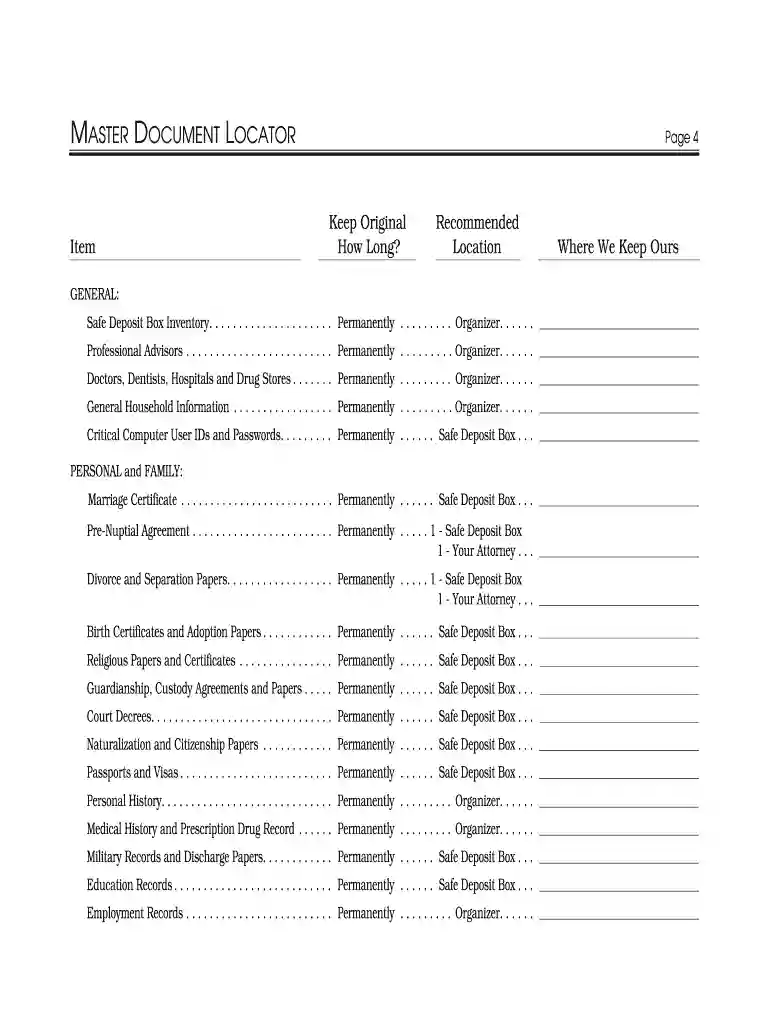
To effectively use the organizer, begin by collecting all of your parents' critical documents. These may include identification papers, bank statements, insurance policies, wills, and healthcare directives. Once gathered, categorize these documents based on their purpose and importance. Utilize the Master Document Locator to document where each item is stored and maintain updates regularly. For enhanced security and organization, consider dividing the storage locations between a home filing system and a safe deposit box, ensuring easy access when needed.

Steps to Complete the Organizer

  1. Gather Information:

    • Compile personal data such as social security numbers, birth and marriage certificates, and contact information for financial and health service providers.
  2. Categorize by Type:

    • Organize documents into categories like financial, legal, medical, and personal, making retrieval easier.
  3. Document Locations:

    • Use the Master Document Locator to list itemized documents, noting where each is stored.
  4. Periodic Reviews:

    • Set regular intervals to review and update the organizer, adding new documents or emending outdated information.
  5. Secure Important Documents:

    • Store vital documents like wills or power of attorney in a secure location, such as a safe deposit box, and keep copies at home.

Key Elements of the Organizer

  • Master Document Locator: A critical component that tracks all essential documents and their locations, ensuring nothing gets misplaced.
  • Storage Suggestions: Recommendations for safe deposit boxes and home filing systems, providing a balance between accessibility and security.
  • Document Categories: Clear classifications such as bank accounts, insurance policies, legal documents, etc., which enhance organization.
  • Security Features: Guidance on protecting sensitive information with password-protected files or encryption for digital records.

Important Terms Related to the Organizer

  • Safe Deposit Box: A secure storage space offered by banks where valuables and vital documents can be stored safely.
  • Power of Attorney: A legal document authorizing one individual to act on another's behalf in legal or financial matters.
  • Healthcare Directives: Documents that outline a person's healthcare preferences in the event they become unable to advocate for themselves.

Why Use the Organizer

Using "Your Personal Document Organizer - As Our Parents Grow Older" can significantly reduce stress and confusion during emergencies. It ensures that all necessary information is readily available, protecting against potential legal and financial complications. This comprehensive approach minimizes the risk of critical documents being lost or overlooked, ensuring more effective management of parents' affairs as their needs grow more complex.

Who Typically Uses the Organizer

The organizer is typically used by adult children of aging parents, legal guardians, and caregivers who are responsible for managing elderly individuals' affairs. It is also valuable for family members planning for potential incapacity or those involved in estate planning and healthcare advocacy.


decoration image ratings of Dochub

Examples of Using the Organizer

A family struggling to locate their aging mother's medical records found that by systematically organizing her documents with this tool, they were able to improve medical care coordination and make well-informed healthcare decisions. Another case involved siblings using the organizer to efficiently manage their father’s estate after his passing, simplifying the legal process and ensuring proper distribution of assets according to the will.

Required Documents

  • Identification: Social Security cards, passports, birth and marriage certificates.
  • Financial Records: Bank statements, investment and retirement account documents.
  • Legal Papers: Wills, power of attorney, and guardianship arrangements.
  • Insurance Policies: Health, life, home, and auto insurance documents.
  • Medical Information: Records of prescriptions, health conditions, and provider contacts.

Comprehensively maintaining these documents within the organizer facilitates easier management and access, providing assurance in personal and emergency situations.

be ready to get more

Complete this form in 5 minutes or less

Get form

Got questions?

We have answers to the most popular questions from our customers. If you can't find an answer to your question, please contact us.
Contact us
Using Labels, Folders, and Digital Solutions If you or your loved one is comfortable with technology, digital filing can be a game-changer. Scan important documents and save them in organized folders on your computer. Make sure these folders match your physical categories for consistency.
Managing your parents finances: 8 steps to guide the transition Start the conversation early. Make gradual changes if possible. Take inventory of financial and legal documents. Taking care of your loved ones finances. Consider a power of attorney. Communicate and document your moves. Keep your finances separate.
Implementing a User-Friendly Filing System for Seniors Using binders or accordion files is a great way to keep papers organized and accessible. Keep them in a dedicated drawer or a small filing cabinet.
Deeds to all properties. Vehicle titles. Documentation of loans and debts, including credit accounts. A power of attorney (POA) in which your parent has named a person or persons to act on their behalf should your parent become incapacitated.
10 Tips on How to Cope with Aging Parents Decide What Matters are Most Important. Be Respectful. Try to Understand Whats Behind Abnormal Behavior. Be understanding. Find an Outlet for Your Stress. Set Boundaries. Know Your Own Limitations. Limit Your Involvement in Caregiving.

Security and compliance

At DocHub, your data security is our priority. We follow HIPAA, SOC2, GDPR, and other standards, so you can work on your documents with confidence.

Learn more
ccpa2
pci-dss
gdpr-compliance
hipaa
soc-compliance

People also ask

Plan Like a Pro: 10 Tips to Organize Care for Aging Loved Ones Address Care Early. Pressing Issues. Keep Track. Let Your Parents Loved Ones Lead. Know Your Boundaries. Keep Everyone Informed. Financial Plan. Find Care Providers.
Health information Current prescriptions (be sure to update this regularly) Living will. Durable power of attorney for health care. Copies of any medical orders or forms you have (for example, a do-not-resuscitate order) Health insurance information with policy and phone numbers.

Related links