






Definition & Meaning
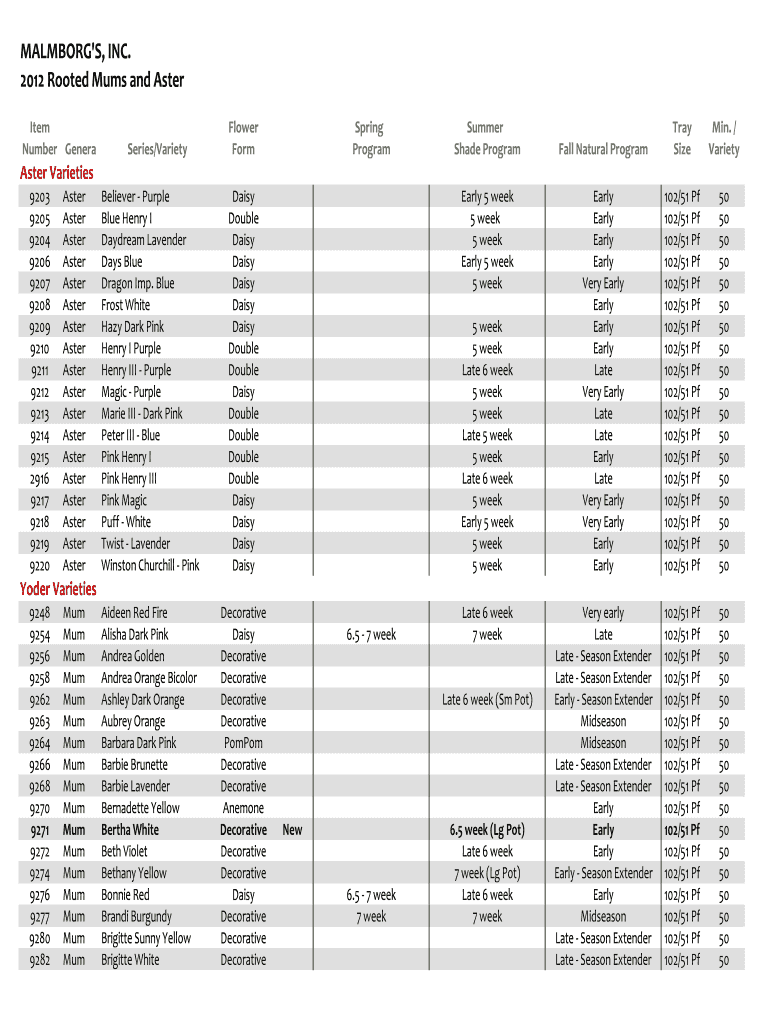
The term "Number Genera" can refer to specific classifications within various contexts, such as botany or document management. In a document management system like DocHub, "Number Genera" might not be explicitly used but could symbolize an integral part of organizing and classifying documents. It could also represent unique identifiers assigned to documents to facilitate easier indexing and retrieval. In botanical terms, "Number Genera" relates to the categorization of plant groups that share common characteristics, often used in detailed catalogs like the one issued by Malmborg's, Inc.
Key Elements of the Number Genera
Understanding the components that define a "Number Genera" helps in grasping its applications in various settings. In documentation systems, key elements might include unique identifiers that assist in document classification. Each element within a "Number Genera" might denote a specific feature, such as document type, date, or author. In a botanical context, these elements could highlight specific plant traits that unify a genera, allowing for simplified identification and study of related plant species.
Steps to Complete the Number Genera Process
Ensuring that a document or classification system benefits from a "Number Genera" requires following certain steps—though these may vary depending on the context:
- Define the Criteria: Establish what makes up the "genera" in your system; for documents, these could be metadata fields.
- Assign Identifiers: Apply unique numbers or codes to documents or elements within a genera for tracking.
- Categorization: Ensure all items are sorted into their corre@sponding "genera" groups.
- Review and Maintain: Regular checks are necessary to confirm that all documents or items adhere to their respective "Number Genera" for accuracy and comprehensiveness.
Why Should You Use the Number Genera?
Implementing a "Number Genera" helps in creating structured and organized systems. For document management, it simplifies retrieval, helps preserve data integrity, and assists with compliance. In botany or other scientific disciplines, it enhances clarity and communication, allowing for more efficient research and comparison between categories or species. This structured approach helps avoid errors and improves the overall efficiency of information handling and classification.
How to Use the Number Genera
Utilizing a "Number Genera" involves integrating it into the existing systems for classification and organization. For documents, it requires applying "genera numbers" as part of the metadata during document creation or import. Users must be trained to recognize and apply these identifiers during their workflows. In botanical or scientific contexts, utilizing a "Number Genera" might involve applying labels or conducting research based on plant traits defined within the genera.
Examples of Using the Number Genera
Various real-world scenarios demonstrate the application of "Number Genera":
- Document Management: A corporation could apply "Number Genera" to quickly categorize and retrieve financial documents required for auditing.
- Scientific Research: Botanists may use "Number Genera" for accurately classifying plant species, enabling them to identify potential research subjects accurately.
These examples illustrate the versatility of "Number Genera" in both practical and scientific fields, showing its potential to enhance workflow efficiency.
Software Compatibility (TurboTax, QuickBooks, etc.)
Most modern document management systems, including those that might utilize "Number Genera," are compatible with popular software like TurboTax and QuickBooks. This compatibility often extends to data import functionalities, allowing for smooth integration and enhanced document processing. Understanding these compatibilities ensures that "Number Genera" systems can work alongside your existing software solutions to streamline processes effectively.
State-Specific Rules for the Number Genera
In legal or bureaucratic contexts, especially within the United States, certain terminologies or systems like "Number Genera" might have specific implementations. Some states may have unique requirements for document classification or tax forms, necessitating adaptations to a standardized process. Checking these state-specific rules ensures that your application of "Number Genera" remains compliant with local laws and regulations, avoiding possible penalties or errors.