
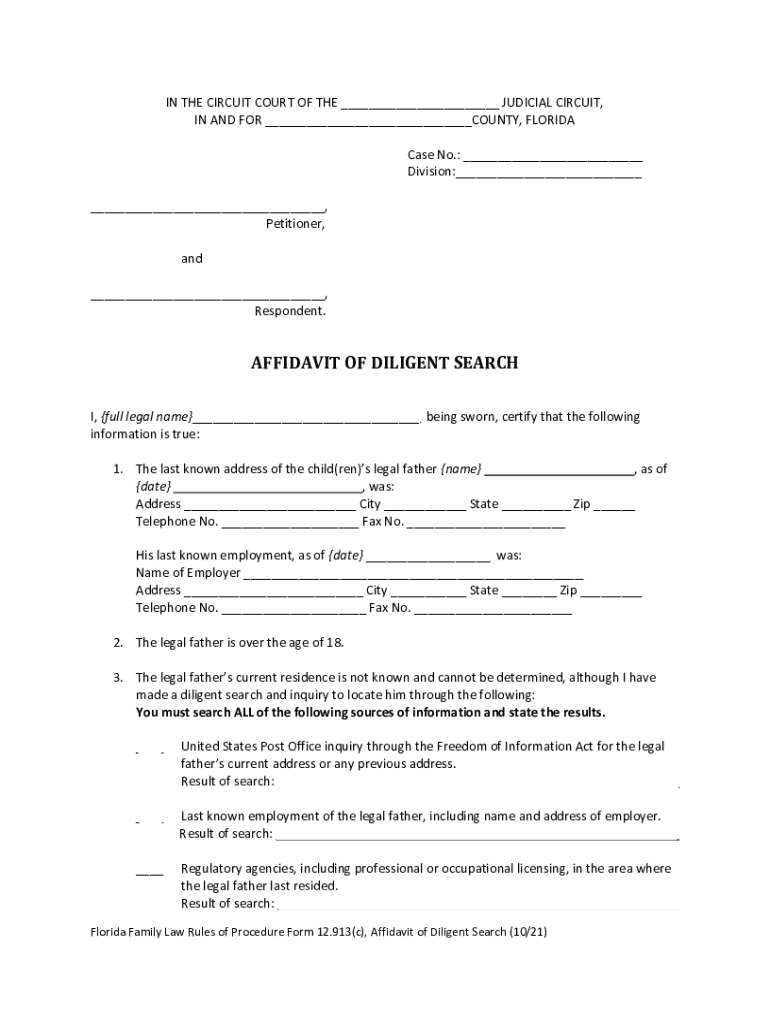







Definition & Meaning
The "Florida Supreme Court Approved Family Law Form 12.913(c), Affidavit of Diligent Search," serves as a vital component in family law procedures, specifically in cases where the legal father's whereabouts need to be established. This form is primarily utilized to certify that a thorough search has been conducted to locate an individual who needs to be notified of legal actions, typically in paternity or parental rights termination cases. The essence of this form is to ensure that all plausible efforts have been made to contact the individual in question, thereby providing an opportunity for constructive service if personal service is deemed unattainable.
How to Use the Form
When utilizing this affidavit form, it is crucial to adhere to specific protocols to ensure its legitimacy. The form itself guides individuals through the process of declaring their efforts in locating the legal father. This involves documenting all attempts to find updated contact information, such as searching through public records and databases or reaching out to known associates. Using the form effectively requires not only filling out the required sections accurately but also ensuring that all identified stages of the search process have been comprehensively executed prior to submitting the affidavit to the court.
Steps to Complete the Form
-
Gather Basic Information: Before starting the form, collect all known information regarding the individual whose whereabouts you are trying to establish, including previous addresses, contact numbers, and associates.
-
Conduct the Diligent Search:
- Search public records databases, including property records and electoral rolls.
- Contact known associates, relatives, and friends to check if they have any recent information.
- Utilize online resources and social media where applicable to widen your search scope.
-
Document Your Efforts: Ensure you have accurate and detailed records of all steps taken during the search process, as this will be a key component of the form submission.
-
Complete the Affidavit: Fill out each section with pertinent details, noting your diligent efforts. Ensure the accuracy and truthfulness of the information being declared.
-
Sign and Notarize: Once completed, the form needs to be signed and notarized to validate the affidavit's claims.
-
File with the Court: Submit the completed form to the appropriate court for it to be evaluated in conjunction with your case.
Who Typically Uses the Form
The primary users of the Form 12.913(c) include individuals involved in family law cases—such as divorce or child custody matters—where one party's location is unknown. Legal practitioners assisting clients in these cases will also frequently deploy this form as part of their procedural duties. Moreover, parties initiating cases that might affect parental rights or require establishing paternity often necessitate filing this form.


Legal Use of the Form
Utilizing the Form 12.913(c) correctly is crucial for complying with legal statutes regarding due process. It is designed for situations where direct service of legal notices is problematic due to an absent or unlocatable father. Ensuring the proper use of this affidavit safeguards the integrity of the legal process by demonstrating that reasonable efforts were made to inform all parties involved, thus protecting the rights of the absent individual while allowing the case to proceed.
Key Elements of the Form
- Diligence Declaration: Outlines the comprehensive search undertaken.
- Affirmation of Efforts: Certifies that all appended declarations are truthful and exhaustive.
- Contact Attempts Documented: Lists detailed steps and the results of each search effort.
- Mandatory Notarization: The form requires notarization to be considered valid within legal proceedings.
State-Specific Rules
Within Florida, this affidavit holds particular procedural significance. Florida law mandates rigorous adherence to due process in notifying individuals of legal actions, especially in family law matters. The specific requirements of Form 12.913(c) align with Florida's statutes, thereby necessitating that all attempts to find the unresponsive party are genuinely diligent and properly documented before a constructive or substituted service is allowed.
Required Documents
When filing the Affidavit of Diligent Search, it is essential to accompany it with any supporting documentation evidencing the search efforts. This might include:
- Public Record Searches: Copies of results from property records, voter registration, or similar databases.
- Written Communications: Any letters or emails sent inquiring about the individual's whereabouts.
- Online Search Evidence: Screenshots or printouts from digital platforms used during the search process.
Form Submission Methods
Submitting the Form 12.913(c) can typically be done through several methods:
- Online Submission: If the court system permits electronic filing, this may save time and ensure faster processing.
- Mail: Send the completed and notarized document to the court's postal address. Ensure all required materials are included.
- In-Person: Direct submission at the courthouse allows for immediate clarification of any doubts with court staff.
By understanding and following these comprehensive instructions, parties involved in crucial family law cases can efficiently use the Affidavit of Diligent Search to progress their legal proceedings appropriately.




